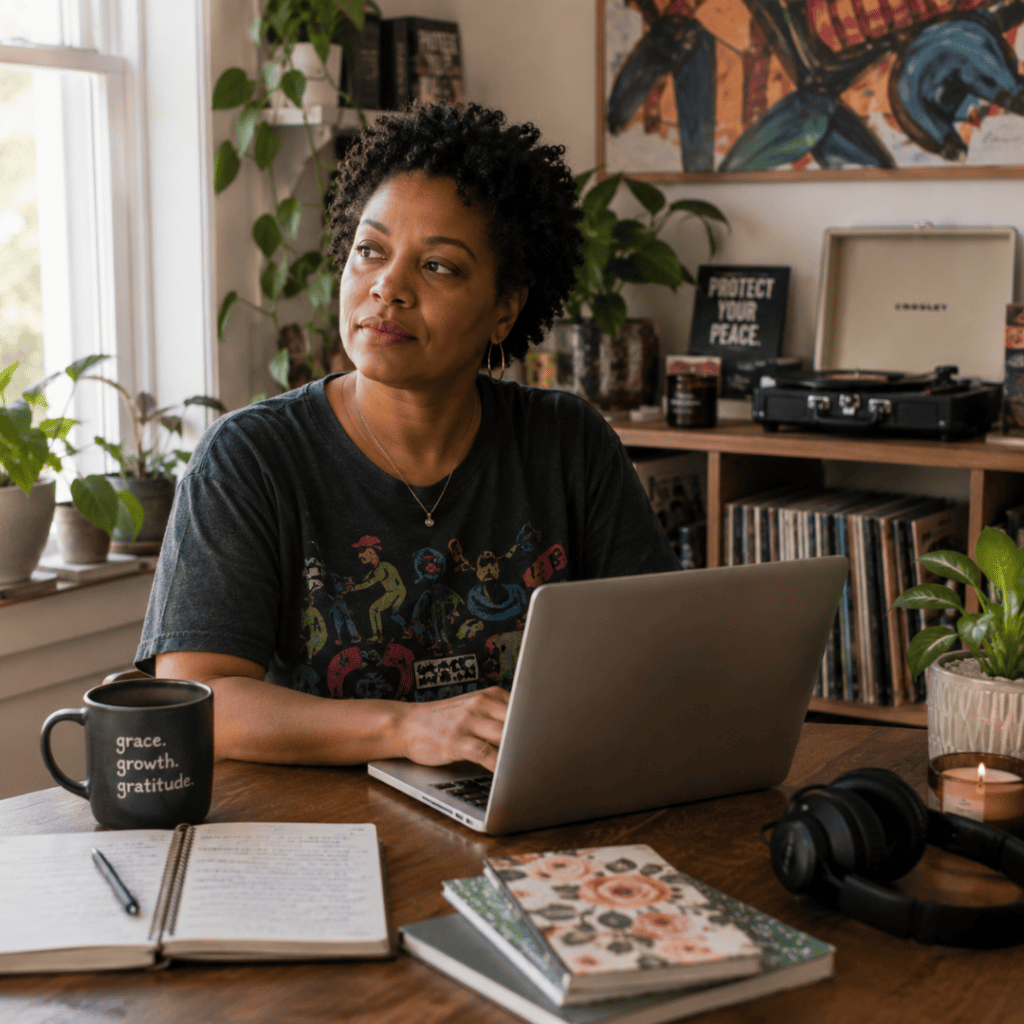
You’ve known you were different. And slowly, the pieces are starting to come together.
For the first time, you have language for what you’ve experienced your whole life—neurodivergence.
Learning that you may be neurodivergent as an adult can be validating, overwhelming, exciting, and heartbreaking—all at once.
And whatever you’re feeling? It’s valid.
But then, what’s next?
What are you supposed to do with all of this information? How do you process the rollercoaster of emotions? How do you make sure your needs are met?
This guide can’t answer all your questions, but it can help with an important starting point—finding the support that meets you where you are. Whether that means pursuing a formal diagnosis, exploring accommodations, talking with a neuro-affirming therapist, or simply learning to acknowledge your needs instead of judging them.
Late- or undiagnosed neurodivergent? You’re not alone
Unfortunately, many neurodivergent Black women don’t receive an autism, ADHD, or other neurodevelopmental diagnosis until later in life1—if we’re diagnosed at all.2
Some of us spend years carrying labels, like “too sensitive,” “disorganized,” or “difficult” from caregivers, teachers, healthcare providers, and others who should be able to see that something else might be going on.
But the delay isn’t a you problem. It’s a systemic problem.
Historically, autism and ADHD research focused on a white population. So many of the signs doctors were taught to recognize don’t always reflect our experiences. Even today, many healthcare providers are still learning how neurodivergence can show up in Black women.
And to be honest, it hasn’t always been safe for us to let our differences show. From masking to code-switching, we’ve learned to suppress behaviors and emotions that don’t fit cultural or societal expectations.
While others may not have looked beneath the surface, you’re learning to. And you will always be your most important advocate.
How to find the neuro-affirming support you deserve
Much of society is built around neurotypical ways of thinking, communicating, and working. That’s why it’s important to have spaces where you’re not constantly being asked to adjust or tough it out. Here’s how to find or create those neuro-affirming spaces.
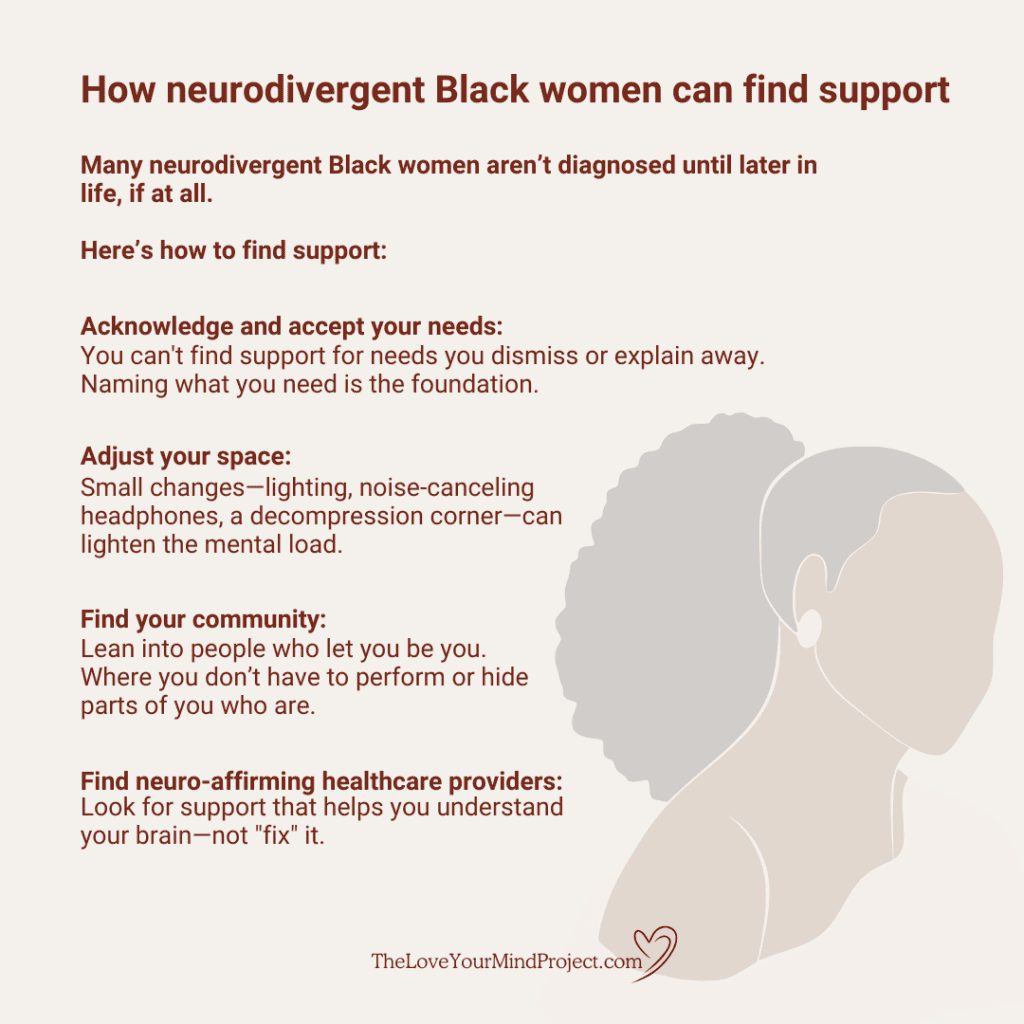
Know and advocate for your own needs
It’ll be difficult to find support for needs that you dismiss, judge, or criticize internally.
If part of you is still tempted to explain away your differences and push through the challenges—I’m just being sensitive, I just need to try harder—it’s worth exploring what’s behind those beliefs.
Some of us grew up in environments where having needs or being different was a sign of weakness, a lack of faith, or an inability to handle life. It can take time to come out of agreement with these narratives so you can begin to rewrite them.
Your traits aren’t defects for you to silence. They’re natural expressions of how your brain works. And your differences are worthy of accommodations in a world that doesn’t always offer them.
Recognizing what allows you to thrive and naming what you need will be foundational to finding support that actually helps you.
Adjust your environment or routine to work for you
We tend to have more control over our personal spaces—our home, desk, or car. These places can be a great starting point in thinking through what accommodations can help reduce some of the mental load.
Maybe that’s relying on ambient lighting at home, such as floor lamps or warm smart bulbs that are more low-arousal. Or even a decompression corner with a weighted blanket, plush pillows, or other items that can help calm your nervous system.
At work, small items like a visual timer, a balance stool under your desk, or a heavy lap pad can help ground you when you start to lose focus. You can also keep noise-canceling headphones handy or listen to low, calming white or brown noise.
Instead of asking your brain to work in overdrive all the time, these spaces and tools can reduce mental effort and give your nervous system the breaks it needs.
Find your community
Other people may not always understand your differences or experiences, and that can be emotionally and mentally exhausting. It can leave you feeling isolated and pressure you to mask or criticize parts of who you are.
Instead, lean into the friends or family members who let you be you, without you having to hide, explain, or defend your natural traits.
Surrounding yourself with people who don’t expect you to change or shrink can reduce cognitive effort. And it’s okay to build in downtime after hanging out so you can decompress and recover.
You can also explore support groups or communities where neurodivergent Black women can connect, share, and be reminded that you’re not alone—and you’re definitely not defective.
Look for neuro-affirming healthcare providers
Having autism, ADHD, or other neurological differences isn’t a defect in itself. But it can present challenges.
Neuro-affirming healthcare providers recognize neurodivergence for what it is—a difference, not a disorder. They may have “affirming” or “neuro-affirming” in their title or description. But most importantly, their approach will focus on helping you better understand how your brain works instead of trying to “fix” you.
And it’s okay to seek support.
The mental and emotional toll of always having to adjust to spaces that don’t always support you is real. And for many of us, the effect on our well-being is layered. We’re also navigating cultural expectations and societal biases that come with simply being a Black woman.
But this mental and emotional strain is not something you have to continue to push through. Care, support, relief, peace—these aren’t luxuries. They’re a basic human need.
A diagnosis can help, but it’s not required
A formal assessment and diagnosis can bring clarity to the experiences, questions, and struggles you’ve had for years.
It can also make it easier to access certain accommodations and workplace protections, such as remote-work flexibility, limited or no back-to-back meetings, or an assigned desk (vs. hoteling or hot-desking).
But a diagnosis isn’t required to begin caring for yourself differently and advocating for what you need.
If you’re not ready to see a healthcare provider or you simply don’t want a diagnosis, your experiences are still valid, and you’re still worthy of support.
You may still have a lot of questions, and that’s okay. Think of this journey as an opportunity to better understand yourself—not through shame or brokenness, but through curiosity, compassion, and acceptance.
Late diagnosis neurodivergent Black women: FAQs
Why are Black women diagnosed with autism and ADHD so late?
Historically, autism, ADHD, and other forms of neurodivergence were primarily studied in white populations, meaning the “textbook” symptoms don’t always match how neurodiversity shows up in Black women. This led to many of us being misdiagnosed or overlooked altogether. Masking, cultural pressures, and mistrust of the healthcare system can also make a diagnosis more difficult.
What should I do if I was recently diagnosed?
A recent diagnosis can bring a wide range of emotions. Give yourself time to process whatever you’re feeling—relief, grief, validation, or uncertainty. The word “diagnosis” can make it feel as though something is wrong and needs to be fixed. But a neurodivergent condition just means your brain works differently—not that it’s broken. Your goal is to better understand how your mind works, where you thrive, and where you could use more support.
How do I find a neuro-affirming therapist?
Look for therapists who have experience working with individuals with autism, ADHD, or other types of neurodivergence. But more importantly, ask about their approach. A neuro-affirming therapist will help you understand and accommodate your differences rather than trying to eliminate them.
References
Last accessed July 2026
- Constantino, J. N., Abbacchi, A. M., Saulnier, C., Klaiman, C., Mandell, D. S., Zhang, Y., Hawks, Z., Bates, J., Klin, A., Shattuck, P., Molholm, S., Fitzgerald, R., Roux, A., Lowe, J. K., & Geschwind, D. H. (2020). Timing of the Diagnosis of Autism in African American Children. Pediatrics, 146(3), e20193629. https://doi.org/10.1542/peds.2019-3629 ↩︎
- Shalaby, N., Sengupta, S., & Williams, J. B. (2024). Large-scale analysis reveals racial disparities in the prevalence of ADHD and conduct disorders. Scientific Reports, 14, 25123. https://doi.org/10.1038/s41598-024-75954-5 ↩︎
- Is the Calm app worth it? How it can help you prioritize rest - October 15, 2026
- Is Headspace worth it considering our unique needs? - October 8, 2026
- The Exhale app: Wellness support that actually centers Black women - October 2, 2026