
Do you find it difficult to trust others? Struggle to feel safe? Never seem good enough?
It’s possible that what you assumed were personality traits or flaws might actually be coping mechanisms—how you’ve learned to survive deep pain.
Unresolved childhood trauma has a way of showing up in adulthood, reminding us that everything is not okay.
But you can lay down this burden, acknowledging that little Black girl who’s been carrying the weight of experiences she never asked for.
Keep reading to understand how to heal from childhood trauma—what it is, how it shows up, and practical strategies to better support what we as Black women need.
What is childhood trauma?
Childhood trauma refers to deeply distressing experiences that happen during childhood.
Trauma is, at its core, an injury. It can be physical, emotional, or psychological.1 When these injuries occur during our more vulnerable and impressionable years, we risk internalizing the pain, allowing it to negatively impact how we see ourselves and the world.
And no, childhood trauma isn’t about being overly sensitive or dwelling on the past. Decades of studies confirm the detrimental effects of childhood trauma on adults when left unacknowledged. And research continues to explore the impact on the brain.2
“Childhood trauma isn’t new. What’s new is our language for it, our ability to name it, and the opportunity to interrupt the cycle instead of repeating it,” said Whitney Coleman, licensed clinical social worker at Washington, D.C.-based Jade Clinical Services. “This generation isn’t ‘softer.’ They’re more aware, open, and willing to say ‘this hurt me,’ instead of pushing it down and passing it on.”
Examples of childhood trauma
While trauma can stem from one catastrophic event, like a natural disaster or the death of a loved one, it’s not always so blatant.
“Some traumas don’t look extreme on the outside but can feel overwhelming inside,” said Coleman. “Things like constant criticism, feeling emotionally invisible, being parentified, or growing up with an extremely anxious caregiver can shape how safe you feel in the world, your ability to trust, and how you treat yourself and others.”
Common sources of childhood trauma, or adverse childhood experiences (ACEs), can include:
- Abuse: This can be physical, emotional, verbal, or sexual. Emotional abuse, such as neglect or constant criticism, can be just as damaging, even though it often goes unnoticed.
- Loss or separation: Losing a parent or loved one, through death, incarceration, or abandonment, can deeply disrupt emotional security.
- Household challenges: Witnessing domestic violence, substance abuse, or untreated mental illness.
- Community violence: Exposure to gang violence or police brutality can lead to chronic stress, PTSD, and depression as an adult.3
- Intergenerational trauma: The pain from our parents’, grandparents’, and ancestors’ can be passed down, affecting the gene function and brain development of future generations.4
How unresolved childhood trauma can affect your adult life
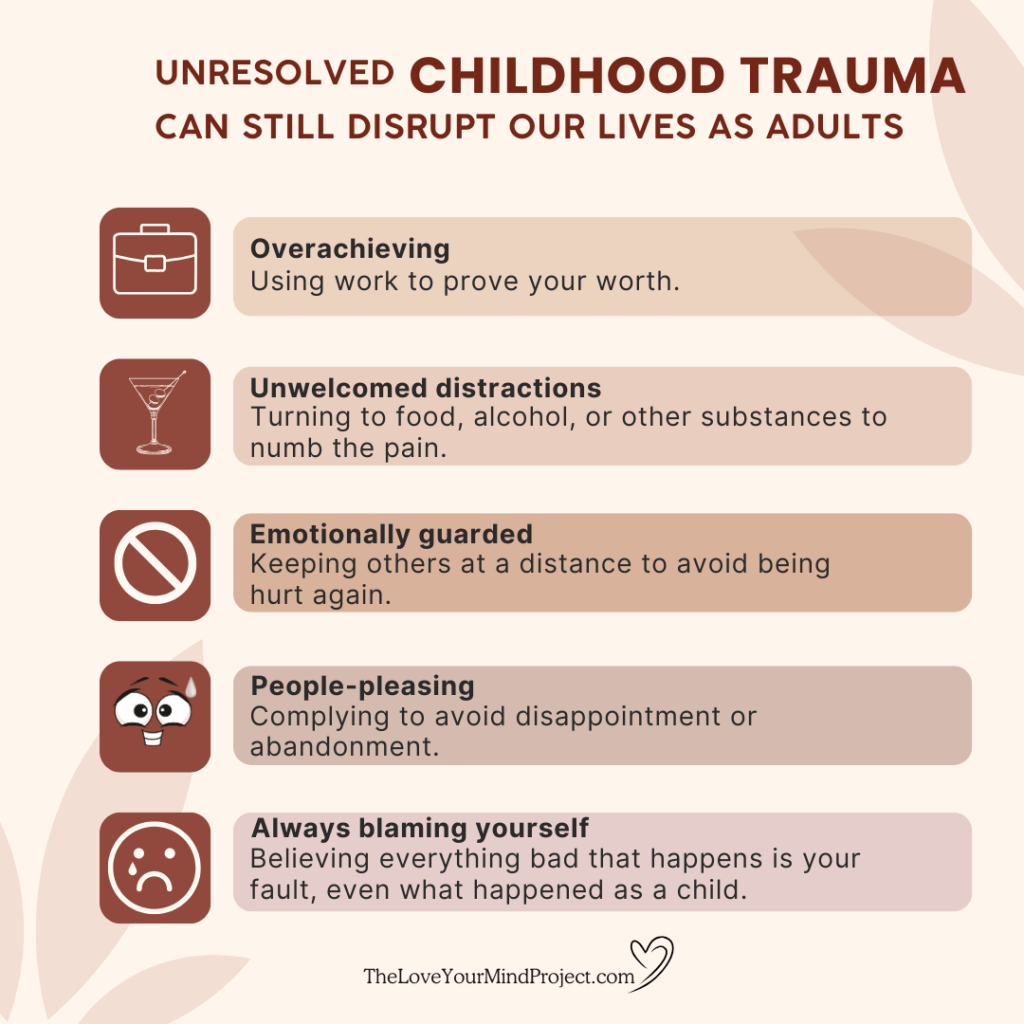
Unresolved trauma doesn’t simply disappear as we get older. We’ve learned to survive it in different ways, many of which can hold us back.
Someone with unresolved childhood trauma might:
Suppress the pain. Maybe you overwork yourself, or turn to social media, food, alcohol, or other substances as a distraction from the hurt. But distractions are temporary. When they wear off, the discomfort comes back.
Build walls. To avoid feeling rejection, you may choose not to get too emotionally invested in any relationship. Maybe you break up with them before they can break up with you. But renowned researcher Brené Brown said it best—when we build walls to keep out the pain, we also block out joy and love.5
Blame themselves. You might think the divorce, the abuse, the loved one walking out, was your fault. If you were better behaved or easier to deal with as a child, maybe it wouldn’t have happened. Even as an adult, you still think everything is your fault—like nothing you do is ever enough. But you are enough. And you are not responsible for what happened to you as a child.
Signs of unresolved childhood trauma
Trauma affects us all differently, but here are some common signs that your inner child may be hurting.6,7
- Low self-esteem
- Harsh self-criticism or self-blame
- Perfectionism
- People-pleasing
- Trust issues
- Anxiety or depression
- Always on edge or easily startled
- Trouble sleeping
- Difficulty expressing emotions
- Social withdrawal or isolation
- Risky or self-destructive behaviors
- Compulsions, like excessive cleaning or organizing
How to heal from childhood trauma as an adult
You may have been told to “get over it” or “leave the past in the past.” But to truly heal, grow, and emerge stronger, you must face the pain and tend to it with care. Try these compassionate and effective strategies.
Acknowledge what happened
Many times, our parents or guardians don’t have the tools to process pain, so they may act like it didn’t happen, or brush it off, saying it wasn’t that bad.
But your experience matters. Your wounds are real, even if they did the best that they could. And it’s easier to address your pain when you no longer cover up or minimize what happened.
Recognize how it affects you
What happened to you was not okay. It’s important to recognize this, especially if over the years, you’ve accepted your trauma as something you deserved or that was somehow your fault.
And it doesn’t matter if it happened to others in your family, if it was common at the time, or if it was an accident. You can still acknowledge that it was painful, something that you must heal from—not an event you have to live with.
Forgive—not to excuse them, but to free yourself
Forgiveness doesn’t excuse the wrongdoing. It releases the person or people who harmed you. When you forgive, you choose to let go of the anger, the resentment, and the need for revenge or retaliation.
And what’s most liberating? They don’t have to apologize or even acknowledge they did anything wrong. This is all you, sis—your decision to move on and no longer carry this weight.
Get to know the real you
Trauma, especially at a young age, can mess with your identity. It can leave you feeling like you’re better off alone, that you’ll never be successful, or that you’re stuck living your life for others’ approval.
But you are not your trauma. It’s time to get to know who you are beyond the coping mechanisms and survival tactics—when you’re not trying to perform, prove, or protect.
The more you tune in to you, the more you can tend to your needs, unlock your passions, and be the gift to the world you were created to be.
Practice radical self-compassion
To heal from childhood trauma, you’ll have to shift away from constantly blaming and talking down to yourself. Treat yourself with the same kindness, understanding, and patience you would your bestie. This means extending grace on those hard days, celebrating small wins, and recognizing your inherent worth, regardless of your past.
Be your biggest advocate, even when others don’t understand
Not everyone will understand or agree with your journey to deal with the past. And yes, that hurts. But no one knows what you experienced and how it impacted you better than you. So, don’t be afraid to stand up for yourself, agree to disagree, or set boundaries to protect your peace and progress.
Just know that this journey is valid, even if they don’t get it. Your emotional, mental, and physical wellness is worth it.
Strengthen your support system
Don’t go at this alone. Spend more time with those who build you up and less time with those who dismiss you. Yes, it’s okay to love from a distance.
Trusted friends, a support group, and even therapy can give you the space just to be and be filled.
How therapy can help heal childhood trauma
Unpacking deep hurt is sometimes best done with a licensed therapist.
“Therapy helps you understand what you experienced and how you feel, without shame,” said Coleman. “You can verbalize and make sense of your story, learn how your brain and body have been trying to protect you, and build healthy ways to feel safe, in control, and at peace.”
Healing from childhood trauma can be a lifelong practice, but one that’s worthwhile. You have the opportunity to break generational cycles and live a free and whole life, which is exactly what you deserve.
How to heal from childhood trauma FAQs
What is repressed childhood trauma?
Repressed childhood trauma refers to the memories or experiences that we push away to the subconscious because they’re too painful or overwhelming to process in the moment. Even though we don’t consciously remember, repressed trauma can still influence how we think, feel, and behave—even as adults. It can even manifest as anxiety, depression, or unexplained physical symptoms.
Can you ever heal from childhood trauma?
Yes, you absolutely can heal from childhood trauma. It involves facing what happened, understanding its impact, and developing healthier ways of living and coping. You may never forget what happened, but you can still grow from it. Its power over you can diminish.
Does childhood trauma ever go away?
The traumatic event won’t go away, but we can lessen its impact on how we think, respond, and interact with others. The idea isn’t to erase what happened, but to no longer let it dictate who you are or how you live. It’s living with an acknowledgment of your past, but not being controlled by it.
References
- Merriam-Webster Dictionary. (2025, July 21). Merriam-Webster.com. https://www.merriam-webster.com/dictionary/trauma ↩︎
- Cai, J., Li, J., Liu, D., Gao, S., Zhao, Y., Zhang, J., & Liu, Q. (2023). Long‐term effects of childhood trauma subtypes on adult brain function. Brain and Behavior, 13(5). https://doi.org/10.1002/brb3.2981 ↩︎
- Community violence and mental health | Mental Health America. (2025, April 8). Mental Health America. https://mhanational.org/resources/community-violence-and-mental-health/ ↩︎
- Yehuda, R., & Lehrner, A. (2018). Intergenerational transmission of trauma effects: putative role of epigenetic mechanisms. World Psychiatry, 17(3), 243–257. https://doi.org/10.1002/wps.20568 ↩︎
- Brown, B. (2012). Daring greatly: How the courage to be vulnerable transforms the way we live, love, parent, and lead. Gotham Books. ↩︎
- Signs You May Be Dealing With Lingering Effects of Childhood Trauma : Institute For Advanced Psychiatry: Psychiatrists. (2025). Psychiatryfortworth.com. https://www.psychiatryfortworth.com/blog/signs-you-may-be-dealing-with-lingering-effects-of-childhood-trauma ↩︎
- MS, C. (2024, June 18). Childhood Trauma in Adults: Signs & How to Deal — Talkspace. Talkspace. https://www.talkspace.com/blog/childhood-trauma-in-adults/ ↩︎

- The Exhale app: Wellness support that actually centers Black women - October 2, 2026
- Feeling unlovable even in a relationship? Here’s what to do with that feeling - September 24, 2026
- How to be vulnerable in a relationship when opening up feels scary - September 17, 2026