
Political conversations can be more than a nuisance.
For many of us, political headlines, events, and outcomes might trigger intense emotions—anxiety, anger, stress, worry, or fear—that can get in the way of your day-to-day life.
If politics tends to give you anxiety, you’re not alone. And no, you’re not too sensitive.
Political anxiety is real. And as Black women, it can feel magnified given all that we navigate. But there are ways you can take care of yourself when it starts to feel like too much.
What is political anxiety?
Political anxiety is emotional stress due to political issues or events.
Signs of political anxiety can include:
- Constant worry about political events or outcomes
- Difficulty concentrating
- Overwhelm or emotional exhaustion from negative news
- Trouble sleeping
- Increased irritability or a sense of hopelessness1
While not a formal mental health diagnosis, the term has become widely used—especially as political topics feel more divisive and fear-inducing to many Americans.
In fact, a 2024 survey from the American Psychological Association (APA) identified politics as a top stressor in America. And stress from presidential elections, in particular, has trended upward since 2016.
But while many Americans worry about our nation’s future or the economy, for Black women it often goes a bit deeper.
Why it hits differently for Black women
Politics can feel like a battle for our identity, safety, and fundamental rights as Black women.
In the same APA report, women were more likely than men to worry about how the 2024 election would affect their lives and democracy. And the majority of Black adults surveyed felt their rights were under attack.
As Black women, political anxiety is layered, affecting our racial, gender, and other identities that are often marginalized.
With political decisions that can dilute our vote2, limit access to reproductive care, threaten maternal health care3, and roll back workplace anti-discrimination efforts4—it’s understandable for politics to feel so deeply personal.
4 ways to cope with political anxiety
As stressful as politics can be, its topics are sometimes hard to avoid. Try these strategies when it starts to feel overwhelming.
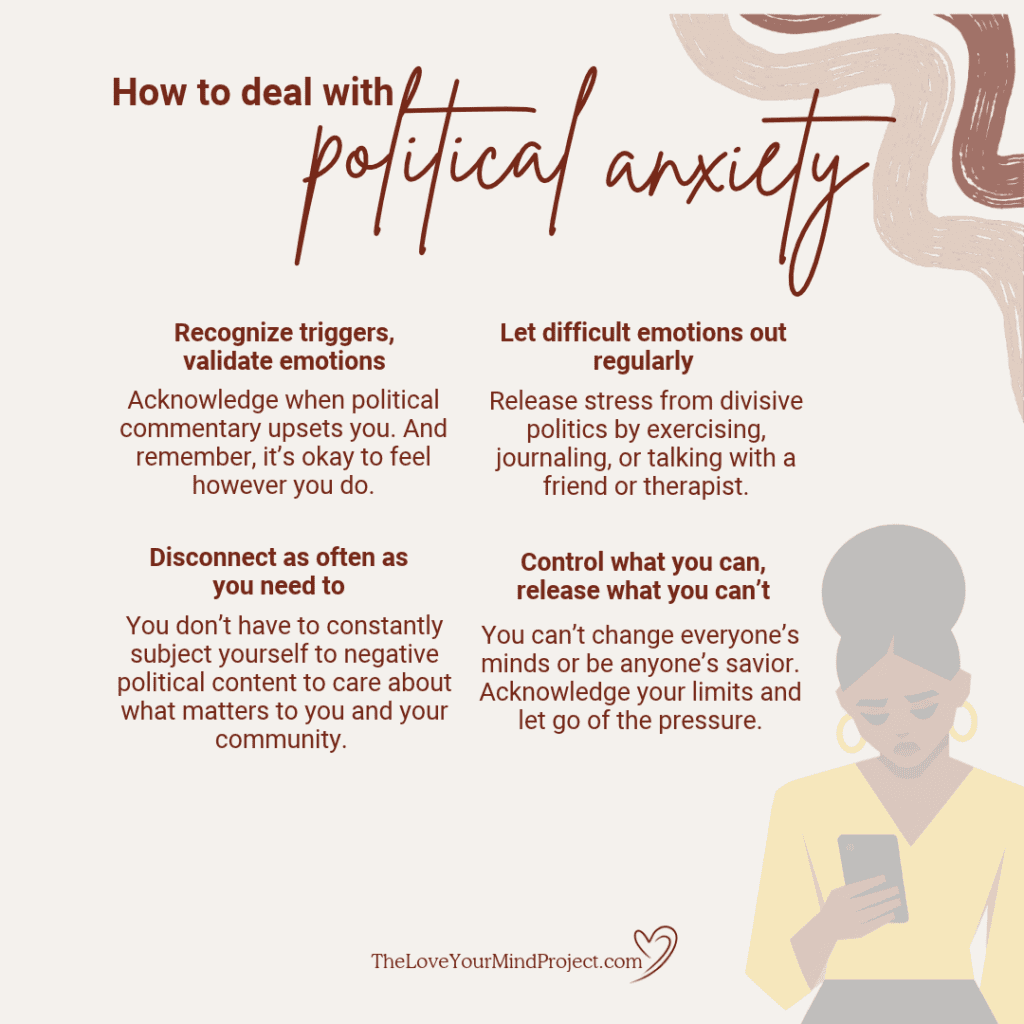
Recognize your triggers and validate how you feel
Our mood can shift quickly when we’re exposed to negative political topics as often as we are.
Without realizing it, a random comment on a political social media post can leave you feeling angry, impatient, and irritable long after you’ve moved on to other tasks.
You might spend the rest of the day wondering why you’re so frustrated all of a sudden. Or maybe you dismiss your feelings as being overly sensitive or a “downer.”
When you don’t pay attention to your emotions, it’s easy to suppress or dismiss them, or allow them to fester. Instead, try noticing when your mood changes and what political topic may have caused it.
This creates space to remind yourself that your feelings aren’t something to judge, ignore, or feel embarrassed by.
Have a space to let it out
Between social media and around-the-clock news coverage, politics can be a chronic source of stress. Over time, this can strain the body—contributing to muscle aches and pain as well as cardiovascular, respiratory, and digestive issues.5
That’s why it’s important to give yourself opportunities to release stress, even when it’s from politics.
Regularly engaging in physical activity like exercising, dancing, walking, or stretching can release endorphins (the brain’s feel-good neurotransmitters) that help improve your mood.6
In high-stress moments, you can journal to release difficult emotions or talk through how you feel with a trusted friend or culturally affirming therapist. Or sometimes it’s as simple as letting yourself grieve and have a good cry.
Be intentional about disconnecting
Sometimes you need a break from the people, conversations, and situations that fuel political anxiety. That might feel difficult, especially if you feel obligated or want to stay engaged.
But you don’t need to expose yourself to a constant stream of negative news, extremism, or hate-fueled commentary to stay informed.
When political anxiety feels like too much, it’s okay to cut back on the amount of content you consume. Maybe you set a limit on how long you scroll on social media or how many times per week you watch the news.
You can also completely disengage from divisive sources, unfollowing news outlets or individuals who prioritize clicks over facts.
And it’s okay to have a “no-politics” boundary with family members, friends, and co-workers.
Disconnect as much as you want to, for as often or as long as you need to. This can give your mind and body much-needed time to decompress and recover.
Release the pressure to fix everything (and everyone)
Meaningful change is all many of us want. But as much as we want to see progress or feel seen and validated, so much of what happens in politics is out of our hands.
Constantly carrying the pressure to change everyone’s minds or be the savior only fuels stress and anxiety.
Instead, try to focus on what you can control—but for your own peace and well-being, release the rest.
Sometimes that means sitting with the discomfort, frustration, and anger that can come when someone doesn’t understand or agree—without trying to change how you (or they) feel.
It’s okay to seek support
Political anxiety may not be a clinical mental health condition, but its impact is real—especially for so many of us who are already carrying more than we should.
Support is warranted. And it can be whatever you need it to be.
You can talk one-on-one with a therapist who will help you process the anxiety and find strategies to set boundaries and release stress.
There are also support groups where like-minded Black women can connect, share, and encourage each other. The community alone can provide the validation so many of us need.
Whichever path you choose, know that seeking support is not an overreaction. While others may not always understand your experiences or emotions, they’re still valid.
And you deserve to be seen and supported.
Political anxiety FAQs
Can politics affect your mental health?
Yes. Political events, rhetoric, and outcomes can trigger stress, anxiety, anger, fear, and even hopelessness. This can feel especially overwhelming when you’re constantly exposed to troubling news or when decisions threaten your rights, safety, or well-being.
How do you stop worrying about politics?
It’s not always possible to stop worrying about politics, but you can find ways to protect your peace and process what you’re feeling. Recognize what triggers your anxiety and give yourself opportunities to release difficult emotions. You can also set healthy boundaries around how much political content you consume so you’re not constantly exposed to stressful conversations.
Is it normal not to like politics?
Yes, it is. Political conversations are often divisive and fear-inducing. For Black women especially, it can feel like politics dismisses our needs or attacks our identities. You don’t have to enjoy politics or force yourself to engage in political topics to care about the issues that affect your life and your community.
References
Last accessed November 2026
- Sherrell, Z. (2024, September 26). How to manage political anxiety. Medical News Today. https://www.medicalnewstoday.com/articles/political-anxiety ↩︎
- Sanchez, G. R., Gilbert, K. L., & Ray, R. (2026, October 1). Recent SCOTUS decisions threaten to uproot communities’ voting power. Brookings Institution. https://www.brookings.edu/articles/recent-scotus-decisions-threaten-to-uproot-communities-voting-power/ ↩︎
- Ranji, U., Diep, K., Gomez, I., Sobel, L., & Salganicoff, A. (2025, October 8). Health policy issues in women’s health. KFF. https://www.kff.org/womens-health-policy/health-policy-101-health-policy-issues-in-womens-health/ ↩︎
- Frye, J. (2025, August 19). 5 ways the Trump administration is eroding the economic stability of Black women and the pathways used by Black workers to move into the middle class. National Partnership for Women & Families. https://nationalpartnership.org/5-ways-trump-administration-eroding-economic-stability-black-women-pathways-middle-class/ ↩︎
- American Psychological Association. (2023, March 8). Stress effects on the body. https://www.apa.org/topics/stress/body ↩︎
- Mayo Clinic Staff. (2025, September 20). Exercise and stress: Get moving to manage stress. Mayo Clinic. https://www.mayoclinic.org/healthy-lifestyle/stress-management/in-depth/exercise-and-stress/art-20044469 ↩︎

- Political anxiety is real—How Black women can cope - November 13, 2026
- Politics and mental health: How it can harm our well-being - November 5, 2026
- The Reflection app: Journaling to help you process what you’re feeling - October 29, 2026