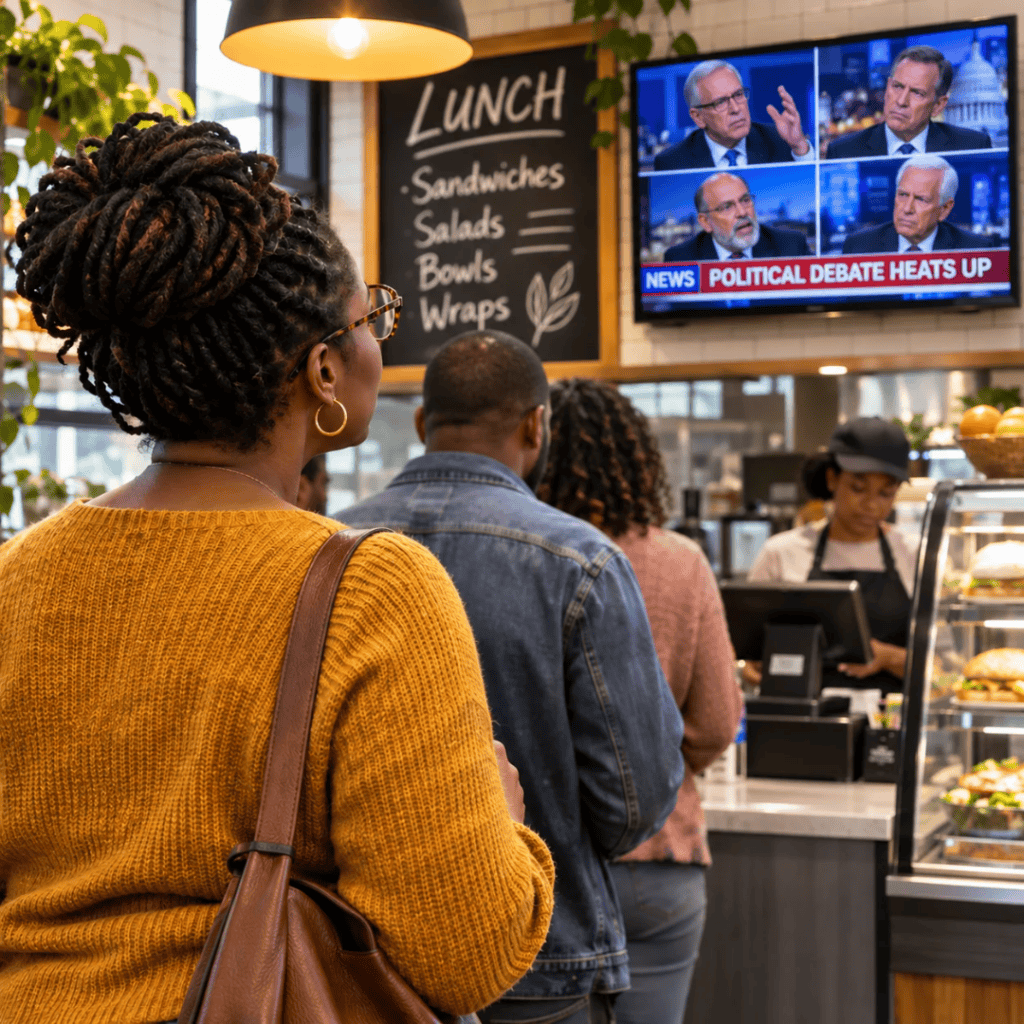
Politics and mental health are connected in ways that go beyond mental healthcare policies.
You can feel overwhelming joy, pride, and optimism watching the first Black president of the United States take office. Or fear, anger, and hopelessness as extremist political leaders threaten your rights.
Politics is intertwined with our values, identities, and hopes for the future. So it’s no surprise that it can deeply affect our mental and emotional well-being.
Why politics and mental health are deeply connected
It’s much deeper than news headlines, debates, and rhetoric.
Politics determines our legally protected rights. Its outcomes can influence access to healthcare, job opportunities, adequate housing, and quality education.
For many of us, politics is a fight that demands a lot—and it can be emotionally exhausting when we don’t see a return.
“Black women, specifically, have a natural defensive maternal instinct,” says Dr. Renee Carr, psychologist and political and corporate advisor. “We have an internal drive to fight for others who are unable or unwilling to do the same for us.”
Dr. Carr cites the 2024 elections as an example of just how deeply politics can affect us—with its resounding message that color and gender matter more than competence.
When our sense of identity, safety, and belonging feels like it’s in the hands of our nation’s leaders, everything from election results to Supreme Court decisions to a State of the Union address can evoke feelings of validation and acceptance, rejection and worry—and everything in between.
The effects can feel more negative than positive
Election season used to mean periodic moments of heightened stress. But these days, politics seems to infiltrate our daily lives.
With constant exposure to news that’s often divisive and framed as right vs. wrong, some researchers describe politics as a chronic stressor in our society.1
Studies have linked politics to trouble sleeping, mood swings, and increases in depression and anxiety symptoms. And these challenges can be more pronounced for demographic groups strongly opposed to those in power.2
Black women aren’t the only group affected, but we are uniquely impacted.
In the past five years alone, we’ve watched leaders restrict access to reproductive healthcare and scale back measures intended to protect our employment and economic security.3,4
Meanwhile, Black women leaders across the country face intense scrutiny, verbal attacks, and attempts to weaponize their identities.5
Repeated exposure to racism and gender inequality can contribute to higher stress, anxiety, and trauma responses. And policy changes that seem to dismiss our fundamental rights only add to the emotional distress.
4 ways politics may be harming your well-being
Stress from political events can gradually erode our mental and emotional well-being, sometimes without us realizing it. Here are some ways that can happen.
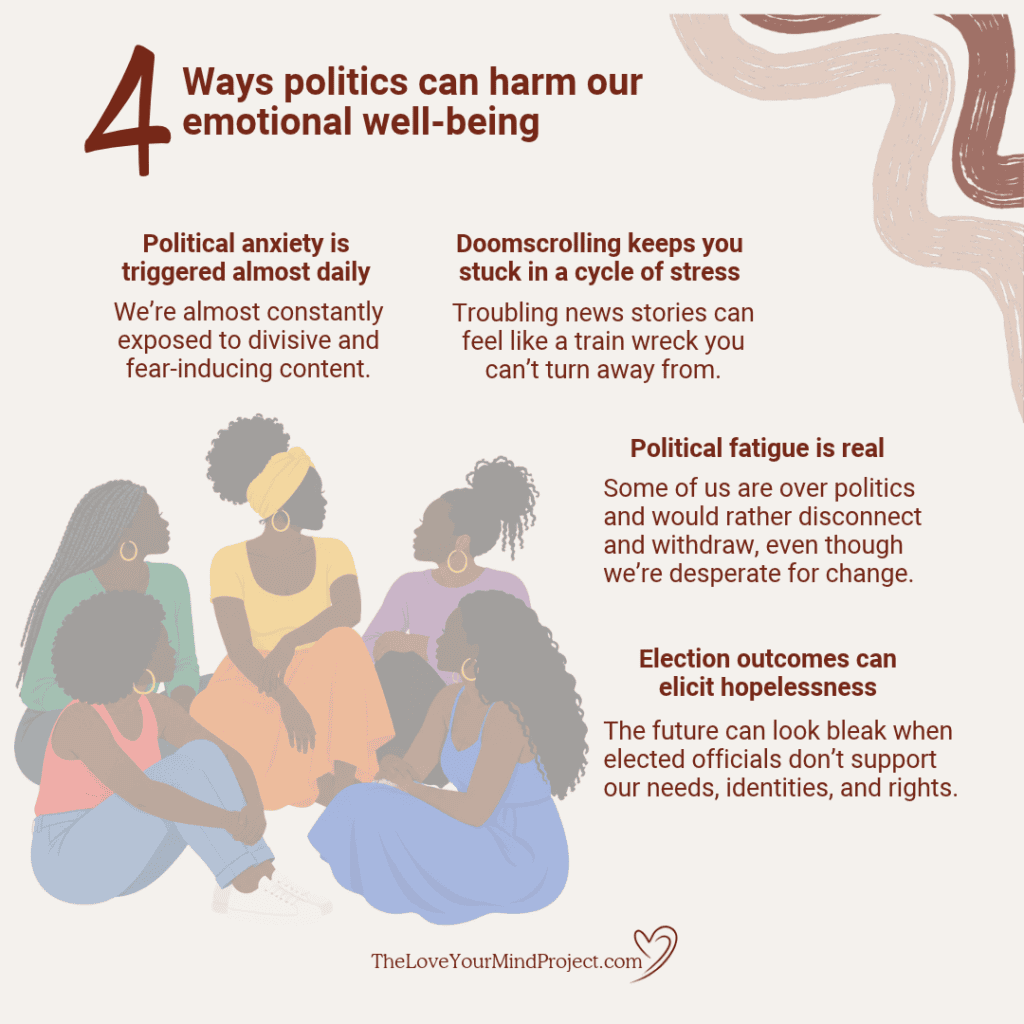
Political anxiety is triggered almost daily
Political anxiety is persistent worry, fear, or stress caused by political headlines, events, and conversations.6
While not a clinical diagnosis like generalized anxiety disorder, its symptoms can be similar. You may worry constantly, feel overwhelmed by news or updates, or struggle to focus. You might also feel overly emotional, irritable, or even hopeless.
The anxiety can feel especially overwhelming because it’s hard to escape politics. With social media, 24/7 news coverage, and smartphones, we have more access to troubling news at almost every moment.
And although cutting back on politics may seem like the obvious answer, it’s not always easy for those of us who want to stay informed or actively help drive change.
Doomscrolling keeps you in a cycle of stress
Doomscrolling is constantly taking in negative news. What might start as a genuine desire to stay informed can turn into being drawn to distressing stories. It’s like a train wreck you can’t turn away from.
Doomscrolling plays into our need for safety, triggering the body’s fight-or-flight response. The brain senses danger and releases stress hormones that prepare the body for a potential threat.7
Even with the best intentions, continuously engaging with fear-inducing content can keep your body’s stress response activated. Over time, that takes a toll, contributing to symptoms of anxiety, depression, and even panic attacks. Doomscrolling can also make it harder to concentrate, regulate emotions, and make decisions.
Political fatigue is real
Many of us are over politics. But for those driving change, it can be especially taxing—adding significant mental stress, according to Dr. Carr.
“Political parties expect us to help get out the vote, raise money, and coordinate voter registrations at Black churches and events,” says Dr. Carr. “We can consistently sacrifice time, sleep, and our own needs to help others get elected, only to have those same elected officials show little commitment to addressing what matters to us.”
Even if you don’t consider yourself an activist, the constant extremism, cross-party feuding, and attacks on our identities can still leave you feeling emotionally exhausted. And this political fatigue can look a lot like apathy,8 leaving you wanting to disconnect rather than continue investing your time, energy, or hope.
Election outcomes can elicit hopelessness
When the candidates you support lose an election, the future can suddenly feel bleak.
“It can lead to depression because you’re being forced to realize that all you fought for and believed in, for the political good of a community or country, was not valued by a large part of the population,” says Dr. Carr. “You may also feel apathy and low motivation to remain politically engaged even though you yearn to be part of the change you know our country needs.”
Election outcomes can trigger fear, a depressive mood, and hopelessness when you’re unsure how leaders will value our needs.
You can protect your peace even if you want to stay informed
Given the impact politics can have on our mental and emotional health, it’s worth taking steps to manage the stress.
This might look like setting practical boundaries around how much political content you consume daily. You might even choose to cut off certain media sources or unfollow people who are pushing fear, hate, or inequality.
Even if you try to avoid politics altogether (which is okay), it can be hard to escape. This is where mindfulness, grounding, and relaxation techniques can help you acknowledge and release stress so you don’t carry that tension long-term.
Politics and mental health FAQs
Why do politics affect me so much?
Politics deeply affects many of us because its outcomes impact our rights, safety, economic opportunities, and those of future generations. When politics feels more fear-inducing and divisive, it can trigger lasting stress and anxiety if we’re constantly exposed to it.
Is being involved in politics bad for your mental health?
Being involved in politics has pros and cons. You may feel a sense of purpose, belonging, and pride as you push for meaningful change. But it can also be emotionally draining, particularly when you’re constantly exposed to distressing news, attacks on your identity, and disappointing outcomes. You don’t have to stop participating, but it’s worth understanding the toll it can take so you can best support yourself.
Is it okay to take a break from politics?
Absolutely. Taking a break from political stressors can give your mind and body time to decompress, rest, and recharge. It doesn’t mean you’ve stopped caring about the issues in your community or that you must step away forever. Instead, you’re learning your limits and making room to process emotions and find balance in your life.
References
Last accessed November 2026
- Ford, B. Q., Feinberg, M., Lassetter, B., Thai, S., & Gatchpazian, A. (2023). The political is personal: The costs of daily politics. Journal of Personality and Social Psychology. https://doi.org/10.1037/pspa0000335 ↩︎
- Smith, K. B. (2022). Politics is making us sick: The negative impact of political engagement on public health during the Trump administration. PLOS ONE, 17(1), Article e0262022. https://doi.org/10.1371/journal.pone.0262022 ↩︎
- Center for Reproductive Rights. (n.d.). Roe v. Wade. https://reproductiverights.org/resources/roe-v-wade/ ↩︎
- Friedman, D. (2026, August 26). EEOC proposes overhaul of federal sector complaint process. Federal News Network. https://federalnewsnetwork.com/workforce-rightsgovernance/2026/08/eeoc-proposes-overhaul-of-federal-sector-complaint-process/ ↩︎
- Brown, N. E. (2024, March 18). In 2024, political violence against Black women is a big threat. Good Authority. https://goodauthority.org/news/in-2024-political-violence-against-black-women-is-a-big-threat/ ↩︎
- Sherrell, Z. (2024, September 26). How to manage political anxiety. Medical News Today. https://www.medicalnewstoday.com/articles/political-anxiety ↩︎
- American Brain Foundation. (2026, July 15). Doomscrolling and its effects on the brain. https://www.americanbrainfoundation.org/doomscrolling-and-its-effects-on-the-brain/ ↩︎
- Phipps, S. (2024, July 29). What is political fatigue and how will it impact voter turnout? WBKO. https://www.wbko.com/2024/07/30/what-is-political-fatigue-how-will-it-impact-voter-turnout/ ↩︎

- Politics and mental health: How it can harm our well-being - November 5, 2026
- The Reflection app: Journaling to help you process what you’re feeling - October 29, 2026
- Daylio mood tracker app: A simple way to understand your emotional patterns - October 23, 2026