It’s that unshakeable feeling that you’re doing life wrong.
You spend your days trying to be flawless, over-preparing, triple-checking, hyper-functioning. Not because you want to be perfect—but because you can’t afford not to be.
You strive to avoid mistakes, but deep down, you often feel like you are the mistake.
But you’re not.
If you constantly feel like a failure, you’re not alone. It’s a burden many neurodivergent Black women carry. Perfectionism and shame often fuel the fire.
This article explains what may be behind the perfectionism, shame, and persistent sense of failure, and how you can begin to see, accept, and celebrate yourself with curiosity and compassion.
You’re not alone in how you feel
Many neurodivergent Black women learn early on that our differences are something to overcome, hide, or ignore.
A white girl who struggles to manage big feelings, focus, or complete tasks is more likely to be seen as overwhelmed and in need of a little support. But many Black girls with similar experiences are often labeled dramatic, aggressive, lazy, or careless.1
Over time, those messages can shape how we see ourselves.
So it makes sense that for so many Black women—misunderstood and mislabeled since childhood—perfectionism and shame become the burdens we quietly carry.
Why perfectionism and shame run so deep in neurodivergent Black women
Together, perfectionism and shame can fuel that “constantly failing” feeling. But those feelings aren’t facts. They’re often the result of coping strategies to survive a world that doesn’t always support you.
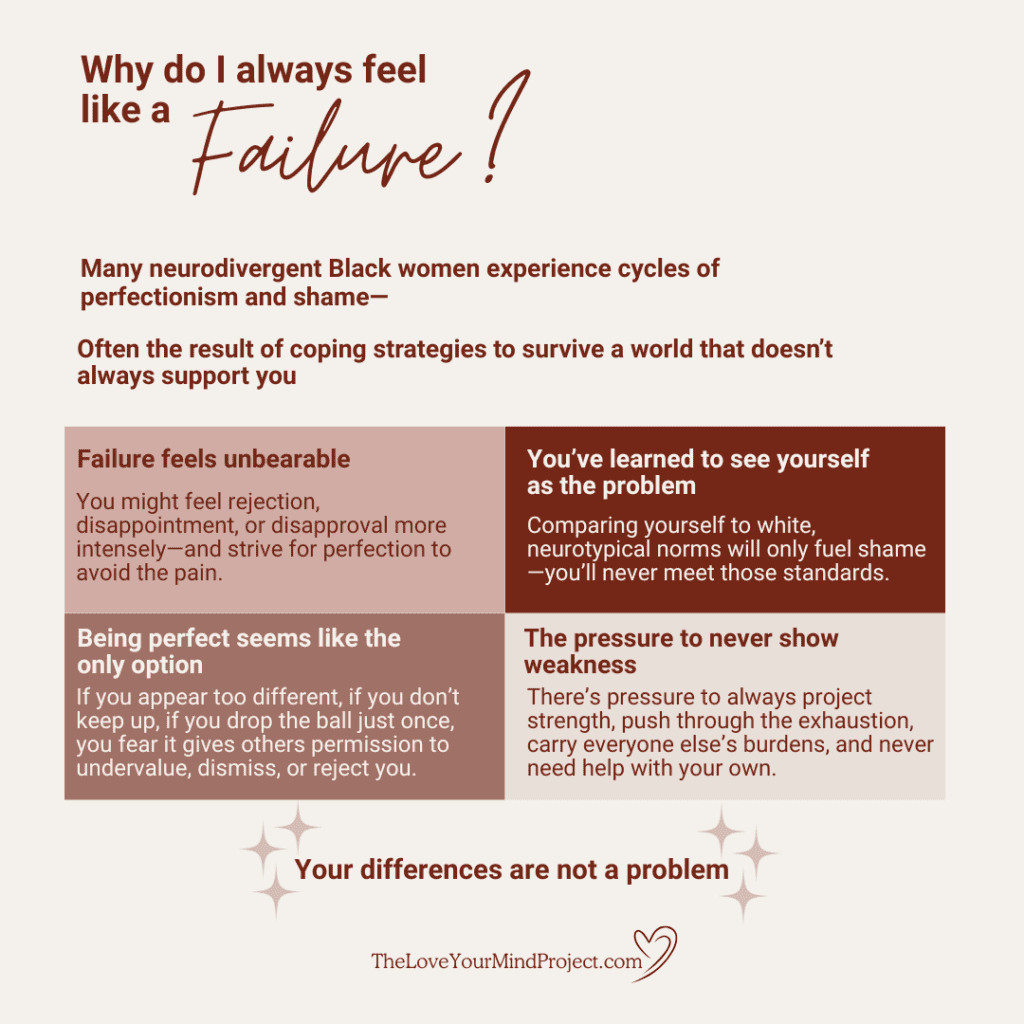
Failure feels unbearable
That mistake you made at work, another job application rejection, even your friend saying they can’t come over tonight—none of it feels small.
Even the most minor disappointments can seem like a punch to the gut, leaving you emotionally reeling for days.
It’s known as extreme rejection sensitivity or rejection sensitive dysphoria (RSD), and it’s common in ADHD and autistic minds.2
And this hyper-sensitivity doesn’t happen in a vacuum. It’s often layered with the realities of navigating discrimination and bias as a Black woman. Research suggests that, over time, many of us learn to anticipate rejection or internalize societal stigma.3
To avoid the emotional pain that comes with falling short, you may strive to avoid failure altogether. This often means carrying the impossible burden of perfectionism. Or maybe allowing your inner critic to take over, fueling low self-worth, guilt, and shame.
Being perfect seems like the only option
Allowing the world to see your true self—to know your lived experiences, including your struggles, as a neurodivergent Black woman—is out of the question.
Perfectionism becomes your mask.
Flawless execution, always excelling, being twice as good, that’s the baseline requirement. Fearing that if you appear too different, if you don’t keep up, if you drop the ball just once, you give others permission to undervalue, dismiss, or reject you.
Masking, hiding parts of who you are to avoid judgment, can become your way of life. And while it’s an understandable attempt to navigate spaces that weren’t built for you and don’t always accept you, it’s exhausting, delays you getting the support you need, and slowly chips away at your self-worth.4
You’ve learned to see yourself as the problem
One danger of living in a world that doesn’t always value you is that you start to believe the message.
That can look like deeming yourself a failure every time you come up short, miss a deadline, lose your phone, appear distracted, or feel overwhelmed by noise.
It’s called internalized ableism, when a neurodivergent mind begins to absorb society’s rules about what’s “normal,” productive, or acceptable.5
But society’s standards aren’t based on truth, equity, or celebrating the diversity of gender, race, sexuality, or neurological differences.
Measuring yourself against white, neurotypical norms will only fuel shame. You’ll never feel whole. You’ll never see yourself for what you truly are—more than enough.
The pressure to never show weakness
A neurodivergent mind deserves support, just as every mind does.
But culturally, needing help, let alone advocating for it, can feel like a failure itself.
There’s a pressure, as Black women, to always project strength, push through the exhaustion, carry everyone else’s burdens, and never need help with our own.6 No crack in the armor, right?
The moment you feel overwhelmed, burned out, or like you’ve hit a mental wall, a wave of guilt hits you—as if you’re failing all the women who came before you.
But this perfectionism only fuels self-neglect and leaves us filled with shame when we inevitably give out.
Your natural needs are not a defect.
Accommodations, extra rest, timed breaks, it doesn’t make you weak or “extra.” It makes you human.
Your differences are not a problem
Your experiences, including your challenges, are real. Situations that come easily for others may feel overwhelming to you. But that doesn’t mean you’re a problem.
A neurodivergent mind works differently. A Black woman experiences the world differently. Neither of these truths is always acknowledged in our society.
So while the world may tell you to push harder, work longer, be more responsible, and need less, the truth is, as a neurodivergent Black woman, you’re fighting to survive environments that weren’t made for you.
And constantly surviving comes at a cost.
It’s okay to lay down this burden
Living under the weight of perfectionism and shame is exhausting. It can wear down your self-esteem and contribute to conditions like anxiety, depression, and burnout.7
But you deserve more. Relief. Moments where you’re not having to prove you belong. Moments where forgetting your keys doesn’t become a referendum on your character.
You deserve support. And that’s not evidence of you failing, but proof that your experiences matter and your needs are worthy of being met.
That starts with shifting how you see yourself. Because your mind isn’t broken or defective. It simply processes the world differently.
And your differences, challenges, strengths, struggles—your experiences as a whole are worth understanding.
Perfectionism and shame in neurodivergent Black women: FAQs
Is perfectionism a sign of neurodivergence?
Medically, perfectionism is not a sign of neurodivergence, but it is a common experience among neurodivergent people. Perfectionism can become a way to avoid criticism, rejection, or misunderstanding. This can be especially true for Black women who culturally are expected to overperform and not need much support.
Can you be neurodivergent and not know it?
Yes, it’s possible. Many Black women reach adulthood without realizing they’re neurodivergent because our experiences are often overlooked, masked, or dismissed as behavioral or personality disorders.8
How do I stop being so hard on myself?
Self-compassion can take time, but it starts with differentiating what you learned from what’s true. Neurodivergence is not a defect. You don’t need perfectionism to mask it. Neither do you have to live in shame, comparing yourself to a neurotypical mind. Understanding your differences and needs can help you replace self-criticism with compassion and curiosity and give yourself permission to seek the support you deserve.
References
Last accessed June 2026
- Epstein, R., Blake, J. J., & Gonzalez, T. (2017). Girlhood Interrupted: The Erasure of Black Girls’ Childhood. Georgetown Law Center on Poverty and Inequality. ↩︎
- Rejection Sensitive Dysphoria (RSD): Symptoms & Treatment. (2022, September 6). Cleveland Clinic. https://my.clevelandclinic.org/health/diseases/24099-rejection-sensitive-dysphoria-rsd ↩︎
- Frost, D. M., & Meyer, I. H. (2023). Minority stress theory: Application, critique, and continued relevance. Current Opinion in Psychology, 51, 101579. https://doi.org/10.1016/j.copsyc.2023.101579 ↩︎
- Miller, D., Rees, J., & Pearson, A. (2021). “Masking Is Life”: Experiences of Masking in Autistic and Nonautistic Adults. Autism in Adulthood, 3(4), 330–338. https://doi.org/10.1089/aut.2020.0083 ↩︎
- Neff, M.A. (2026, April 25). What Ableism Looks Like: Examples Across Systems, Culture, and Self. Neurodivergent Insights. https://neurodivergentinsights.com/what-ableism-looks-like/?srsltid=AfmBOopedt3WxeEMpaxr4dzlhR_wLSQ4y_W94Rz-dIegIMhJ2HXP3HP6 ↩︎
- Woods-Giscombe, C., Robinson, M. N., Carthon, D., Devane-Johnson, S., & Corbie-Smith, G. (2016). Superwoman Schema, Stigma, Spirituality, and Culturally Sensitive Providers: Factors Influencing African American Women’s Use of Mental Health Services. Journal of Best Practices in Health Professions Diversity : Research, Education and Policy, 9(1), 1124. https://pmc.ncbi.nlm.nih.gov/articles/PMC7544187/ ↩︎
- Benson, E. S. (2003). The many faces of perfectionism. Https://Www.Apa.Org. https://www.apa.org/monitor/nov03/manyfaces ↩︎
- Shalaby, N., Sengupta, S., & Williams, J. B. (2024). Large-scale analysis reveals racial disparities in the prevalence of ADHD and conduct disorders. Scientific Reports, 14(1). https://doi.org/10.1038/s41598-024-75954-5 ↩︎
- Feeling unlovable even in a relationship? Here’s what to do with that feeling - September 24, 2026
- How to be vulnerable in a relationship when opening up feels scary - September 17, 2026
- When only needing “me, myself, and I” leaves little room for love - September 11, 2026