Maybe you’ve always felt like the odd one out. Wondering why certain things—socializing, focusing at work, or loud environments—seem to come easier for everyone else.
Or maybe you don’t stick out at all, but that in itself takes lots of thoughtful planning, rehearsing, and mental effort.
Life as an autistic Black woman is not always easy, but that doesn’t make autism a defect.
The more you learn about how your mind works, the more you can support it and make sure your environment better supports you.
This article walks through what autism in Black women can look like, particularly the experiences that often go unseen, overlooked, or masked for years.
You experience the world differently
Autism is a neurodevelopmental difference where your brain takes in and processes information—such as sound, emotions, social cues, and sensory input—differently than what’s considered “typical.”
“Autism can affect social communication and interaction, and often involves restricted or repetitive behaviors, interests, and routines, along with heightened or reduced sensory sensitivity,” says Dr. Patrice Le Goy, LMFT and host of the Like-Minded with Dr. Patrice podcast.
This isn’t you being dramatic, overly sensitive, or “too much.” And it’s not a flaw in how your mind works.
It’s a different operating system entirely. One that may notice details others miss. Feel emotions more intensely. Lose track of time diving deep into what you love. Or need more time and space to take in what’s happening around you.
Others may not always see your reality. But your differences, strengths, and struggles are all real, valid, and worth understanding.
Different is not defective
Many of us grew up measuring ourselves against expectations we could never meet—whether that meant always exuding strength, never showing weakness, or working twice as hard to earn our place.
For autistic Black women, that pressure is often magnified. Not only are you up against the “strong Black woman” ideology, but you’re pitted against a “normal” that simply does not exist.
Society often assumes there’s one right way to communicate, socialize, regulate emotions, work, and move through the world. When your brain doesn’t naturally operate that way, it’s easy to believe you’re the one falling short.
But the problem isn’t you. It never has been.
The problem is the many environments that demand we all think and function in a neurotypical way.
Just like the world has struggled to support the experience of Black women, it can also fail to support autistic minds.
But being a Black woman is not a problem, neither is being autistic.
What it means to be an autistic Black woman
Autism shows up differently in everyone, but there are common experiences autistic Black women may share.
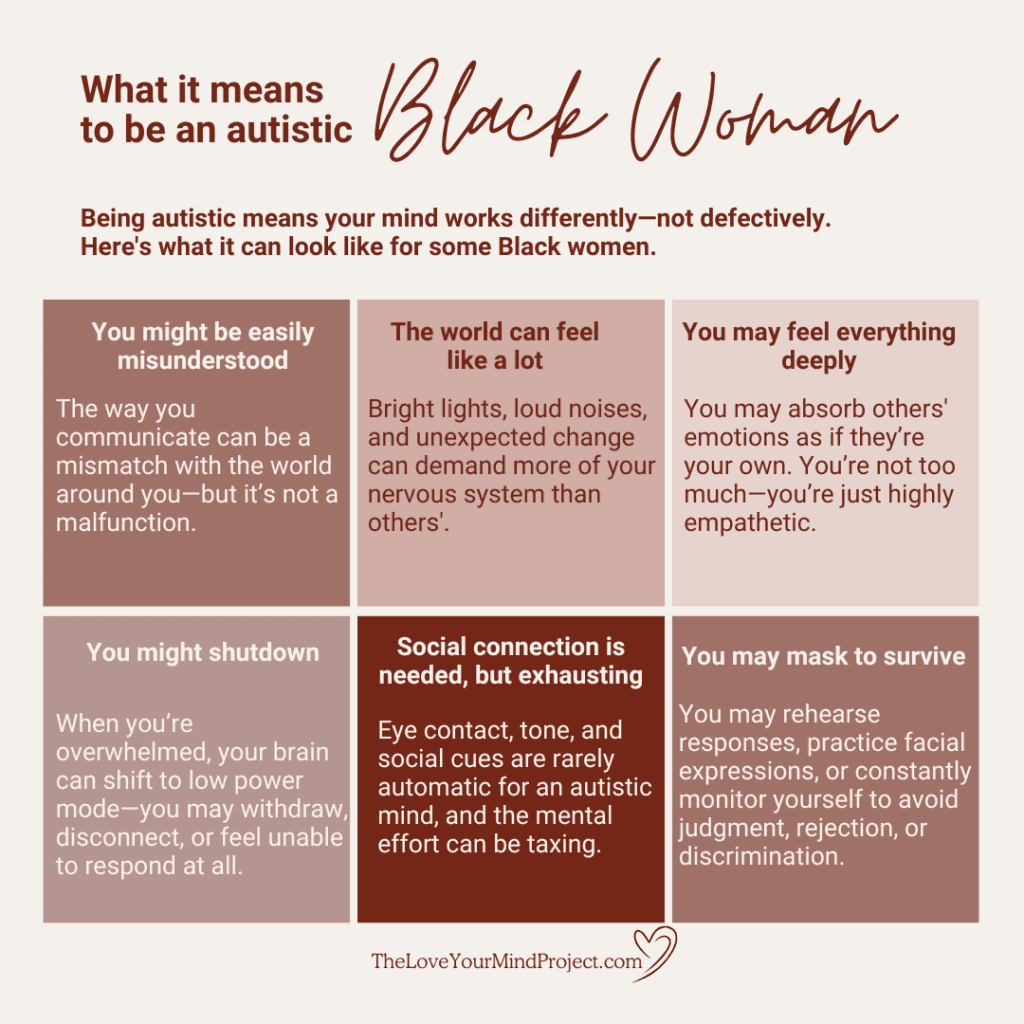
You might be easily misunderstood
It can seem like people always take your responses the wrong way. Or maybe you struggle to read others—when they’re offended or don’t want to be bothered—the way everyone else seems to instinctively.
Autistic minds tend to speak more directly. And the emotions you feel may not always show up in your facial expressions or tone of voice, compared to neurotypical minds.
But the way you communicate is different, not lacking.
Researchers liken it to two different operating systems trying to talk to each other. It’s a mismatch, not a malfunction. In fact, evidence suggests that autistic individuals understand each other well—just as neurotypical people do.1
But that doesn’t make it any easier when you are misunderstood, especially as a Black woman.
For many of us, misunderstandings are not benign. We rarely hear neutral labels, like “introvert” or “reserved.” Instead, we’re more likely to be seen as distant, angry, or closed off.
The truth is, you aren’t difficult or aggressive. Your brain is simply communicating in its natural, honest language.
The world can feel like a lot
Everyday environments can demand a lot more from your nervous system than you might realize.
Bright lights, background conversations, scratchy clothing, strong smells, and unexpected changes to your routine often require more mental effort than for a neurotypical mind.
This sensory overload can range from a distracting annoyance to actual physical distress. It happens because an autistic mind tends to manually process what a neurotypical one easily tunes out.2 Some experts compare it to a browser with twenty tabs running at once.
This means you’re using an immense amount of energy simply to exist in these spaces, leaving your nervous system on high alert. And that’s on top of the other daily stressors and pressures we often carry.
So if you find yourself completely drained from something as seemingly simple as a trip to the grocery store, know that the fatigue is real and additional rest is justified.
You may feel everything deeply
Emotions can hit hard. You might feel your friend’s sadness like it’s your own. Or experience strong emotions from a situation others seem to brush off.
There’s a misconception that autistic people lack empathy. But in reality, many Black autistic women are the exact opposite. In fact, experts call it hyper-empathy—where you can absorb others’ emotions so intensely that it becomes difficult to separate them from your own.3
As if that concept isn’t exhausting on its own, autistic hyper-empathy is often layered on top of our roles as the emotional caretakers or anchors in our communities. The one who is always the reliable pillar of strength for those around her.
So if you’ve felt like an emotional sponge, it’s not a flaw or an inability to handle life. It’s a reflection of a highly compassionate, deeply resonant nervous system.
You may shut down when you’re overwhelmed
When everything starts to feel like too much, your brain may protect itself by shutting down.
You may go quiet, withdraw from your friends, disconnect from what’s happening around you, or feel unable to respond at all.
This emotional shutdown can happen when your brain takes in more sensory, emotional, or mental input than it can process. It’s like hitting a safety switch for low-power mode.4
It’s not you being difficult, distant, rude, or uncooperative—it’s your nervous system reaching its limit. Simply running out of the resources required to interact with a world you constantly have to adjust to.
Autistic shutdowns can happen often, especially if you learned it was safer to hide or dismiss difficult emotions. But that doesn’t mean you’re broken.
Your nervous system is trying to protect you when the world gets too loud. And no, it’s not a failure to cope—it’s your mind demanding the quiet space it needs to reset.
Connection can feel both needed and exhausting
Community and connection matter for our well-being, usually more than we realize. But for an autistic mind, social interactions can take a ton of mental effort.5
Maintaining eye contact, reading facial expressions, understanding conversational timing, and knowing what to say next likely don’t happen automatically for many autistic individuals.
And for Black women, this is often added to all the other ways we’re adjusting socially, changing our language, tone, or demeanor, to fit into different spaces.
It’s a cognitive load that can make even enjoyable experiences with your people feel exhausting.
You might feel like you need a three-day nap just to recover from a casual lunch. And that can bring guilt, wondering why connecting with people you care about feels like such heavy lifting.
But you’re not a bad friend. You’re not antisocial. Your mind simply works harder to show up in social situations.
You may mask to fit in (or survive)
Many autistic individuals change or hide parts of themselves to avoid standing out or being judged.
You might rehearse conversations, copy others’ expressions, suppress stimming, or constantly monitor how you’re coming across.
“Many of us have become very good at masking, a skill often shaped by the broader Black female experience of needing to appear composed and unbothered regardless of how we actually feel,” says Dr. Le Goy.
Masking is often done out of survival. It may help you navigate school, your job, and key relationships.
It’s not something you need to be ashamed of. But constantly masking can take a toll.
It’s okay to honor who you are
Maybe you’ve lived your life trying to become more like everyone else. But you can’t meet a standard you weren’t built for.
You’re different. And different doesn’t mean defective.
So, what if your growth and healing are tied to better understanding yourself—your strengths, your needs, and where you may need additional support?
Because you are whole. A Black autistic woman who doesn’t need to be fixed. And you deserve a life that sees and supports you.
Autism in Black women: FAQs
Does autism show up differently in Black women?
Autism in Black women can sometimes look different than people expect. For many of us, the pressure to be strong, to prioritize others over ourselves, and to survive a biased and unjust world can lead to us masking a lot of our differences and challenges. And because initial research on autism did not include Black women, our autistic experiences can be overlooked or misunderstood
Can you be autistic and not know it?
Yes. Many Black autistic women were not diagnosed growing up and spent years masking their traits or being misdiagnosed with anxiety or mood disorders. While some of us are diagnosed later in adulthood, there are plenty who are not diagnosed at all.
Do I need a diagnosis to get support?
A formal diagnosis can open doors to workplace accommodations, educational supports, or other services. But you don’t need a diagnosis to begin learning about your needs, practicing self-compassion, and creating supportive routines where you can. It may also help to seek neuro-affirming mental health care.
References
Last accessed July 2026
- Milton, Damian (2012) On the ontological status of autism: the ‘double empathy problem’. Disability & Society, 27 (6). pp. 883-887. ISSN 0968-7599
↩︎ - Proff, I., Williams, G. L., Quadt, L., & Garfinkel, S. N. (2022). Sensory processing in autism across exteroceptive and interoceptive domains. Psychology & Neuroscience, 15(2), 105–130. https://doi.org/10.1037/pne0000262 ↩︎
- Kimber, L., Verrier, D., & Connolly, S. (2024). Autistic People’s Experience of Empathy and the Autistic Empathy Deficit Narrative. Autism in Adulthood, 6(3), 321–330. https://doi.org/10.1089/aut.2023.0001 ↩︎
- Paris, K., Lodestone, A. Z., Houser, M., & Lewis, L. F. (2025). “Shutdowns Are Like You’re Stuck on the Blue Screen of Death”: A Metaphor Analysis of Autistic Shutdowns. Autism in Adulthood. https://doi.org/10.1089/aut.2024.0193 ↩︎
- Pearson, A., & Rose, K. (2023). Conceptualising Autistic Masking. Autism in Adulthood, 5(1), 52-60. https://doi.org/10.1089/aut.2022.0017 ↩︎
- Is Headspace worth it considering our unique needs? - October 8, 2026
- The Exhale app: Wellness support that actually centers Black women - October 2, 2026
- Feeling unlovable even in a relationship? Here’s what to do with that feeling - September 24, 2026