
Others may not understand how much work it takes for you to get through the day.
The extra time spent double- and triple-checking your work. Hiding your confusion because you don’t want to inconvenience anyone. Or forcing yourself to appear calm and put together no matter how overwhelmed you feel.
On the outside, you look fine. But inside, your brain rarely gets a break.
Masking in neurodivergent Black women can feel like a baseline requirement for survival.
Yet, it takes so much out of you. Here’s why.
What is masking?
Masking is hiding or changing parts of who you are to blend into environments that don’t fully support you.
“For a neurodivergent person, that might mean suppressing stimming, rehearsing conversations in advance, forcing eye contact that feels unnatural, or carefully managing your tone and expressions so you come across as acceptable,” says Dr. Joanne Patterson, DNP, MSN, PMHNP-BC, APHN-BC, owner of Integrative Mental Wellness & ReLeaf Clinic.
Dr. Patterson explains that for Black women, masking is often layered on top of the pressure to be polished, agreeable, and beyond reproach—just to be taken seriously.
“You may have a Black woman who is masking her neurodivergence and also managing the expectations placed on her because of her race and gender, all at the same time. It becomes a second and third job that no one sees her doing,” says Dr. Patterson.
Much of this work happens automatically, so you may not even realize how much energy you’re spending just to get through the day.
Your mind is working harder than you think
Our minds are always at work. But when a neurodivergent mind is masking, it can work in overdrive1.
Masking often involves adapting yourself to fit in, working extra hard to navigate challenges, or hiding parts of yourself that feel different—all of which place additional demands on your mind.
“Masking asks the brain to monitor itself constantly and suppress its natural responses, which is metabolically demanding,” says Dr. Kimberly Idoko, board-certified neurologist, attorney, and author of The Miswired Child. “Over time, this can lead to anxiety, depression, and burnout.”
Dr. Idoko adds that for Black women in particular, code-switching and masking at the same time can create a cumulative burden.
This mental overload isn’t you overthinking or doing something wrong. It’s your mind working hard to translate. It’s taking what feels natural to you and translating it into something that reads as “normal” to neurotypical minds.
But that translation takes a toll.
Why masking can be so exhausting for neurodivergent Black women
Masking takes energy. But for neurodivergent Black women, that effort is on top of many of the other mental demands we carry.
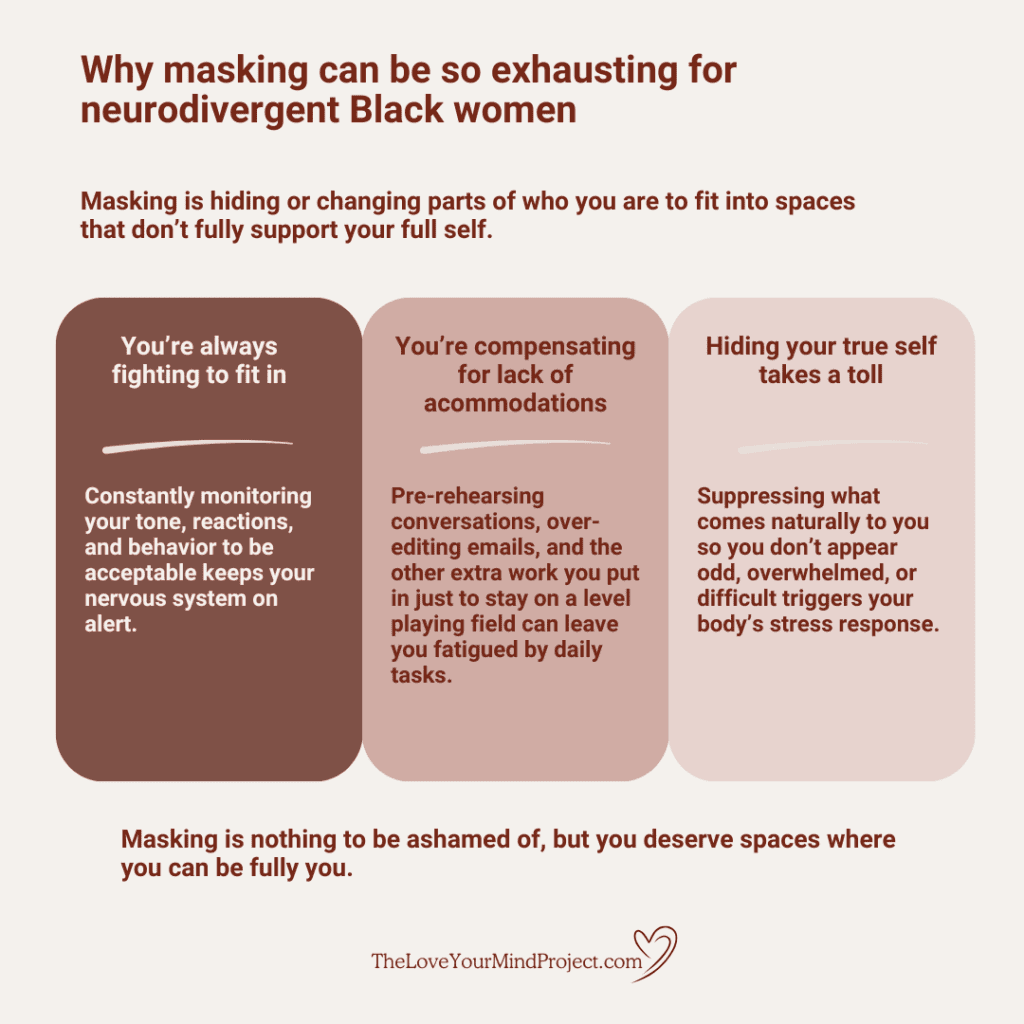
You’re constantly fighting to fit in
There’s a lot you might do to avoid being misunderstood, mislabeled, or discriminated against.
It’s known as assimilation, and it can look like changing the way you speak (code-switching) or overanalyzing your behavior or reactions so you don’t come across as unprofessional, angry, or distant.
“Black women are faced with constantly monitoring their words, language, social cues, sensory responses—and often anticipating how others might perceive them,” says Krista Norris, LMFT, PhD(c) and practice owner at Conscious Connection Therapy Services LLC. “This level of hypervigilance keeps the nervous system on alert.”
Assimilating can require the brain to manually run tasks that should be automatic. This additional mental effort can leave you drained and exhausted by everyday situations.2
You’re compensating for lack of accommodations
You may put in extra effort to make up for environments that weren’t designed with your needs in mind—and that takes work.
Maybe you use five different alarms and ten productivity apps to stay organized throughout the day. Or spend hours over-editing an email to make sure your tone isn’t “off.”
This is compensating—working harder and longer, often invisibly, to make it through work, home responsibilities, or even time out with your friends.
Maintaining that effort, just to stay on a level playing field, can add up and leave you feeling mentally and emotionally done by the end of the day.
Hiding your true self takes a toll
It may feel safer to suppress your natural tendencies as to not appear odd, distracted, or without self-control.
Maybe it’s holding back your excitement about a topic that your coworkers find strange. Or you stop yourself from rocking, nail-biting, or other stimming behaviors that may calm you.
But over time your brain can begin to treat your neurodivergent traits as inherently unsafe, triggering your body’s stress response.3
That means internally, you can be in full fight-or-flight mode, as your brain actively works to avoid being misunderstood—all while you’re simply sitting in a team meeting or having dinner with friends.
And suppression is layered for many neurodivergent Black women who suppress more than how our minds process information.
“African American women hold an extra layer of cultural expectations that cause masking to feel heavier over time,” says Norris. “Labels such as ‘the strong Black woman’ come with the expectation to be resilient no matter the circumstances.”
In adopting this persona, many of us learn to conceal our emotions rather than process them. And that doing so is a matter of strength, loyalty, and responsibility.4
Yet, the reality is that neglecting and hiding parts of who you are, including your emotional and neurological needs, comes at a cost.
Masking isn’t a character flaw—it’s a survival response
Certain masking behaviors may be intentional and others subconscious, but none of them are morally wrong or a sign of personal failure.
“Masking can stem from a survival response,” says Yovanna Madhere, LMSW and founder of The Clarity Practice Therapy and Wellness. “But a survival response isn’t always related to trauma.”
Madhere explains how survival responses can be explained by something as simple as birth order (think: oldest daughters), or as complex as navigating a blended family.
So you’re not masking to deceive anyone. It doesn’t happen because you’re weak, undisciplined, or attention-seeking.
“People learn to mask because at some point being their authentic self felt unsafe, whether that meant being judged, misunderstood, excluded, or penalized,” says Dr. Patterson. “The mask is protective—it is the mind doing exactly what it was designed to do, which is to keep you safe and connected.”
So you don’t have to feel ashamed of masking. It’s not a sign that you’re broken. It’s an act of self-preservation—even if it’s come at a cost you’re only now starting to recognize.
You deserve spaces where you don’t have to perform
Masking may feel safe, or like it’s the only option. But performing every day, hiding who you are, and allowing your needs to go unmet are burdens you weren’t meant to carry long-term.
There’s a freedom in having environments where you can take off the mask. It may be at home, at the gym, an art studio—any place or relationship where your full self is accepted.
And if you don’t have that space, it’s okay to reach out for support. Therapy and support groups are known for being welcoming, validating spaces that can help you heal from years of assimilating, compensating, and suppressing.
A neuro-affirming therapist can help you understand your mind with compassion, not judgment and remind you that your goal isn’t to become someone else—it’s to prioritize the places where you can safely be yourself.
Masking in neurodivergent Black women: FAQs
What is masking for neurodivergent Black women?
Masking is hiding or changing your natural traits to fit social expectations. For many neurodivergent Black women, it can include monitoring and altering our communication, emotions, and facial expressions. It may also involve suppressing sensory needs, copying social behaviors, or working extra hard to avoid being judged or misunderstood.
Why does masking make you tired?
It can demand a lot of mental energy. What a neurotypical mind does on autopilot, a neurodivergent mind often does manually, requiring extra processing to assess and adapt to what’s needed in a given situation. Mental tasks, like assimilating to fit in or suppressing natural tendencies, can cause the nervous system to work harder, leaving you feeling exhausted.
Does masking ever go away?
Masking won’t necessarily go away on its own or overnight. But as you better understand how your mind works, you can become more comfortable unmasking. And actively choose to spend time in supportive environments and relationships that accept you as you are. Ideally, you’d be able to put down the mask everywhere, but knowing the realities of our society, you can focus on having places where you don’t have to perform to belong.
References
Last accessed July 2026
- Knopf, E. (2026, February 20). How ableist systems gaslight neurodivergent people. Essy Knopf. https://www.essyknopf.com/neurodivergent-survival-mode/ ↩︎
- Hull, L., Mandy, W., Lai, M.-C., Baron-Cohen, S., Allison, C., Smith, P., & Petrides, K. V. (2018). Development and Validation of the Camouflaging Autistic Traits Questionnaire (CAT-Q). Journal of Autism and Developmental Disorders, 49(3), 819–833. https://doi.org/10.1007/s10803-018-3792-6 ↩︎
- Zubizarreta, S. C.-P., Isaksson, J., Faresjö, Å., Faresjö, T., Carracedo, A., Prieto, M. F., Bölte, S., & Lundin Remnélius, K. (2025). The impact of camouflaging autistic traits on psychological and physiological stress: a co-twin control study. Molecular Autism, 16(1). https://doi.org/10.1186/s13229-025-00695-9 ↩︎
- Woods-Giscombe, C., Robinson, M. N., Carthon, D., Devane-Johnson, S., & Corbie-Smith, G. (2016). Superwoman Schema, Stigma, Spirituality, and Culturally Sensitive Providers: Factors Influencing African American Women’s Use of Mental Health Services. Journal of Best Practices in Health Professions Diversity : Research, Education and Policy, 9(1), 1124. https://pmc.ncbi.nlm.nih.gov/articles/PMC7544187/ ↩︎

- The Exhale app: Wellness support that actually centers Black women - October 2, 2026
- Feeling unlovable even in a relationship? Here’s what to do with that feeling - September 24, 2026
- How to be vulnerable in a relationship when opening up feels scary - September 17, 2026