
There’s nothing like having a true friend.
Meaningful connections—those where you feel fully seen, supported, and safe to just be—can support your mental and emotional well-being, leaving you with greater confidence, resilience, and fullness in life.
But these relationships might feel harder to find as an adult. Maybe you’ve outgrown childhood friendships, experienced unhealthy dynamics, or simply find it difficult to open up.
If making friends as an adult feels intimidating, you’re not alone—but it’s still important and still very possible.
Why friendship still matters in adulthood
Friendship may become a lower priority as you get older, especially when connection doesn’t come easily.
But it still matters. In fact, friendship is deeply tied to our mental and emotional wellness.
Healthy connections remind you that you belong and don’t have to go through life alone. They give you space to laugh, cry, and exhale in hard seasons.
And the effects of supportive relationships can help regulate your mood, ease stress, and reduce anxiety and depression.1
Sure, none of this makes it easier to open up. But it shows that friendships in adulthood are a need, not a nice-to-have.
Why real connection can feel hard as an adult
Friendship as an adult takes more effort.
You may not be in environments where connection happens naturally. Or maybe your time is limited, or your values have changed since you were younger.
And painful past relationships can leave you questioning whether you even want friendship.
Dynamics that left you feeling criticized, emotionally drained, or taken advantage of could leave you guarded, self-conscious, and hesitant to open up again.
So if you feel like you can “do bad all by yourself,” it makes sense. But just know that genuine, supportive, life-giving connections are out there—and you deserve that.
How to make friends as an adult (when connection feels hard)
You don’t have to force it or pretend to be someone you’re not to build meaningful friendships. These tips can help you show up authentically—with intention and a little openness.
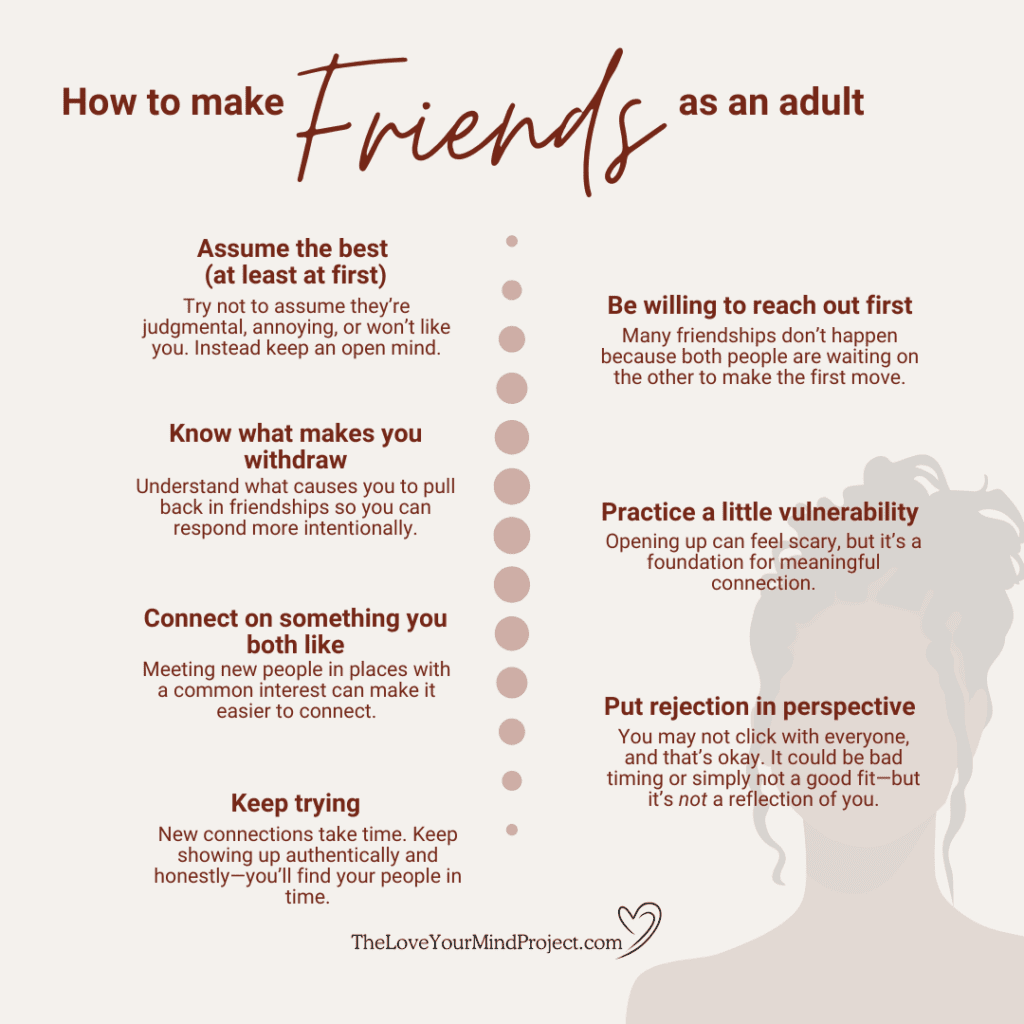
Assume the best (at least at first)
It’s hard to make new friends when you expect the worst from people.
And there’s no shame in that. If you’ve been hurt before, it might feel safer to assume someone will be judgmental, annoying, or fake—so you’re not hurt again.
But expecting the worst in others can also keep you from forming healthy bonds.
Instead, try approaching someone with an open mind. When you assume good intentions, at least until they give reason to suggest otherwise, you might be surprised at the genuine connections you form.
Be willing to reach out first
Many adult friendships never happen because both people are waiting for the other to make the first move.
Being the first to reach out can feel scary. The fear of someone not responding to a text or turning down an invitation is real—and it can stop the connection before it starts.
But taking initiative is how friendships begin.
When you’re the first to say “hi” or suggest coffee, you’re not doing too much. You’re not being needy. You’re showing courage and giving the friendship a chance.
Know what makes you withdraw
What causes you to pull back in a new friendship?
Maybe it’s the first time you disagree on a topic, or when they say something that annoys you.
Or perhaps it has nothing to do with your friend at all—but seasons of overwhelm, stress, or fatigue might cause you to withdraw.
If you know what makes you put up your guard, you can respond more intentionally—and decide whether the discomfort is a true red flag or the natural awkwardness of building something new.
Practice a little vulnerability
Real connection requires some level of vulnerability.
That doesn’t mean trauma dumping or sharing your life story the first time you meet. But you will need to put yourself out there a bit to show the real you.
This could be as simple as walking up to introduce yourself, sharing that you’re having a rough day, or admitting that making friends feels awkward.
And you’re not alone if vulnerability feels hard.
Past rejection, trauma, or disappointment can make it difficult to open up again. But instead of shutting down, you can learn to process the pain and make space for supportive relationships in the future.
Connect on something you both like
It can feel easier to make a new friend when you meet over a shared interest.
This is why group fitness classes, church events, or parent groups can be great places to meet friends. Having something you both like right in front of you can make that first conversation seem less awkward and more organic.
So think of those places or hobbies that can help you meet new people—whether it’s the library, a coffee shop, or a community event. Making a friend there could feel more natural than you think.
Put rejection in perspective
You may not click with every person you meet. And that can sting—especially if rejection feels personal.
But when an introduction doesn’t turn into a friendship, it doesn’t mean something’s wrong with you or that you’re to blame.
Sometimes, it’s about personality fit, timing, their emotional capacity, or reasons you’ll never know.
But it’s not a reflection of who you are.
Disappointment is part of the process. It doesn’t change your self-worth—or make you too much, not enough, or hard to connect with.
So if it doesn’t work out, that’s okay.
Keep trying
Building adult friendships can take time2—more than one conversation, more than one invite, and more than one almost-friendship that never fully develops.
But that doesn’t mean friendship will never happen.
Keep showing up and being true to who you are. Continue allowing space for new connections. And remind yourself that there’s no timeline.
The right fit will come in time—because you’re worthy of meaningful, supportive friendships.
Making friends as an adult FAQs
Do adults really need friends?
Yes, we do. We need meaningful connection from childhood through adulthood.1 Healthy friendships can give a sense of safety and belonging—and support our overall mental and physical wellness. While they can feel harder to make or maintain as adults, they’re still important.
What’s the best way to make friends as an adult?
There’s no one best way, but it can help to connect with people in spaces where there are shared interests. Think: the gym, a favorite cafe, or community group you attend regularly. This can make it easier to introduce yourself and start a conversation.
What if you don’t want friends as an adult?
It’s a feeling worth exploring (with honesty, not judgment). You may genuinely be content with a small social circle—and that’s okay. But if you don’t have meaningful relationships and don’t want any, it could be a sign of burnout, emotional fatigue, or unresolved hurt.
References
Last accessed April 2026
- Dunbar, R. I. M. (2025). Why friendship and loneliness affect our health. Annals of the New York Academy of Sciences, 1545(1), 52. https://doi.org/10.1111/nyas.15309 ↩︎
- Hall, J. A. (2018). How many hours does it take to make a friend? Journal of Social and Personal Relationships, 36(4), 1278–1296. https://doi.org/10.1177/0265407518761225 ↩︎

- How to be vulnerable in a relationship when opening up feels scary - September 17, 2026
- When only needing “me, myself, and I” leaves little room for love - September 11, 2026
- Everyone eventually leaves me: How fear of abandonment gets in the way of love - September 4, 2026