
When you take the courageous step to seek mental health support, what you need most is care that can understand and respect all parts of you.
That’s culturally-affirming care.
But that’s not always our experience.
It’s not uncommon for a Black woman in therapy to feel exhausted from having to explain and justify her experiences.
Maybe it’s a family dynamic that’s challenging yet common, a spiritual belief that’s conflicting, or social and political tensions leave you feeling unwelcome or unsafe.
When you feel unseen, unheard, or dismissed in a space as vulnerable as mental health care, it can make it difficult to heal.
This article explains culturally-affirming care so you can see what it looks like and why it’s non-negotiable on your wellness journey.
What culturally-affirming care really means in mental health
It’s more than finding a mental health provider who looks like you.
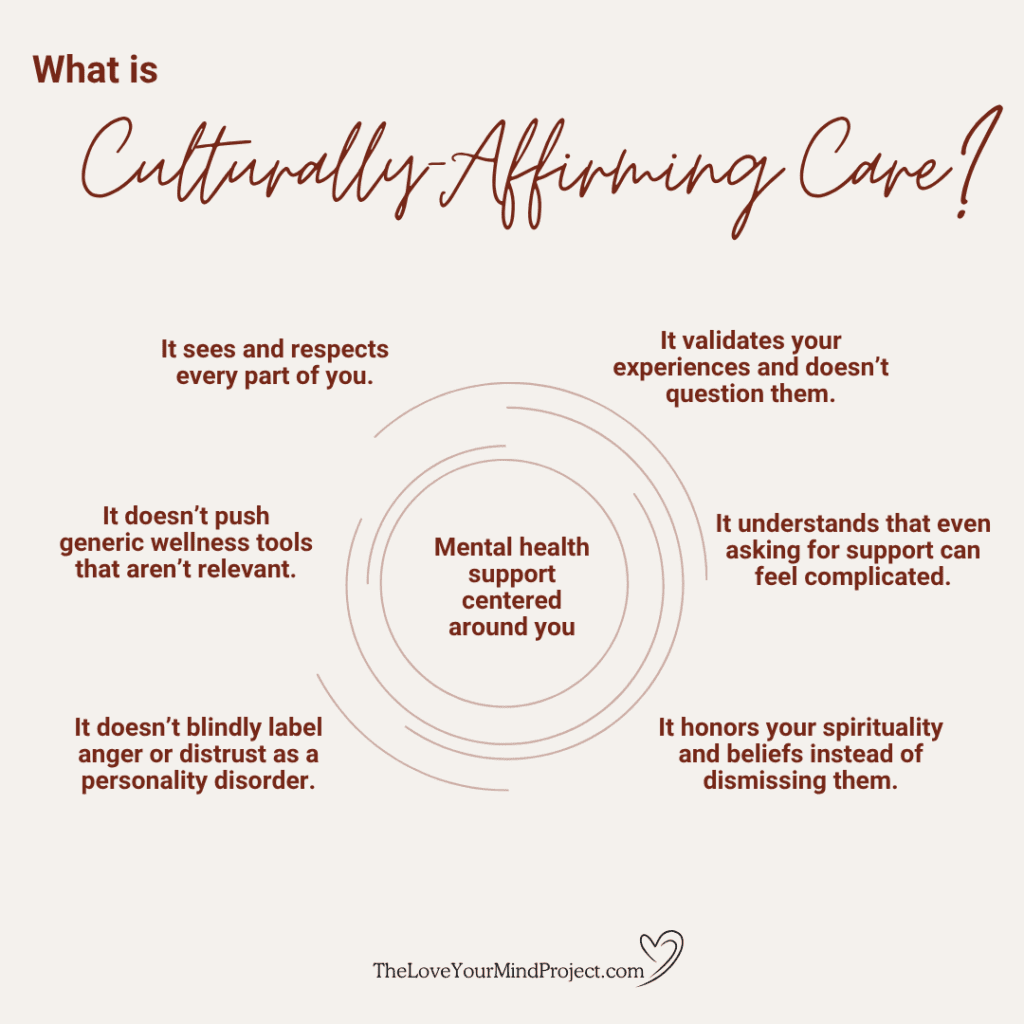
Culturally-affirming care is support that acknowledges how your race, gender, family patterns, faith, economic opportunities, and other cultural and societal dynamics can affect your emotional well-being.
“It’s built on four principles that lay the foundation for psychological safety,” says Jennifer Miller, LCSW-S and founder of The Place Psychological Services. “First, intention and respect mean the provider treats cultural background as important as a client’s medical and mental health history.”
That’s care that doesn’t view your identity as a footnote, but as an integral part of your healing.
But culturally-affirming care also recognizes that you are the expert on your experiences—not the provider.
“The final two principles, humility and regard, allow the client to take the lead—with the provider having an openness to learn from them while knowing that it’s not their job to teach us,” Miller says.
When you have access to this kind of care, you can feel safe sharing and working through whatever challenges stand in the way of your wellness.
What culturally-affirming care can look like in practice
Care that truly gets you can show up in many ways.
It could be a provider who respects and uses your desired pronouns. Or a therapeutic approach that honors your spirituality, instead of dismissing it as a coping mechanism.
In practice, culturally-affirming care may look like a therapist who:
- Recognizes the pressure to be strong, appear unbothered, or handle everything on your own—and how it can contribute to emotional exhaustion.1
- Acknowledges family dynamics, like “don’t air our dirty laundry,” and how they can make therapy feel like family betrayal.
- Easily sees the impact of workplace microaggressions without requiring a 10-minute history lesson.
- Validates your anger or grief as a natural response to systemic biases, rather than labeling you as an “angry Black woman.”
On a deeper level, you’ll recognize culturally-affirming care when you no longer feel like an outsider.
“It can look like making room for a client to feel safe—not minimizing their experiences or challenging their reactions,” says Anim Aweh, LCSW and co-founder of Aweh Support Services. “As Black women, we don’t get many spaces where we’re not questioned on the legitimacy of our feelings or asked if we might be overreacting.”
In these spaces, you don’t feel like you’re on trial, having to defend yourself. Instead, mental health care is what it was always meant to be—a place to drop your armor and simply be heard.
Why culturally-affirming care is essential for our mental health
Feeling understood in mental health care isn’t just comforting—it can affect the quality of the support you receive. Here’s how.
Fewer misdiagnoses and overlooked symptoms
The mental health system—including how providers are trained to diagnose and treat conditions—is historically based on a European population.2 As a result, our experiences, traumas, and survival responses aren’t always understood.
For instance, a therapist who is culturally unaware might misread hypervigilance, being emotionally guarded, or being overly self-reliant as a hostile or uncooperative personality. When in reality, those behaviors are often protective strategies that help us navigate personal trauma, systemic racism, or workplace bias.
Providers without a cultural lens can also miss our mental health symptoms altogether. Miller describes how depression, for example, doesn’t always look like textbook sadness in Black women.
“Instead, it can manifest as a short fuse from being overextended and unsupported, unexplained pain or discomfort, or showing up for everyone else while drowning internally,” Miller explains.
Culturally-affirming care ensures your experiences, symptoms, and challenges are understood, so you can receive support that actually helps you heal.
Care that actually feels relevant to your life
Traditional mental health advice often relies on general wellness tools that don’t always reflect our lived reality.3 Affirming care incorporates homework, strategies, and tools that do.
Culturally-relevant care could look like:
Realistic tools for common stressors: Gratitude journals, meditations, and more “me time” may not be the most effective treatment for caregiver burnout, discrimination, or childhood trauma. Therapy that understands your experiences can help you set boundaries, prioritize rest, and find other realistic ways to heal and calm your nervous system.
Addressing barriers to choosing yourself: Therapy itself can trigger guilt when you’ve been conditioned to be the anchor for everyone else. Affirming care creates space where you feel comfortable discussing and processing that guilt, giving yourself the freedom to see and nurture your own emotional needs.
Working with your faith—not against it. Spirituality and mental health care are not at odds. Culturally-affirming care can incorporate your prayer life and religious beliefs while still helping you learn to acknowledge and address your emotional pain.
Fewer barriers to the care you need
Culturally-affirming support addresses two significant barriers to mental health care for many Black women—distrust and stigma.4
It’s easier to trust support that’s not afraid to put who you are at the center. You don’t have to filter what you say or fear being mislabeled, misdiagnosed, or mistreated.
And instead of bracing yourself before an appointment, you can treat that first session as an act of true self-love.
That’s exactly what mental health support can be, self-love—not a sign of weakness or a lack of faith.
Affirming care helps strip away this shame. It honors true resilience, which is not the same as appearing “okay” all the time.
It turns therapy from a “last resort for the broken” into a natural, much-needed tool for thriving.
Improved wellness and quality of life
Ultimately, culturally-affirming care is about reclaiming your right to a full life.
For too many of us, survival mode is the norm. Chronic stress, fatigue, worry, heaviness, and self-doubt quietly wear us down while we continue showing up and overperforming for others.
But with access to care that truly supports you, your quality of life can shift:
- You can learn to stop ignoring emotional pain.
- You can know what it’s like to listen to your body and allow yourself the rest that you need.
- You can make room for joy, not just survival.
How to find culturally-affirming mental health support
Finding a mental health professional who gets you is not a nice-to-have—it’s a priority. Here are a few steps to help you get started.
- Search directories that highlight Black, diverse, or culturally-responsive providers.
- Look for shared identities, experiences, or specializations in therapist bios.
- Use the first session to get to know the provider and their experience working with clients with similar lived experiences.
- Pay attention to how you feel interacting with them. If you feel judged, rushed, or like you have to over-explain, it’s okay to keep looking.
You’re worthy of a space where you can show up as your whole self, exhale completely, and be met with the deep respect, understanding, and care you have always deserved.
Culturally-affirming care for mental health FAQs
What is culturally-affirming care in mental health?
Culturally-affirming care is mental health support that respects and considers your identity, background, values, and lived experiences. It’s more than having a Black therapist—it’s support where you don’t have to constantly explain the familial, cultural, or societal pressures that may affect your well-being.
Why is cultural competency important for mental health care?
Cultural awareness helps a mental health provider truly understand what you’re going through. This allows them to accurately assess your needs and find the best approach or strategies to improve your wellness. Without it, it’s easy for providers to misread, mislabel, or miss certain struggles of Black women altogether.
What is an example of culturally-appropriate care?
An example could be a provider who incorporates your faith into your healing plan, instead of dismissing it. Or one who understands that a Black woman who shows anger isn’t always dealing with a personality disorder. Even something as simple as listening to your experiences without making assumptions is a sign of culturally-appropriate care.
References
Last accessed May 2026
- Woods-Giscombé, C. L. (2010). Superwoman Schema: African American Women’s Views on Stress, Strength, and Health. Qualitative Health Research, 20(5), 668–683. https://doi.org/10.1177/1049732310361892 ↩︎
- American Psychological Association. (2021, October). APA resolution on dismantling systemic racism against people of color in the United States. https://www.apa.org/about/policy/resolution-dismantling-racism.pdf ↩︎
- Alegria, M., Atkins, M., Farmer, E., Slaton, E., & Stelk, W. (2010). One Size Does Not Fit All: Taking Diversity, Culture and Context Seriously. Administration and Policy in Mental Health and Mental Health Services Research, 37(1–2), 48–60. https://doi.org/10.1007/s10488-010-0283-2 ↩︎
- Jimenez, D. E., Park, M., Rosen, D., Joo, J., Garza, D. M., Weinstein, E. R., Conner, K., Silva, C., & Okereke, O. (2022). Centering Culture in Mental Health: Differences in Diagnosis, Treatment, and Access to Care Among Older People of Color. The American Journal of Geriatric Psychiatry, 30(11), 1234–1251. https://doi.org/10.1016/j.jagp.2022.07.001 ↩︎

- How to be vulnerable in a relationship when opening up feels scary - September 17, 2026
- When only needing “me, myself, and I” leaves little room for love - September 11, 2026
- Everyone eventually leaves me: How fear of abandonment gets in the way of love - September 4, 2026