
It may be easier to crack a joke, change the subject, or simply deflect when the conversation gets personal.
Or maybe your relationships are always on the clock. As soon as it starts to feel serious, you look for the nearest exit.
Allowing a partner to really see you—the sensitive, insecure, and imperfect parts—can feel terrifying. But staying guarded can make intimacy and connection more difficult.
Deeper connections require vulnerability. But you can make room for vulnerability without leaving yourself feeling completely exposed. This article explains how.
Why it’s so hard to be vulnerable in a relationship
Vulnerability can be hard to stomach because it brings a real risk of feeling criticized, judged, dismissed, or outright rejected.1
If your partner could see the real you—those parts you usually keep hidden—would they accept it?
That uncertainty can be enough to make you feel like being vulnerable isn’t worth it.
And if opening up hurt you in past relationships, even coming close to that possibility of pain again can trigger a protective response from your mind and body. You might put up walls even when you don’t want to.1
So maybe you don’t admit to your partner how much you care. Or you refuse to tell them what you need (especially emotionally) or how that comment really bothered you.
Hiding simply feels safer than the possibility of being fully seen, but rejected.
Why vulnerability matters in a relationship
You can’t have intimacy without vulnerability.
Emotional intimacy is that closeness that comes from knowing each other beneath the surface.2 And not just the cute, put-together, and agreeable parts.
On the other hand, staying guarded and keeping up appearances can leave you feeling invisible and questioning whether your partner would still love you if they truly knew you.
But imagine you and your partner knowing it all—the good, the bad, and the ugly—and you both still choose each other.
Being vulnerable gives your partner the chance to see, love, and accept you for who you really are.
How to be vulnerable in a relationship (when it feel scary)
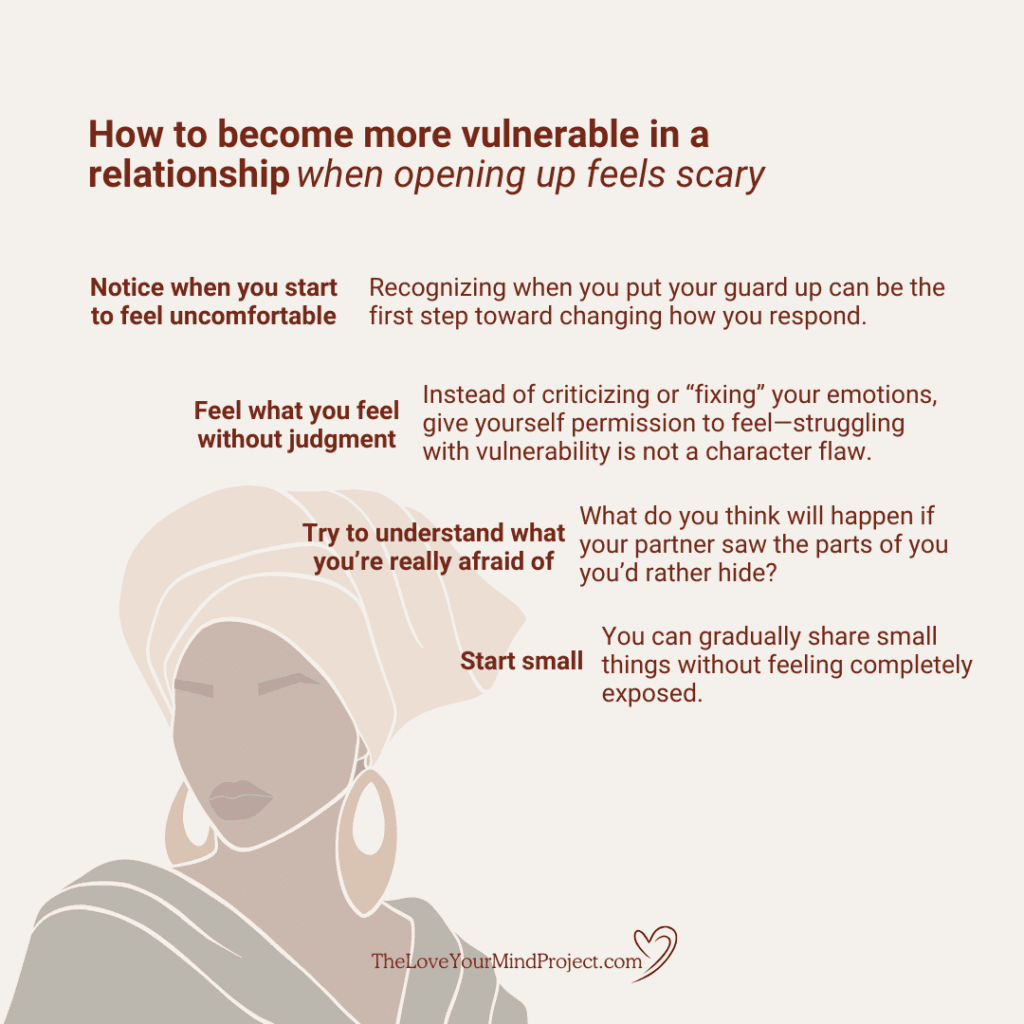
Vulnerability is a skill you can practice—gradually and on your own terms. Here are a few strategies to try.
Notice when you start to feel uncomfortable
It’s hard to intentionally be more vulnerable when you don’t realize you’re putting your guard up.
Try to notice when you feel yourself withdrawing from a conversation, making light of something that actually hurts, or becoming defensive at a question your partner asks.
You can also pay attention to your body. Your muscles may tighten, or your heart may beat faster when you start to feel uncomfortable.3
Simply becoming aware of when you put up walls can be the first step toward shifting how you respond to vulnerable moments in the future.
Feel what you feel without judgment
Your first reaction to discomfort when you feel vulnerable may be to “fix” or get rid of what you’re feeling.
Why can’t I just share how I feel?
Why am I making this such a big deal?
This shouldn’t be this hard.
But being afraid to open up isn’t a character flaw. You’re not bad at love or even bad at being vulnerable. Experiences may have simply taught you that opening up doesn’t end well.
The goal isn’t to force yourself to be okay with vulnerability, or to “get comfortable with the uncomfortable.”
Instead, validate what you feel—because you feel that way for a reason. And as you create an emotionally safe space for yourself, you can recognize where that safety already exists with your partner—or work together to build more of it.
Understand what you’re really afraid of
When you’re not quick to judge, dismiss, or fix the discomfort that comes with vulnerability, you make room to understand what’s beneath the surface.
If your partner knew how you truly felt or saw the flaws you work so hard to hide, what do you think would happen?
Maybe you don’t want to appear needy or be seen as weak, too much, or not enough. Or perhaps you don’t want to be the one who bares your heart only to learn your partner doesn’t feel the same way.
Maybe beneath all of these concerns is a fear that after getting to know the real you, they won’t choose you.
Whatever the reason, understanding what you’re afraid of can give insight into what you may need to feel safer opening up.
Start with small acts of vulnerability
When you’re ready to practice vulnerability, start small.
Starting small doesn’t mean vulnerability won’t feel difficult, or that you should be able to get over the discomfort quickly. It could mean sharing something with a low emotional risk.
Maybe you choose to tell your partner you actually had a bad day at work, or that you don’t really like going to that restaurant they like. Or maybe it’s simply telling them you were thinking about them and they mean a lot to you.
Sharing may bring up anxiety, guilt, or fear. Simply notice whatever emotions arise without judgment, and stay curious about what’s behind them.
And with each small step, you’re showing yourself you can experience the discomfort that comes with vulnerability—but also the deeper connection it can make possible.
How to be vulnerable in a relationship: FAQs
Why do I struggle with vulnerability?
Vulnerability can be difficult because it opens you up to the possibility of disappointment, rejection, or hurt. And if opening up has hurt you in the past, it’s understandable to want to protect yourself from experiencing that pain again.
Does being vulnerable mean I have to let my guard down?
Vulnerability can ask you to let your guard down, at least a little. But you decide how much you share and to whom. If you struggle with vulnerability or aren’t sure if your partner has earned it, it’s okay to start small. Becoming vulnerable can happen gradually, with small moments of letting yourself be seen—without feeling completely exposed.
How do I know if someone is safe to be vulnerable with?
Notice how they handle what you already share. Do they listen without judging or dismissing you? Do they respect your boundaries? Can you disagree or express a need without being mocked, punished, or shamed? Your partner doesn’t always have to respond perfectly. But you should be able to show those vulnerable parts without being routinely criticized, belittled—or having what you share used against you.
References
Last accessed September 2026
- Delboy, S. (2025, September 4). Letting each other in: Vulnerability and relationships. Psychology Today. https://www.psychologytoday.com/us/blog/relationships-healing-relationships/202507/letting-each-other-in-vulnerability-and ↩︎
- Goldsmith, B. (2010, April 2). Intimacy and vulnerability: Can you have one without the other? Psychology Today. https://www.psychologytoday.com/us/blog/emotional-fitness/201004/intimacy-and-vulnerability-can-you-have-one-without-the-other ↩︎
- Kindman & Co. (n.d.). On how vulnerability is terrifying—here’s why you should try it anyway. Kindman & Co. https://www.kindman.co/blog/why-vulnerability-feels-scary ↩︎

- How to be vulnerable in a relationship when opening up feels scary - September 17, 2026
- When only needing “me, myself, and I” leaves little room for love - September 11, 2026
- Everyone eventually leaves me: How fear of abandonment gets in the way of love - September 4, 2026