
Maybe it’s a text that seems shorter than usual or your partner wanting some time with their friends. Or perhaps you can’t put your finger on it, but there’s this feeling that the relationship is not okay.
When you expect your partner to eventually leave you, every bump in the relationship can feel like a sign that they are.
But this emotional pattern of bracing for love to disappear can make it difficult to feel secure in the love that’s there.
This article dives into how fear of abandonment can get in the way of a healthy relationship—so you can notice what may be keeping you from the closeness, trust, and security you deserve.
What is fear of abandonment?
Fear of abandonment is a persistent anxiety that someone you love will eventually leave—physically or emotionally.
Sometimes, it can be connected to experiences much older than your current relationship. Losing someone you loved, experiencing neglect or inconsistent care as a child, or being hurt in past relationships can all shape what you expect from current and future ones.1
“It can throw you into a tailspin,” says Dr. Brianna Gaynor, PsyD, clinical psychologist and founder of Peace of Mind Psychological Services in Atlanta. “You can fear abandonment or worry so much that you can’t stop focusing on it—and that fear can even affect how you treat your partner.”
This fear can be nagging even when your relationship otherwise seems loving and secure.2 That means your partner may do “all the right things” or show no signs that they’re going anywhere, but part of you may still be preparing for the possibility that they will.
Signs you’re dealing with fear of abandonment
Fear of abandonment can show up in how you feel and respond to everyday moments in your relationship.
“A person who fears abandonment can often see red flags that may not really be there,” says Dr. Gaynor. “If their partner doesn’t call as often one day or doesn’t seem as attentive, they may think they’re pulling away—when it could be for different reasons.”
Emotionally, you might feel an ongoing anxiety about your relationship. Is my partner happy? Am I doing enough? Are things changing between us?
You may also feel highly sensitive toward every disagreement, criticism, or random opinion, thinking it means the end of your relationship.
Behaviorally, maybe you read into every text, facial expression, or change in tone—adding a sense of impending doom to it all. Or you need constant reassurance that everything is good between you.1
“Your partner can tell you they love you and want to be with you, but doubt and fear can creep in,” says Sejginha Williams-Abaku, LMFT, practice director at Personal Life Wellness Marriage and Family Therapy. “Even with a healthy partner, your nervous system can struggle to recognize that you are safe and can trust that feeling of safety.”
Fear of abandonment isn’t about a moment or even a season of worrying about your relationship. It’s often a persistent emotional pattern that makes it difficult to believe any meaningful relationship will last.
How fear of abandonment can get in the way of love
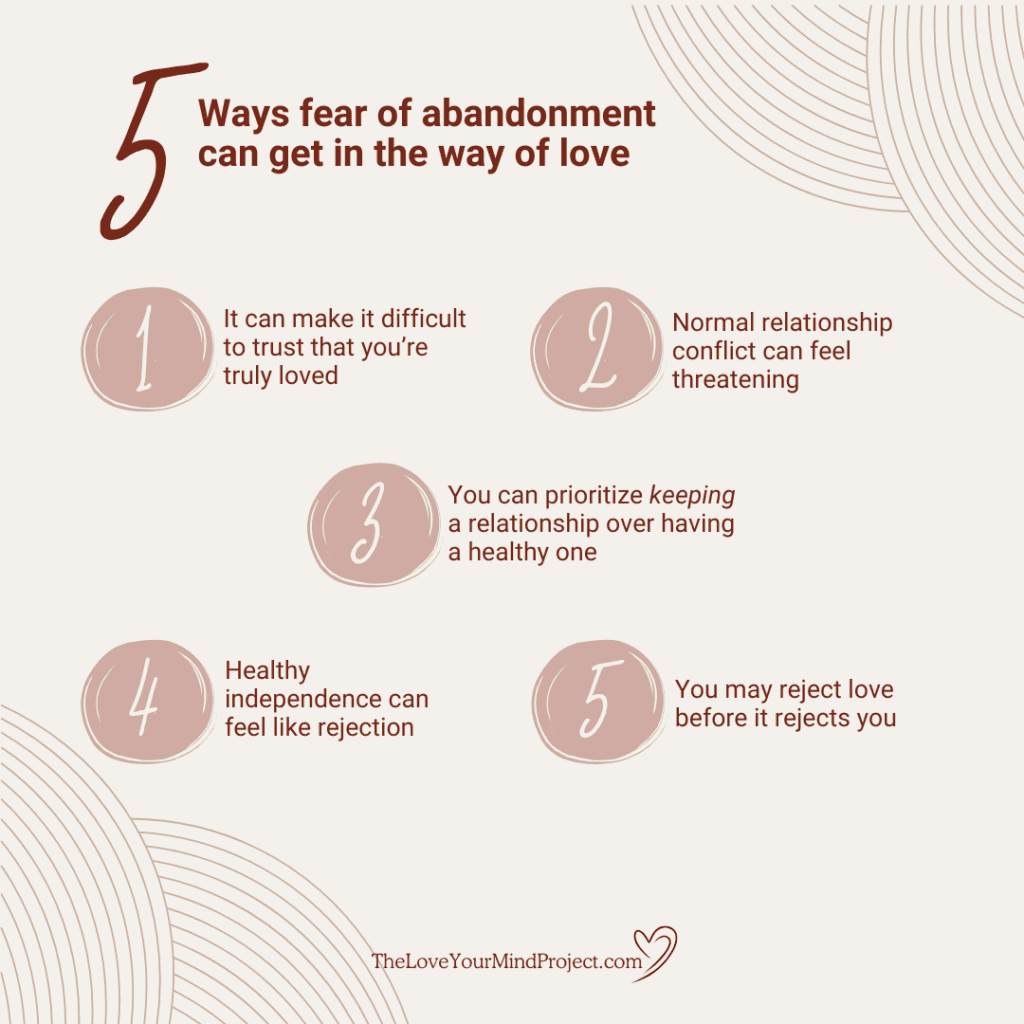
When you’re assuming everyone will eventually leave you, it doesn’t just affect your emotions or behaviors in the relationship. It can actually make it harder to receive the closeness and security you crave.

It can make it difficult to trust that you’re truly loved
Your partner can be affectionate and consistently show up for you. But when part of you expects they’ll eventually leave, it can still be difficult to trust that their love is real or will last.3
Instead of feeling reassured, it may feel safer to question their love. Are they just saying that? Do they really mean it? Will they feel the same way in the future?
Maybe you believe you’re protecting yourself from heartache—and that’s understandable. But in reality, it can stop you from truly receiving the love your partner’s showing you.
You can’t guarantee that no one will ever leave you. But you can receive the love you’re shown and trust that, even if you experience hurt or disappointment, you can heal.
Healthy independence can feel like rejection
Healthy relationships need some level of independence, no matter how close you are as a couple. That independence leaves room for personal growth and helps ensure one isn’t over-reliant on the other, especially for needs like validation, value, and worth.4
But when you fear your partner will leave, this healthy independence can feel dangerous, driving you to cling to them (physically or emotionally) so you don’t lose them.
This constant need to feel validated, chosen, or prioritized can be like a leaking bucket you can never fill. And it can take a toll on how you see yourself and the value you actually bring to the relationship.5
You can’t control whether someone stays or leaves, but you can have confidence in who you are and your unique value in the relationship.
Whether they choose you or not, you’re worthy of being chosen.
Normal relationship conflict can feel threatening
When you’re dealing with fear of abandonment, every disagreement can feel like a threat to your relationship.5
Maybe small arguments, like what to watch on TV, completely set you off, triggering an intense emotional response.
Or perhaps you try to avoid conflict altogether, suppressing how you really feel, hiding what bothers you, or agreeing just so you don’t rock the boat.
But healthy conflict is normal in relationships. You don’t have to treat it as a threat or evidence that your partner is pulling away. It can create room for honesty and lead to deeper connection when you’re able to work through your differences.6
You can prioritize keeping a relationship over having a healthy one
Doing all that you can to keep a relationship going is understandable. No one wants to lose a good thing. But when you’re driven by a fear of them leaving you, you can lose sight of yourself and what you need from the relationship.7
“For Black women specifically, abandonment fears can often show up as overfunctioning in relationships,” says Williams-Abaku. “We’ve been undervalued and overlooked in this culture for a long time and can overcompensate, giving more than we are given.”
If you’re constantly serving their needs while ignoring your own or adapting core parts of who you are to appease them, it could be a sign that keeping the relationship has become more important than having a healthy one.8
This can leave you clinging to something that doesn’t serve you, meet your needs, or treat you the way you deserve—all to avoid abandonment.9
Fear may tell you, “What matters most is that they stay.” But love is mutually beneficial. And it’ll be difficult to receive if you don’t allow yourself to be an equal partner.
You can reject love before it rejects you
The thought of someone leaving you can seem so painful that you’d rather end the relationship first—or avoid one altogether.3
“It’s an example of self-sabotage,” says Williams-Abaku. “You may find something to be upset about because creating distance on your own terms feels safer than sitting with something that is out of your control or that you may never see coming.”
And if you do break up, it may not feel like, “It just didn’t work out.” It can connect to deeper fears of rejection and unworthiness.10
So it makes sense that you’d want to avoid heartache at all costs. But this pattern of avoidance can have you walking away from relationships you actually want—or keeping yourself from ever experiencing the love you deserve.
The end of a relationship doesn’t have to be a catastrophe you must prevent. It can be a painful experience you recover from.
Heartbreak can hurt deeply. But it doesn’t mean it wasn’t worth it. It doesn’t mean you’re unworthy of love. And it doesn’t mean you’ll never love again.
You can love, lose it, grieve, heal, and still be open to love in the future.
You can change what it means when someone leaves
The underlying beliefs associated with fear of abandonment can shift, no matter how long you’ve held them.
Working with a therapist can give you space to understand where those thoughts, fears, and beliefs come from, process the emotions behind them, and begin healing from any unresolved pain.
The goal isn’t to convince yourself that no one will ever leave—it’s to change what their leaving means to you. If a relationship ends, it doesn’t define your worth, erase the love you experienced, or mean that every other relationship will end the same way.
It doesn’t have to limit the love you experience in the future.
Fear of abandonment FAQs
What causes fear of abandonment in relationships?
Fear of abandonment can stem from loss, childhood neglect or emotionally unavailable caregivers, or past relationship hurt. These experiences can shape what you expect from the people you love, leaving you worried that current or future partners won’t stick around.
How do I know if I have a fear of abandonment?
You may be dealing with fear of abandonment if the idea of a partner leaving causes you to cling to, push away, or completely avoid relationships. You might need constant reassurance, see every disagreement as a sign the relationship is ending, feel threatened by time apart, or question your partner’s love and affection.
How can I stop being afraid that everyone will leave me?
When a partner leaves you, it can hurt. And it’s understandable to want to avoid that. But what sometimes drives fear of abandonment is what you believe that breakup says about you, your worth, and your future relationships. It can be helpful to understand the underlying thoughts and beliefs behind your fears. And this is where therapy can be especially helpful.
References
Last accessed September 2026
- Fritscher, L. (2026, March 30). Understanding fear of abandonment. Verywell Mind. https://www.verywellmind.com/fear-of-abandonment-2671741 ↩︎
- Tyler, D. (2025, February 18). The abandonment schema: Why fear of loss shapes relationships. Qualia Psychology. https://qualiapsychology.com.au/abandonment-schema-relationships/ ↩︎
- Moore, S. (n.d.). How does a fear of abandonment affect your relationship? Sarah Moore, LPC. https://www.sarahmoorelpc.com/blog-roll/how-does-a-fear-of-abandonment-affect-your-relationship ↩︎
- Marriage & Family Services. (n.d.). Fostering independence in relationships: Balancing togetherness and individuality. https://www.marriagefamilyservices.com/fostering-independence-in-relationships/ ↩︎
- Silver Lake Psychology. (n.d.). 13 signs that you might be struggling from abandonment issues. https://www.silverlakepsychology.com/blog/13-signs-that-you-might-be-struggling-from-abandonment-issues/ ↩︎
- OU Health Sciences Student Wellness. (2024, May 1). Embracing conflict: How it can strengthen your relationship. https://students.ouhsc.edu/news/articles/embracing-conflict-how-it-can-strengthen-your-relationship ↩︎
- Moore, M. (2024, March 27). The psychology behind people pleasing. Psych Central. https://psychcentral.com/health/the-need-to-please-the-psychology-of-people-pleasing ↩︎
- Magee, H. (2026, July 13). Do you people-please in your relationship? The Gottman Institute. https://www.gottman.com/blog/do-you-people-please-in-your-relationship/ ↩︎
- DeBonis, K. (2021, July 14). Fear of abandonment: What people-pleasers should know. https://karendebonis.com/fear-of-abandonment/ ↩︎
- The New Hope Mental Health Counseling Services. (n.d.). How breakups can trigger attachment wounds. https://www.thenewhopemhcs.com/how-breakups-can-trigger-attachment-wounds/ ↩︎

- Is the Calm app worth it? How it can help you prioritize rest - October 15, 2026
- Is Headspace worth it considering our unique needs? - October 8, 2026
- The Exhale app: Wellness support that actually centers Black women - October 2, 2026