It’s hard to believe any compliment from your partner.
“I love you” feels like something they have to say.
You may wonder what your partner sees in you. Or fear it’s just a matter of time before their feelings change.
And when the two of you hit a bump in the road, it feels like evidence that you’ve screwed up—that something is inherently wrong with you.
Feeling unlovable can complicate love, but those feelings are not facts.
If you feel unlovable, even when you’re in a relationship, this article explores what could be behind it and how you can begin receiving the love that’s there more freely.
Feeling unlovable can have deep roots
That persistent feeling that you’re unlovable doesn’t just appear out of thin air. It can come from past relationships—disappointment, betrayal, or rejection that left you thinking you were the problem.1
It could also stem from childhood experiences—especially if love was conditional, unreliable, or completely absent.
Experiencing this type of pain repeatedly can chip away at your self-worth, making it easier to believe that you’re somehow unworthy of love.2
But feeling unworthy of love doesn’t mean that you are. Feelings are real and valid, but they’re not necessarily true.
Believing you’re unlovable can actually make love harder
While feeling unlovable doesn’t make it true, it can still affect your relationship—more importantly, how you experience it.
For example, you might quickly dismiss your partner’s expressions of love or explain them away as habit or pity.3 And otherwise neutral behaviors, like your partner being quieter or seeming more distracted than usual, can feel like abandonment.
Mentally, you may struggle with a harsh inner critic, constantly dealing with self-doubt or blaming yourself for seemingly everything that feels wrong in the relationship.
You might also have a hard time setting healthy boundaries, communicating your needs, or expecting more from the relationship.4
Simply put, feeling unlovable can make it harder to receive the love you deserve—and easier to accept treatment you don’t.
How to allow yourself to receive love when you feel unlovable
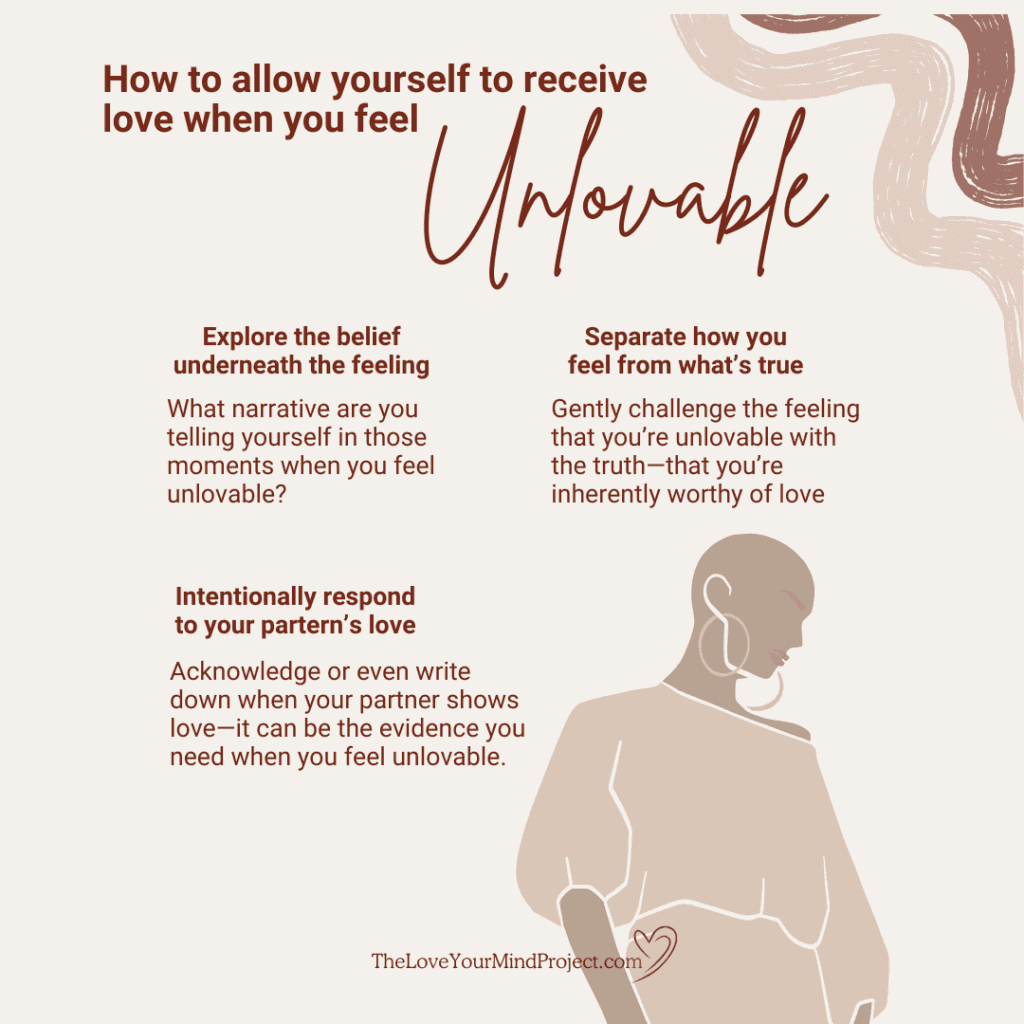
When you feel unlovable, there are ways to slowly begin changing what you believe about yourself and the love you deserve.
Explore the belief underneath the feeling
In those moments when feeling unlovable hits hardest, it’s easy to spiral into harsh criticism, self-doubt, and self-rejection—all of which can fuel the idea that you’re incapable of being loved.
Instead, try to notice when that feeling is most intense and the narrative you draw from it.
Is the belief that you always screw up relationships? That you don’t deserve a good one? Or is it that your partner will come to their senses because others who were supposed to stay and care for you always seemed to disappoint you?
The idea is to pause, notice, and understand the narrative before letting it take hold.
Separate how you feel from what’s true
What actually went down in those situations where you felt unlovable? Ground yourself in what you know—the facts, not the meaning you may attach to them.
For example, you disagreed with each other, and your partner got upset. Those are facts. Believing their frustration means you’re a burden to the relationship or undeserving of love—those are not facts.
When you feel the unlovable narrative creeping in, you can gently challenge it with what’s true: You are inherently worthy of love.
The more you practice this, the more opportunities you’ll have to shift that belief.
Intentionally respond to your partner’s love
When you believe the unlovable narrative, you can easily dismiss the love that’s there—or miss it altogether.
Instead, if your partner shows up for you, supports you, and openly expresses their love and affection, try to lean into those moments.
It could be as simple as a mental acknowledgment. They said “I love you,” and I can let myself receive that.
Or you can keep a brief journal. Documenting when your partner shows you love can be the evidence you need in those moments when you feel unlovable.
It’s not a belief you have to unpack alone
Understanding and truly believing that you’re worthy of love can take time. But you don’t have to unpack it alone.
You can work with a therapist who’ll help you safely explore what’s behind the belief that you’re unlovable, separate past pain from your self-worth, and heal old wounds.
With therapy and time, you can shift away from the harmful narratives that have shaped how you see yourself and experience your relationship.
Because you can receive love more freely when you know you’re worthy of it.
Feeling unlovable in relationships: FAQs
Why do I feel unlovable?
Feeling unlovable can stem from past experiences with rejection, betrayal, disappointment, or abandonment that affected how you see yourself and your worth. Those experiences can contribute to an underlying belief that you’re fundamentally broken and undeserving of love, even though you’re not.
Can you feel unlovable even when you’re in a healthy relationship?
Yes. You can be with a loving and supportive partner and still feel unlovable. You might find it hard to believe their compliments or affection, or worry that at some point they’ll come to their senses and see you for what you really are. A healthy relationship doesn’t erase the beliefs you held before it began.
Will I always feel unlovable?
You don’t have to. You can gradually learn that feeling unlovable doesn’t mean that you are. By better understanding what’s behind that feeling, gently challenging unhealthy narratives, separating past experiences from your self-worth, and allowing yourself to recognize the love that’s present in your life, you can start to shift unhealthy beliefs. Therapy can be especially helpful in doing this work.
References
Last accessed September 2026
- O’Sullivan, F. (2026, September 12). How to deal with feeling unloved in your relationship. Empathi. https://empathi.com/blog/how-to-deal-with-feeling-unloved/ ↩︎
- Webb, J. (2024, November 22). Am I unlovable? Here’s why you feel unworthy of love. NOCD. https://www.treatmyocd.com/blog/unworthy-of-love ↩︎
- Golden, B. (2024, June 28). How low self-esteem can impact an intimate relationship. Psychology Today. https://www.psychologytoday.com/us/blog/overcoming-destructive-anger/202406/how-low-self-esteem-can-impact-an-intimate-relationship ↩︎
- Raypole, C. (2022, February 14). Am I unlovable? Verywell Mind. https://www.verywellmind.com/why-you-might-feel-unlovable-and-how-to-cope-5215404 ↩︎

- Feeling unlovable even in a relationship? Here’s what to do with that feeling - September 24, 2026
- How to be vulnerable in a relationship when opening up feels scary - September 17, 2026
- When only needing “me, myself, and I” leaves little room for love - September 11, 2026