
Some seasons in life are harder than others.
Recent life events can leave you feeling more anxious than usual, emotionally exhausted, overwhelmed, or hopeless.
Or maybe you’re navigating feelings you’ve held onto for a long time—low self-esteem, sadness, or an overall heaviness that doesn’t let up.
Whatever you’re carrying, none of it makes you weak or dramatic.
Some people think mental health support is only for crises or people who can’t handle life. But it’s not. It can be for healing, clarity, growth, and learning to love and care for your whole self.
If you’ve been wondering when to seek mental health support, this article shares some of the best times to reach out—and what that support can look like.
Mental health support isn’t just for “problems”
Yes, mental health support can help with severe issues, but that’s not all it’s good for. Just as your body benefits from regular care and check-ins, so does your mind.
Outside of fixing a problem, mental health support can help you:
- Better understand who you are and what you value so you can live more authentically.
- Build resilience to better manage everyday stress and challenges without relying on unhealthy coping strategies.
- Improve your core relationships and build a healthy support system.
During your best seasons and your hardest ones, it’s okay to reach out for support for your mental and emotional well-being—even if you haven’t always been given permission to.
Signs it may be time to seek mental health support
You can consider mental health support if life feels heavy, confusing, or difficult to navigate.
And know that seeking help says nothing about your personality, spirituality, or character.
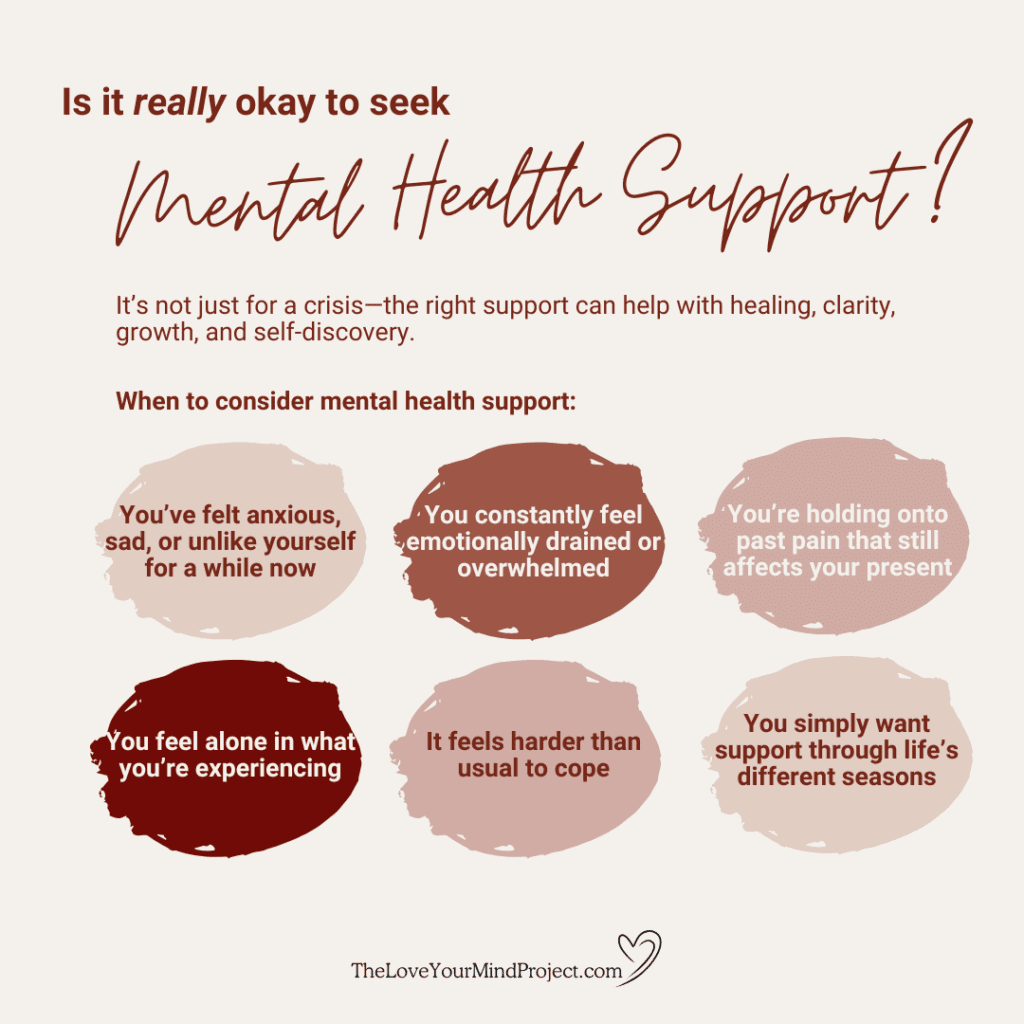
You’ve felt anxious, sad, or unlike yourself for a while
Certain situations can trigger worry, sadness, irritability, numbness, or that sense of feeling “off.” But when these emotions linger more often than not, it might be a sign that you could use support.
But it’s not because you’re too sensitive or lacking faith.
Stressors like anxiety, depression, prolonged grief—they don’t reflect anything you’re doing wrong. But they can strain the mind and body, wear you down over time, and affect your overall well-being.1
Mental health support can help you process what you’re going through and identify what you need to regain a sense of safety, peace, and confidence again.
You constantly feel emotionally drained or overwhelmed
If you’re functioning and showing up on the outside, but feeling depleted on the inside, it might be a good time to reach out for support.
Even if you’re used to pushing through this fatigue, what’s often done for survival doesn’t always serve you in the long term.
Mental or emotional exhaustion can be a sign that your body has carried too much for too long.
Everything from your nervous system to your muscles, heart rate, digestive system, and immune system can be impacted when you’re running on empty.2,3
Support, in these seasons, can help you learn what it feels like to pause, exhale, and let go—so your mind and body can truly rest and recover.
You’re holding onto past pain that still affects your present
Old wounds can make it difficult to maintain relationships, know your worth, or even get out of bed.
Past pain can linger when you’re unsure how to process it4, or you exchange it for unhealthy distractions—like excessive drinking, eating, or an over-reliance on other substances.
Without knowing how to face past trauma, you can easily hold onto it—where it might show up as unhealthy thought patterns, decisions, or seasons of feeling stuck in the same struggle.
But with mental health support, especially culturally-affirming care that truly gets you, you can safely face and heal old wounds. You can live your life with more intention and thrive despite what you’ve been through.
You feel alone in what you’re experiencing
Maybe you prefer to go through hard times alone. You might feel like less of a burden or like you’re being strong and independent.
But you weren’t meant to navigate life’s ups and downs by yourself.
In fact, carrying everything alone can intensify the pain,5 making even small challenges feel intense. And it becomes easier to internalize the isolation and feel like you’re unworthy of the love, care, and support you truly need.
Mental health support can be a welcoming space to lay down your burden. You can partner with a mental health professional to unpack what’s behind your feeling so alone and discuss ways to nurture genuine, safe, and meaningful connections.
It feels harder than usual to cope
Sometimes life can hit you so hard that it’s difficult to respond.
Maybe you experienced a significant change that turned your life upside down, or perhaps stress and overwhelm slowly built up over time.
When it’s harder to cope, you might feel more irritable, impatient, empty, or emotionally numb. If it begins to affect your relationships, job, or day-to-day responsibilities, it may be a sign you could use more help in this season.
Mental health support can help you understand the complex emotions you may be experiencing and the best ways for you to reclaim your peace and inner strength.
You simply want support through life’s different seasons
You don’t need a crisis for mental health support.
Maybe you want help navigating marriage, parenting, a big move, or a career change.
Many of us face unique pressure as the “first and only.”6 The first to graduate or earn a high income in our families. The only Black woman in the department or the office. It’s okay to seek support to navigate environments that can often overlook, undervalue, and take advantage of our strengths.
Mental health help can fill you up in a world that seems to always take. And you deserve restorative spaces.
Mental health support can look the way you need it to
Whether you prefer deep, private conversations or group settings, you can find help that fits you. These are just a few examples of the different types of mental health support you can explore.
- Individual therapy or counseling: One-on-one interactions with a licensed or credentialed professional where you can unpack past trauma, address specific mental health conditions, and uncover emotional needs and the best ways to address them.
- Group therapy: One or more licensed mental health professionals lead group discussions that may be highly structured and focused on issues like anxiety, depression, or PTSD.
- Peer support groups: Less formal group conversations typically led by volunteers, facilitators, or individuals who share a similar experience. The focus is less about treatment and more about building community.
- Coaching: While they can’t diagnose or treat specific mental health conditions, certified coaches can help you set mental health goals and create a plan to reach them.
- Self-guided tools: Books, apps, and worksheets that you can use at your own pace to better manage stress, anxiety, or major life transitions.
- Crisis support: Immediate, emergency help is available 24/7 for individuals experiencing thoughts of suicide, self-harm, or thoughts of harming others.
You have options. So give yourself time and permission to choose what works best for your needs, preferences, and lifestyle.
When to seek mental health support: FAQs
How do you know if you need mental health help?
You can reach out for mental health support if stress feels overwhelming, you’re dealing with childhood pain, or you’re navigating a major life change. Support can help you heal, process difficult emotions, or simply gain clarity—especially if you’re used to carrying everything on your own.
What kind of mental health support should I start with?
Start with what feels most accessible. If you prefer one-on-one conversations, therapy could be a good fit. Maybe community is most important right now, so you explore peer support groups. If you’re not comfortable sharing just yet, self-guided tools can also help. You can always try something and switch it up as your needs become clearer.
Is it normal to feel nervous about asking for help?
Yes, it is. You might feel afraid or vulnerable at the thought of reaching out for support. Many of us were taught that seeking mental health help signaled a lack of strength, faith, or self-control. But it’s really a sign of courage and radical self-love as you learn to identify and tend to your emotional needs.
References
Last accessed May 2026
- Chu, B., Marwaha, K., Sanvictores, T., Awosika, A. O., & Ayers, D. (2024, May 7). Physiology, Stress Reaction. Nih.Gov; StatPearls Publishing. https://www.ncbi.nlm.nih.gov/books/NBK541120/ ↩︎
- Abd-Elfattah, H. M., Abdelazeim, F. H., & Elshennawy, S. (2015). Physical and cognitive consequences of fatigue: A review. Journal of Advanced Research, 6(3), 351–358. https://doi.org/10.1016/j.jare.2015.01.011 ↩︎
- (2023). Fatigue. Better Health. Vic.Gov.Au. https://www.betterhealth.vic.gov.au/health/conditionsandtreatments/fatigue ↩︎
- What Happens When We Push Emotions Down? (2026). Psychology Today. https://www.psychologytoday.com/us/blog/the-stories-we-tell/202601/what-happens-when-we-push-emotions-down ↩︎
- Is Loneliness Making My Mental Health Struggles Harder? | Mental Health America. (2024). Mental Health America. https://mhanational.org/resources/is-loneliness-making-my-mental-health-struggles-harder/ ↩︎
- Farmer, J. R. (2021). First and Only: A Black Woman’s Guide to Thriving at Work and in Life. Broadleaf Books. ↩︎

- The Exhale app: Wellness support that actually centers Black women - October 2, 2026
- Feeling unlovable even in a relationship? Here’s what to do with that feeling - September 24, 2026
- How to be vulnerable in a relationship when opening up feels scary - September 17, 2026