
Deciding to seek mental health support is a big step.
You’ve likely had to overcome stigma or battle the pressure to be a strong Black woman who handles life on her own.
So once you make the decision to find help, the sheer number of options shouldn’t make the process harder.
This guide aims to make it a little easier, explaining the major types of mental health support, when they make sense, and how to decide what’s right for you.
What is mental health support?
Mental health support isn’t just therapy. It includes any resource that helps you cope, heal, process emotions, manage symptoms, and feel less alone in your experiences.
It typically involves talking through your current struggles, past trauma, or wellness goals with a mental health professional to best understand how you can find relief or live a fuller life.
Who offers mental health support?
Several types of professionals provide mental health support in different ways.
- Psychiatrists: Medical doctors who can diagnose conditions and prescribe and manage mental health medication.
- Psychologists: In addition to providing therapy, they may use assessments or evaluations to better understand what you’re experiencing (and make a diagnosis if necessary).
- Licensed therapists and counselors: Provide therapy to help you navigate overwhelming emotions or mental health conditions, but cannot prescribe medication.
- Peer group specialists or facilitators: Can help lead peer support groups or community spaces, and may have a personal experience with mental health conditions
- Certified mental health coaches: Generally focused on helping you through specific life transitions or broader wellness goals, rather than treating mental health conditions.
More important than the type of professional is having one who truly sees you.
That’s why for many of us, culturally-affirming care in mental health is essential. It’s the type of support that acknowledges your unique challenges and the systems, cultural norms, and familial pressures that can make it difficult to admit you need help, let alone find support.
6 types of mental health support to help you decide what’s best for you
While not an exhaustive list, these options give a general sense of the different types of mental health care you can explore.
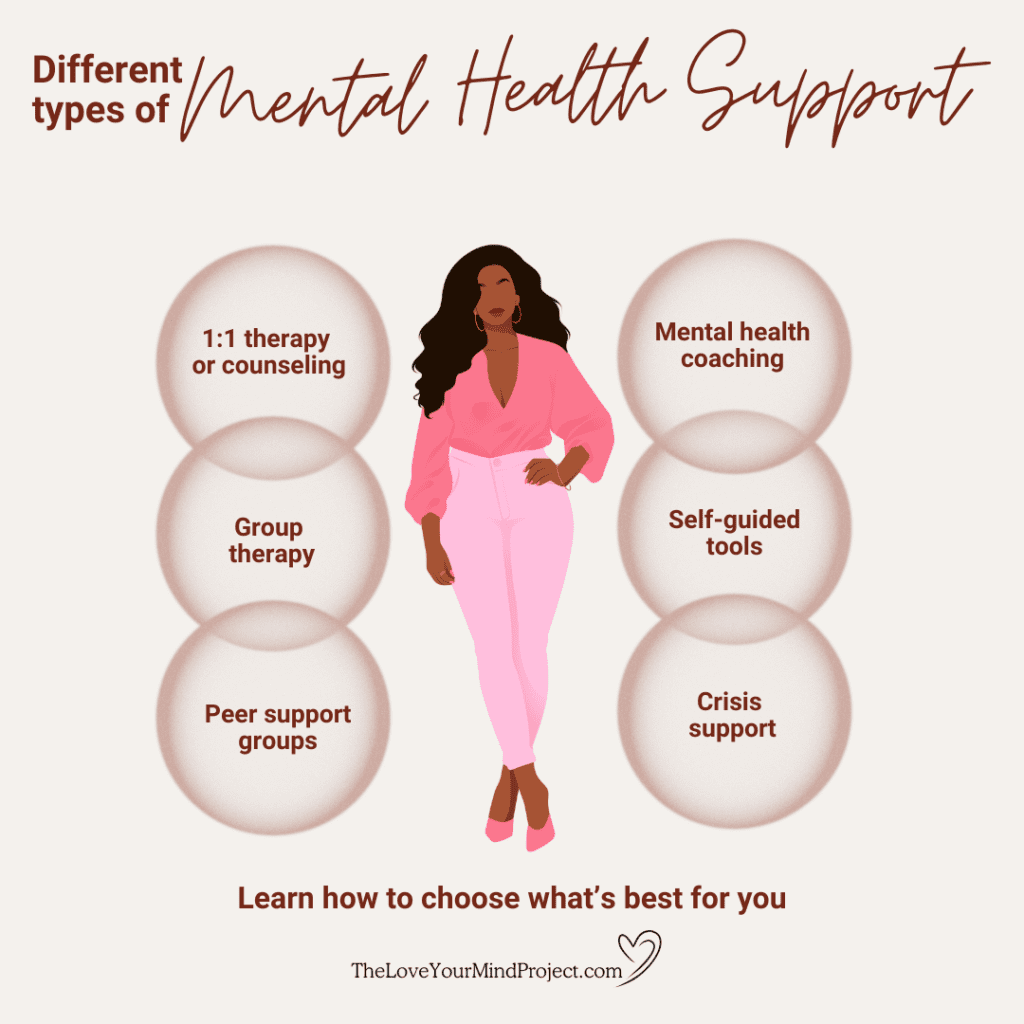

Individual therapy or counseling
Best if you want dedicated, one-on-one support, individual therapy usually involves partnering with a licensed psychiatrist, psychologist, counselor, or social worker to uncover what’s behind your emotional pain and the unhealthy patterns that may feed it.
You might seek therapy if you’re experiencing anxiety, depression, trauma, prolonged grief, burnout, substance abuse, or relationship conflict—especially if it gets in the way of living a quality life.
Different therapy methods can help you get to the root causes of emotional pain.1
- Cognitive behavioral therapy (CBT): Conversations that focus on the connection between your thoughts, feelings, and behaviors—specifically the negative ones that can fuel anxiety, depression, or pain from past trauma.
- Dialectical behavior therapy (DBT): Designed to address intense emotions, like those associated with borderline personality disorder (BPD), post-traumatic stress disorder (PTSD), panic attacks, or addiction.
- Psychodynamic therapy: Focuses primarily on your past to understand how it shapes your present emotional challenges.
- Acceptance and commitment therapy (ACT): Helps you accept your thoughts while separating yourself from them so you can focus on behavioral changes.
- Eye movement desensitization and reprocessing (EMDR): Therapist-guided eye movement exercises while you focus on a traumatic memory to help you reprocess the event and reduce its emotional intensity.
If therapy sounds like a fit, you can start by finding a therapist who’ll get to know you, your challenges, and your goals to determine the best path forward.

Group therapy
Group therapy could be for you if you want therapist-led sessions but prefer the company of your peers.
Therapy in a group setting can be as effective as individual therapy for conditions like depression, anxiety, bipolar disorders, schizophrenia, and obsessive-compulsive disorder (OCD).2
Group therapy could help you feel less stigma and less alone in what you’re experiencing—especially as a Black woman seeking therapy.

Peer support groups
A peer support group lets you share your experiences with like-minded individuals.
Sessions are generally less about clinical treatment and more focused on creating a safe space and building community.
Attendees can usually drop in without committing to several weeks of sessions, making it less formal than group therapy.
Instead of a licensed therapist, you might have a certified facilitator or a volunteer lead the discussion.
Therapy for Black Girls, Black Girls Break Bread, and Black Girl Smile are just a few of the online communities available. You can also find groups near you if you want to attend in person.

Coaching
Mental health coaching could be an option if you have broader wellness goals and want accountability as you work toward them.
You might choose to work with a coach if you feel emotionally regulated—meaning you’re not struggling with anxiety, depression, or other mental health symptoms that significantly interfere with daily life—but still want guidance navigating a career change, a big move, or other personal goals.
You can look for a coach certified by the National Board for Health and Wellness Coaching (NBHWC) if this feels like the support you need.

Self-guided tools
Not everyone is ready to talk. If the idea of sharing one-on-one or in a group feels like too much, self-guided tools could be a better starting point.
Self-guided mental health resources can include books, journaling prompts, guided meditations, anti-anxiety apps, workbooks, podcasts, articles, and more.
These are tools that you can use at your own pace to learn more about what you may be dealing with and explore healthy coping strategies.
But it’s okay to seek more personal support if you feel overwhelmed or stuck.

Crisis support
The most distressful and urgent care may need crisis support.
It’s available 24 hours a day, seven days a week, for those who feel unsafe, unable to cope, or concerned they may harm themselves or others.
Crisis support is confidential and judgment-free. It can be a phone call, text message, or visit to the nearest emergency room.
Platforms like the 988 Suicide and Crisis Lifeline and SAMHSA’s Helpline (Substance Abuse and Mental Health Services Administration) have trained professionals to help walk you through your options.
While there is absolutely no shame in receiving crisis support, you don’t have to wait until you hit rock bottom to reach out for help.
How to choose the support that fits you
Choosing the right type of mental health support starts with knowing what’s most important to you. Here are a few factors to keep in mind.
- What type of help do you need the most? If anxiety, depression, or other severe symptoms get in your way, clinical support like therapy could better address what you’re experiencing.
- Are you comfortable sharing? Group support often means expressing difficult feelings with potential strangers. Individual therapy allows you to open up in private over time. And self-guided tools mean you don’t have to share at all.
- Consider your budget: Therapy can be more expensive than peer support groups, especially without insurance.3
- How much structure do you want? Therapist-led sessions can be more formal than peer groups, which allow you to pop in and out more freely.
You might not find the best type of support right away. Give yourself time to explore, try new things, and better understand what you’re looking for.
Sometimes the bravest step is starting somewhere.
Types of mental health support: FAQs
Are there different types of mental health support?
Yes, there are. Support could look like individual therapy, group therapy, peer support communities, coaching, self-guided resources, or crisis support. Each has its benefits and drawbacks depending on what you’re looking for.
Which type of mental health support works best?
There is no one best option because we all have different needs. Individual therapy can work best for a deeper analysis of your past and how it affects your future. A coach could be more effective if you have broader goals and just want accountability. What works best for you often comes down to what you’re most comfortable with.
How do I know what kind of support I need?
Start by looking at the quality of your daily life. If symptoms leave you feeling overwhelmed, anxious, depressed, stuck, or alone more often than not, structured support like therapy or counseling could help. If you’re simply looking for community, a support group could be a better place to begin. Crisis support is best if you feel unsafe, unable to cope, or need urgent mental health care.
References
Last accessed May 2026
- Effective Anxiety and Depression Treatments | Explore Therapy Options & Find Support. (2025). Adaa.Org. https://adaa.org/find-help/treatment-help/types-of-therapy ↩︎
- Pappas, S. (2023). Group therapy is as effective as individual therapy, and more efficient. Here’s how to do it successfully. Https://Www.Apa.Org. https://www.apa.org/monitor/2023/03/continuing-education-group-therapy ↩︎
- Group Therapy vs Individual Therapy: Uses, Benefits & Effectiveness. (2025, January 20). American Addiction Centers. https://americanaddictioncenters.org/therapy-treatment/group-individual ↩︎

- How to be vulnerable in a relationship when opening up feels scary - September 17, 2026
- When only needing “me, myself, and I” leaves little room for love - September 11, 2026
- Everyone eventually leaves me: How fear of abandonment gets in the way of love - September 4, 2026