Black Women’s Mental Health Institute, Boris Lawrence Henson Foundation, and Loveland Therapy Fund are just a few low- or no-cost options for Black women.

We all could use help supporting our mental health, but the cost of therapy makes it out of reach for too many of us.
Therapy can cost $100 to $200 a session without insurance—and for many of us, that puts real support out of reach. But affordable options exist, and you deserve to know about them
Whether you’re dealing with stress, anxiety, depression, or other mental health challenges, you deserve access to culturally aware and understanding therapists who can help you heal.
This guide highlights seven low- or no-cost therapy resources for Black women and other ways to find affordable therapy and continue this self-love journey.
Low- or no-cost options if you can’t afford therapy
These organizations provide affordable or free mental health support. Many of them are specifically knowledgeable of or sensitive to the unique mental health challenges of Black women.
Black Women’s Mental Health Institute
The Black Women’s Mental Health Institute (BWMHI) offers free in-person and virtual counseling. BWHMI has free services in Alabama, where it’s based. If you’re outside Alabama, complete their form to see if BWMHI serves your area.
In addition to free counseling, the BWMHI has several programs to unite and support our community. For example, their Faith and Mental Health Collective provides counseling services to churches and faith leaders.
Boris Lawrence Henson Foundation
Taraji P. Henson founded the Boris Lawrence Henson Foundation (BLHF) in honor of her late father, who experienced unsupported mental health challenges after serving in the Vietnam War.
BLHF serves Black, Indigenous, and people of color (BIPOC), recognizing the lack of support for these groups within the mental health space.
You can sign up for BLHF’s free mental wellness support program when enrollment opens, or search its therapist directory to see if there is a provider in your area with free or low-cost services.
Open Path Collective
Primarily for the uninsured or underinsured, who earn less than $100,000 yearly, Open Path connects members to in-person and online therapy services for $40 to $70 per session and up to $80 for couple or family sessions.
On top of the session fee, you’ll pay a $65 one-time membership fee that gives access to Open Path’s directory, discounts with partner companies, and educational resources.
Once you join, you can find a therapist through Open Path who specializes in the area where you desire help. You can specify their therapeutic approach, race, ethnicity, and more.
Loveland Therapy Fund
The Loveland Foundation provides financial assistance to Black women and nonbinary individuals, using vouchers that cover up to 12 therapy sessions with partner websites, like Therapy for Black Girls, National Queer & Trans Therapists of Color Network, and Psychology Today.
One voucher pays for up to $120 for a session. Recipients can pay their therapist out of pocket and be reimbursed by Loveland, or have Loveland pay the therapist directly.
You can learn more or apply by visiting the Loveland Therapy Fund website.
Black Emotional and Mental Health Collective
The Black Emotional and Mental Health Collective (BEAM) focuses on education, training, and advocacy for marginalized communities. This national organization hosts in-person events in Los Angeles and Atlanta as well as virtual events you can access nationwide.
BEAM offers Heart Space, a group support program led by Black therapists and wellness practitioners that’s not only a place to share and find support but also learn practical and healthy ways to deal with hard emotions and experiences.
Tickets for BEAM’s events appear to be low-cost. But they also offer a limited number of free tickets and the generous option to pay what you can as a donation.
Learn more about their LA, Atlanta, or virtual programs on BEAM’s website.
Sad Girls Club
Sad Girls Club is an online community for Millennial and Gen Z women of color. It’s a nonprofit organization that provides free virtual group therapy primarily through a chat.
Not Your Average Chat Room is a safe space where women and girls can vent, share, and heal. You can expect 45-minute sessions with a mental health facilitator and up to ten other members.
FreeBlackTherapy.org
Free Black Therapy delivers on its name, providing free online therapy if you earn a low income and don’t have adequate health insurance.
It works by connecting you to a licensed or pre-licensed Black therapist who’ll hold up to five, 45- to 50-minute sessions via phone or video. Free Black Therapy covers the session fee. You pay nothing.
Unfortunately, there is a waitlist for Free Black Therapy, but consider joining it and exploring your other options.
Black therapists who accept insurance
If you have insurance, therapy could cost you much less than paying out of pocket – about $20 per session on average for in-network providers and $60 for out-of-network.
However, not every therapist accepts insurance. Explore these Black therapists who do.
- Therapy for Black Girls: Founded by licensed psychologist, Dr. Joy Harden Bradford, Therapy for Black Girls has a directory of in-person and online therapists who can help us navigate being Black women in America.
- Black Female Therapists: Search for therapists who offer online or in-person sessions, accept insurance, and even offer sliding-scale fees. You can also see which therapists accept Loveland Therapy Fund vouchers.
- Therapy for Black Women: Therapy for Black Women is a private practice founded by licensed therapist and mental health advocate, Jessica V. Taylor, LCSW-C. The practice is licensed in Maryland, DC, and Virginia as of this writing and accepts Aetna, CareFirst/Blue Cross Blue Shield, United Healthcare, Oscar Health, and Oxford insurance.
- Black Mental Health Alliance: The Black Mental Health Alliance has a database of culturally competent and licensed mental health professionals. The organization works by providing confidential referrals. To connect with a therapist, complete a questionnaire noting the type of help and therapist you’re seeking. You can also note your insurance carrier.
Crisis and emergency help
You don’t have to wait until you find a therapist if you’re experiencing thoughts of suicide or harming yourself or others. Free and immediate help is available.
Call or text 988 to connect with a live, trained counselor available 24/7 through the Suicide and Crisis Lifeline. Conversations are one-on-one, confidential, and completely free.
If you’re suffering abuse, emotional or physical, the National Domestic Violence Hotline is available 24/7. You can call, text, or live chat with an advocate who can help you work through your situation.
Pregnant or new moms struggling with depression, anxiety, or any other symptoms can talk live with a trained counselor 24/7 through the National Maternal Mental Health Hotline.
What to do if you can’t afford therapy
Finding a quality therapist can be expensive, but your mental health, joy, and peace are worth fighting for.
You are worth fighting for.
Here are a few more paths to explore if you can’t afford therapy.
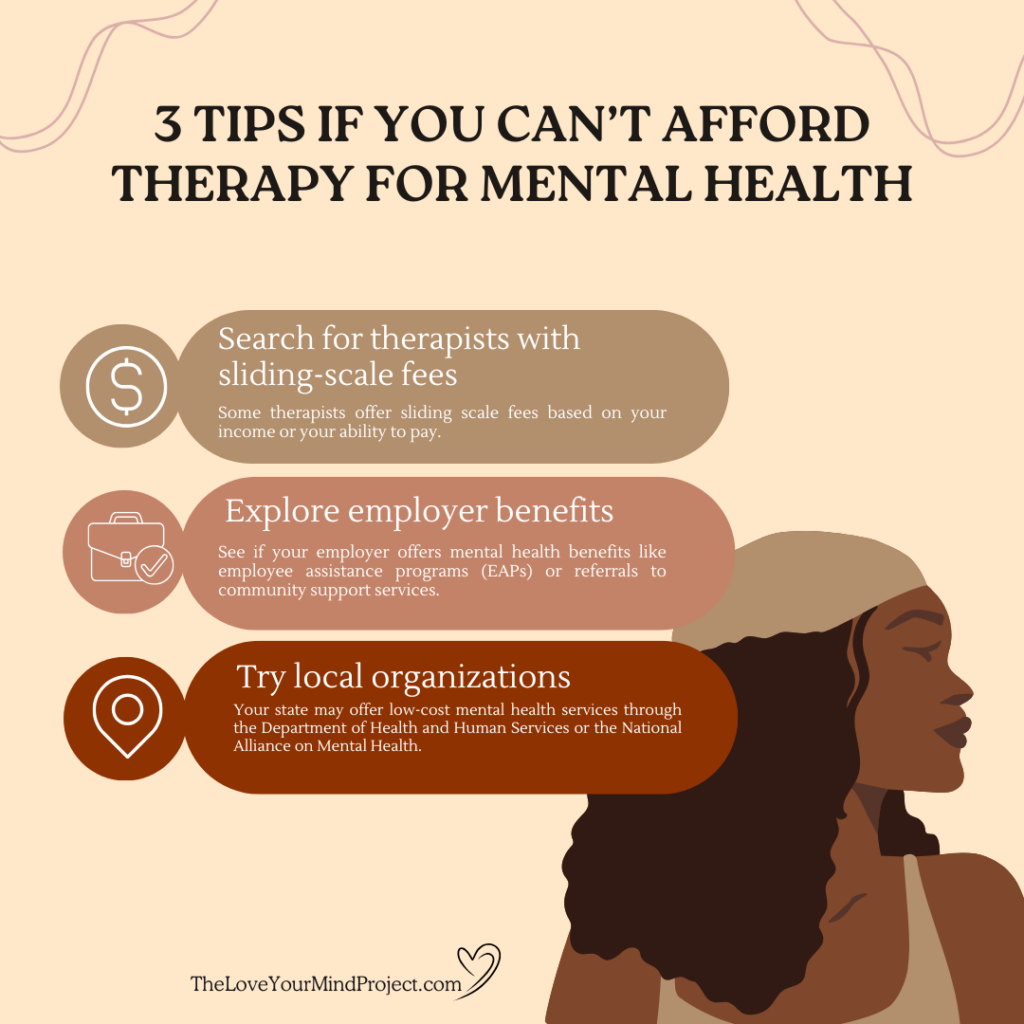
Search for therapists with sliding-scale fees
Some therapists offer sliding scale fees, even if they don’t accept insurance. This generally means the session fee will be based on your income or ability to pay.
Even if you think you earn too much, it’s usually still worth asking for this flexible payment option since the income requirements can vary by therapist.
Look for therapist directories, like Psychology Today or Inclusive Therapists, that show which ones offer sliding scale fees. Or you can simply ask.
Explore your employer’s mental health benefits
Even if your employer’s health insurance doesn’t cover therapy, your workplace may offer other mental health benefits like employee assistance programs (EAPs) or referrals to community support services. Talk to HR to understand the benefits available through your employer.
Try local organizations
Look for community organizations near you that offer free or discounted mental health services. You can search the U.S. Department of Health and Human Services for free or low-cost health centers or state agencies in your area.
The National Alliance on Mental Health also has sites and affiliates across the U.S. that have different programs to support your emotional wellness.
Can’t afford therapy FAQs
Does Medicaid cover therapy for mental health?
Medicaid covers several mental health services, including therapy. Coverage can look different for each state. Check your state’s Medicaid website to understand the types of mental health services covered and find providers.
How do I afford therapy with no insurance?
If you don’t have insurance, explore low- or no-cost therapy options through websites like The Loveland Therapy Fund, Black Women’s Mental Health Institute, and Black Emotional and Mental Health Collective. You can also look for therapists who offer sliding scale fees, which are typically based on your income. Lastly, look for local community programs through organizations like the National Alliance on Mental Illness.
How can I help myself if I can’t afford therapy?
While there are simple, daily habits we can practice to cope with life’s challenges, connection and social support can be a critical part of the healing journey. Consider talking with a trusted person in your inner circle as you explore the low-cost therapy options listed above.

- When only needing “me, myself, and I” leaves little room for love - September 11, 2026
- Everyone eventually leaves me: How fear of abandonment gets in the way of love - September 4, 2026
- Why is love so hard? 4 emotional patterns that can make love complicated - August 28, 2026