
Life can feel harder than it does for everyone else.
Maybe you struggle to stay organized despite countless planners and productivity apps.
Or you feel overwhelmed by loud noises, large crowds, or too many tasks at once.
A neurodivergent Black woman can easily feel like the problem. Underperforming when you’re told to overachieve. Constantly distracted when you’re supposed to be hyper-aware. And too dramatic when you’re expected to hide every negative emotion.
If you’ve grown up wondering what’s wrong with you, know that you are not the problem.
Your brain may simply work differently.
It’s called neurodivergence. And the more you understand it, the more you’ll recognize where you shine, where you might need a little more support, and why there’s absolutely nothing wrong with you.
What it means to be neurodivergent
Neurodivergence broadly describes brains that process information, learn, communicate, focus, or experience the world differently from what society expects.
While not a medical term, it can include conditions such as autism, ADHD, dyslexia, and sensory processing sensitivity.
Neurological differences can sometimes come with challenges, making it difficult to focus, complete tasks, stay organized, or socialize without feeling stressed, confused, or fatigued.
But experiencing these challenges does not make you defective. Having a neurodivergent mind doesn’t mean you’re broken.
Why it can feel like something is wrong with you—even though it’s not
It’s easy to spend years wondering what’s wrong with you when your differences are overlooked, or you’re constantly compared to standards you were never meant to meet.
You’re compared to unfair standards
Neurodivergence is often compared to ‘neurotypical’—the term for a brain that develops and functions in typical ways.
Many learning environments, workplaces, social gatherings, and even entertainment like the cinema, sporting events, and concerts, are usually designed for neurotypical minds.1
Struggling where a neurotypical person thrives doesn’t make you a problem. It’s often the systems around you that are falling short—not taking into account the diversity of how brains function.
The reality is that there is no gold standard for how a brain should operate.
Every brain is unique.
Rather than viewing these differences as flaws that need to be fixed, focusing on neurodiversity reminds us that human brains naturally vary.
Your differences are judged, and your struggles dismissed
For many of us, neurodivergence goes unnoticed or misunderstood.
At a young age, you may have learned to mask your struggles, overcompensate, or push yourself harder to meet expectations—in many cases, it’s out of survival.2
And when you are seen, you’re likely mislabeled.3 Teachers, caregivers, and later on managers may think you’re lazy, absent-minded, overly sensitive, or unmotivated—when you’re actually fighting through challenges beneath the surface.
Even within the healthcare system, the differences in how your brain works can be overlooked.
Historically, research on neurodivergence has excluded us.4 Many healthcare providers are still working to understand how different neurodivergent conditions can show up in Black women.
This can leave many of us going through life without a language for what we’re experiencing and the type of support we need, so we assume something is wrong with us.
Common ways a neurodivergent mind might work differently
While every neurodivergent person is different, there are some common patterns that might help explain your experiences.
Understanding how your mind may work can make it easier to replace self-criticism with self-compassion.
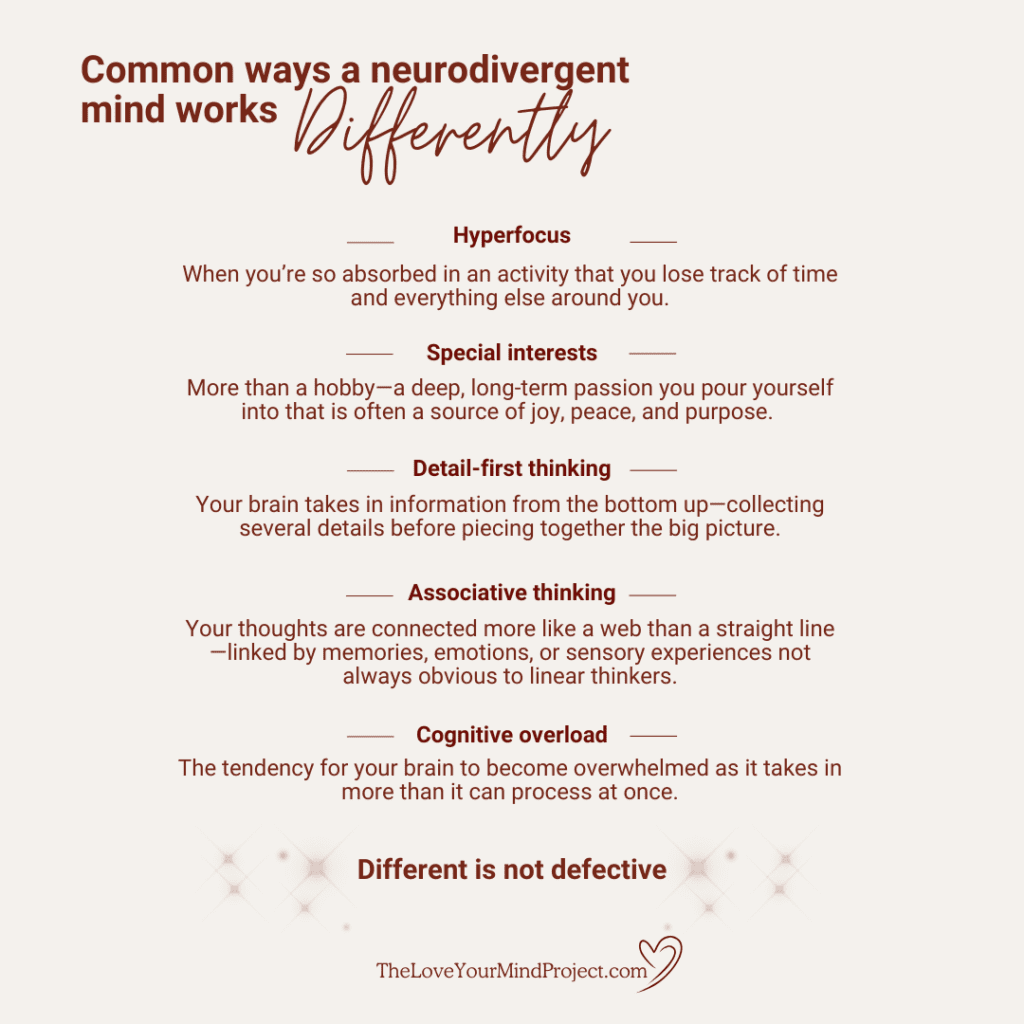
Tendency to hyperfocus
Neurodivergent hyperfocus is when the brain becomes so deeply absorbed in an activity that you may lose track of time, the people around you, and other responsibilities.
It’s a common experience for adults with ADHD and has to do with the brain’s chemicals.
Often, neurodivergent brains are low on dopamine, the chemical messenger involved in reward, satisfaction, and motivation.5 Because dopamine levels are lower, the brain may naturally prioritize activities that feel more engaging or rewarding.
Routine, repetitive, or boring tasks can feel impossible to focus on, while those aligned with your passions or that give immediate gratification can make the world around you disappear.
What’s most important is knowing that these are not deficits in and of themselves, but a difference in how your brain manages your attention.
Deep engagement in special interests
Special interests are common in individuals with autism. Unlike a hobby, they are often more intense, longer-lasting, and can serve a deeper purpose.
The topic can vary, but you may spend hours researching your special interest or talking about it to friends and family. You might even join online communities or meetups to socialize and learn more about it.
It’s something you dive into wholeheartedly, and it might even take up the majority of your free time.
Others may be in awe of your deep, expert-level knowledge on the topic. But for you, it might be so much more, providing comfort, predictability, joy, motivation, and an outlet for expression.6
Your special interests can be central to building confidence, strengthening relationships, and regulating your emotions.
Details first—big picture later
Many neurodivergent brains work from the bottom up—taking in the details first, then letting the big picture fall into place.7 This is different from a neurotypical mind that might start with assumptions and fill in the details later.
This can look like being completely overwhelmed when someone asks you, “How was your weekend?” Not comfortable summarizing, you might hash through every detail because, to you, they’re all equally important.
You may be extremely detail-oriented or amazing at finding errors and unlocking patterns—but easily overwhelmed by everything your brain has to process in a new environment.
And socially, your brain may still be working harder than you know, having to dissect sarcasm, subtext, and figurative language when you thrive with straightforward conversation and clear instructions.
Associative (non-linear) thinking
A neurotypical mind often thinks in a straight line.
A friend says, “It’s supposed to rain this weekend.”
A neurotypical response might be, “Okay, I’ll bring an umbrella.”
Neurodivergent minds can think in associations—ideas that may not seem related to a neurotypical brain, but are connected by memories, emotions, or sensory experiences.8
So you hear, “it’s supposed to rain this weekend,” and immediately start playing Missy Elliott’s “The Rain (Supa Dupa Fly)” in your head.
That song reminds you of an article saying she’s from Virginia, which reminds you of Pharrell and Timbaland—which makes you think about how this one region completely revolutionized hip-hop in the early 2000s.
Your response, “Honestly, Virginia doesn’t get enough credit for its impact on hip-hop.”
Your friend is probably lost (and possibly annoyed), wondering how the conversation went from the weather to the history of hip-hop in two seconds. But to you, it makes complete sense.
Having an associative brain can mean you’re deeply creative and a dynamic problem solver. But it can also be mentally exhausting and often leave you feeling misunderstood by linear thinkers.
Cognitive processing overload
The brain can only handle so much. When it’s taking in more information than it can process, it can become overloaded.
Cognitive overload can be common for neurodivergent minds, which are often already working hard to process noise, lighting, subtext, and other details a neurotypical mind automatically filters out.9
While everyone might experience occasional overload, when it’s constant or repeated, it can leave you feeling fatigued. You might experience burnout, emotional shutdowns or meltdowns, or difficulty focusing, planning, or relaxing.
Common types of neurodivergence
Neurodivergence may show up in many ways, but the following conditions can be common within the neurodivergent community.
- ADHD: You may have trouble focusing or feel forgetful, disorganized, restless, or impulsive.
- Autism: Sensory sensitivities, narrow interests, repetitive behaviors, and social challenges are common traits in autistic individuals.
- Dyslexia and other learning differences: Dyslexia (trouble reading) and dysgraphia (trouble writing) are common. Other conditions may leave you struggling with math (dyscalculia) or coordination (dyspraxia).
- Tourette’s: Typically includes involuntary repetitive movements (such as eye blinking, head jerking, or shoulder shrugging) and sounds (like clearing your throat, sniffing, or grunting), known as tics.
- Sensory processing differences: You might be hypersensitive to certain fabrics, loud environments, or bright lights. You can also be under-responsive, needing deep pressure, intense movement, or loud music to feel calm.
These conditions can make life difficult. Understanding them can help you see that your challenges are real, your needs matter, and you deserve support.
It’s okay to care for your needs as a neurodivergent Black woman
The world may not always see you. Family and friends might not always understand you. But you can still acknowledge your needs and advocate for support.
What does that look like? Not dismissing or masking the fatigue, discomfort, or stress you may feel in certain situations.
It means giving yourself permission to adjust your life with noise-canceling headphones, comfortable clothing, dim lighting, regular sensory breaks, or anything else you may need in the moment.
And finally, as a neurodivergent Black woman, you are allowed a space to share, unload, and receive help. Look for neuro-affirming mental health providers who can help you create the life you deserve—and remind you that there’s nothing wrong with being exactly who you are.
Neurodivergence and Black women FAQs
What does neurodivergent mean?
Neurodivergent is an umbrella term for individuals whose brains process information differently from what’s considered neurotypical. It includes conditions such as ADHD, autism, dyslexia, and other neurological differences.
Is neurodivergence a mental health disorder?
Not necessarily. Neurodivergence describes natural differences in how the brain functions and doesn’t imply a defect. Mental health conditions, on the other hand, are generally viewed as changes in how you think, feel, or function that can cause significant distress.10
What are the signs of neurodivergence in Black women?
While Black women can experience many of the common signs of neurodivergence, our experiences are often overlooked or mislabeled. A need for routine, a calm environment, or any other accommodations might be seen as being aggressive or “extra.” Experiences that are unique to us may simply not be understood because neurodivergent research hasn’t always included Black women.
References
Last accessed June 2026
- (2025, May 6). What Is Neurotypical? Cleveland Clinic. https://my.clevelandclinic.org/health/articles/neurotypical ↩︎
- McNulty, Mike. USC Chan Division of Occupational Science and Occupational Therapy. (2024). Belonging and camouflaging while Black, female and autistic. https://chan.usc.edu/news/latest/belonging-and-camouflaging-while-black-female-and-autistic ↩︎
- Shalaby, N., Sengupta, S., & Williams, J. B. (2024). Large-scale analysis reveals racial disparities in the prevalence of ADHD and conduct disorders. Scientific Reports, 14(1). https://doi.org/10.1038/s41598-024-75954-5 ↩︎
- Lovelace, T. S., Comis, M. P., Tabb, J. M., & Oshokoya, O. E. (2021). Missing from the Narrative: A Seven-Decade Scoping Review of the Inclusion of Black Autistic Women and Girls in Autism Research. Behavior Analysis in Practice, 15(4), 1093–1105. https://doi.org/10.1007/s40617-021-00654-9 ↩︎
- (2026, April 10). ADHD Hyperfocus: The Secret Weapon to Unleashing Productivity and Creativity – ADDA – Attention Deficit Disorder Association. ADDA – Attention Deficit Disorder Association. https://add.org/adhd-hyperfocus/ ↩︎
- NeuroNav Self-Determination Specialist. (2025, October 7). Understanding Autistic Special Interests: What They Are & Why They Matter. Neuronav.Org. https://neuronav.org/self-determination-blog/understanding-autistic-special-interests-what-they-are-why-they-matter ↩︎
- Sanborne, E. (2023, August 8). What is bottom-up thinking in autism? Autistic PhD; Autistic PhD, a division of Erika Sanborne Media LLC. https://autisticphd.com/theblog/what-is-bottom-up-thinking-in-autism/ ↩︎
- (2018, October 16). Thinking & The Autism Spectrum – The Place. The Place for Children with Autism. https://theplaceforchildrenwithautism.com/autism-blog/thinking-and-the-autism-spectrum ↩︎
- (2026). Cognitive Overload. Neurodivergent Insights. https://neurodivergentinsights.com/glossary/cognitive-overload/?srsltid=AfmBOorTtRPzH2tIOUL4aQTdWwHJANy6mqkt-FF2oftClp8qGpQs3Jvn ↩︎
- Princing, McKenna. (2022, September 13). What Is Neurodiversity? Right as Rain by UW Medicine. https://rightasrain.uwmedicine.org/mind/mental-health/neurodiversity-or-neurodivergence ↩︎

- Feeling unlovable even in a relationship? Here’s what to do with that feeling - September 24, 2026
- How to be vulnerable in a relationship when opening up feels scary - September 17, 2026
- When only needing “me, myself, and I” leaves little room for love - September 11, 2026