
Sometimes feeling constantly tired isn’t just about how many hours you sleep or how busy you are. Your thoughts, feelings, and emotions can also play a role.
Anxiety and depression can subtly drain your energy over time. The constant worry, the pressure to prove your worth, or a deep longing to belong can take a physical toll—even when you’re still showing up, handling responsibilities, and seemingly holding it all together.
But it’s not something you have to keep pushing through.
This article explores how anxiety and depression can make you feel tired—so you can better understand what your body may need to finally exhale and let go.
Can anxiety make you tired?
Yes, anxiety can leave you feeling fatigued.
It’s often marked by excessive, ongoing worry about different areas of life, from finances and work deadlines to future events that may never even happen.1
All of this can make sleep feel impossible. But there’s a deeper reason you could be feeling drained.
Anxiety is a form of psychological stress that can activate the body’s stress response.2 This survival response prepares the body to deal with a perceived threat. Think: fast heartbeat, tight muscles, and quickened breathing.
When fear, worry, rumination, and other anxiety symptoms continue for long periods, they can wear the body out, leaving you feeling physically and emotionally fatigued.
Does depression make you tired?
Yes, depression can make you tired, too.
Common symptoms include a lasting low mood, persistent sadness, or a loss of interest in things you once enjoyed. And like anxiety, depression can mess with your sleep patterns, drain your energy, and make it difficult to get through the day.3
But depression is also linked to physical and chemical changes in the brain that are intended to slow you down.4 Think of a smartphone in “low power” mode—small tasks can require a lot of effort.
Common reasons anxiety and depression can leave you tired
Anxiety and depression can affect your energy in ways that aren’t always obvious. Here are four common reasons they may leave you feeling exhausted.
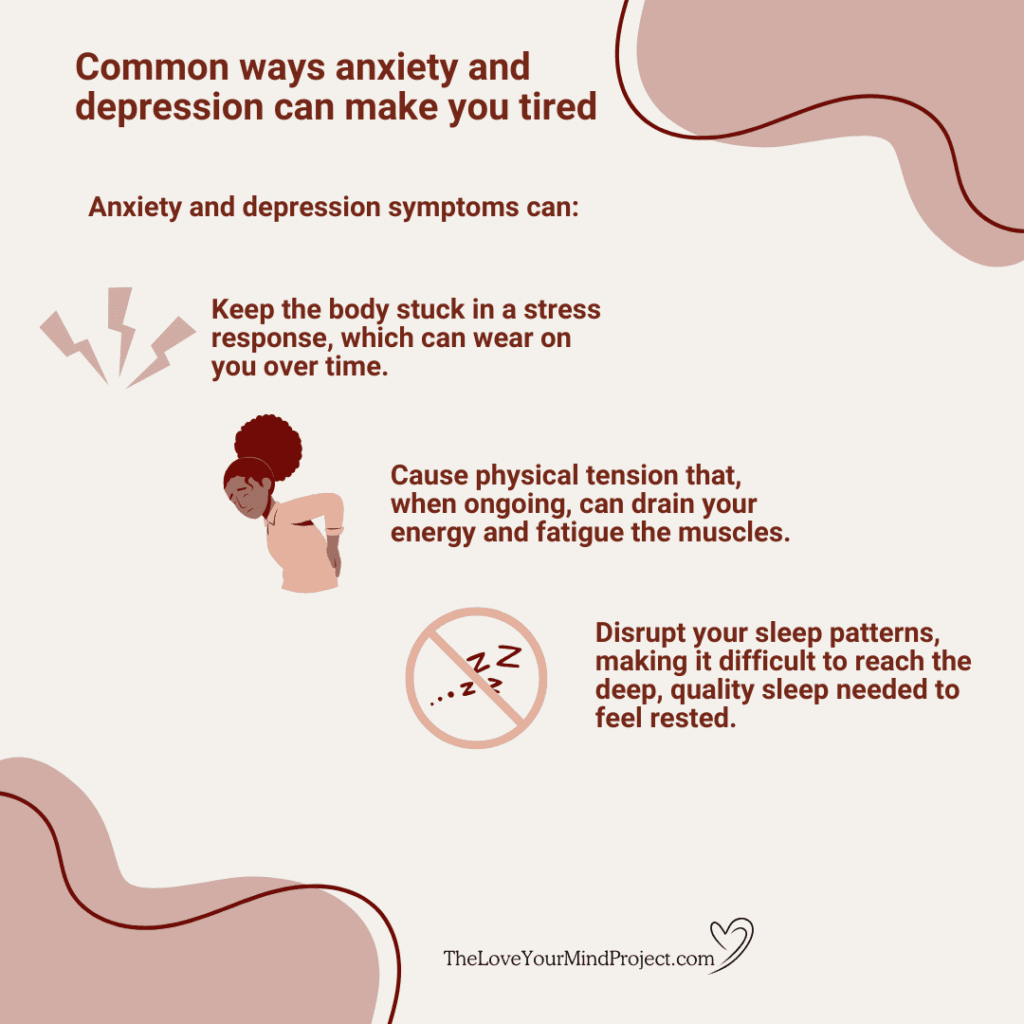
The constant stress response
Your body’s stress response is meant to be temporary.2 But ongoing anxiety or depression symptoms can keep the nervous system on high alert.
And a constant stress response can act as an invisible energy drain.
Think of what happens when a large app runs in the background on your phone. Other apps slow down. And the phone’s battery drains, even when you’re not using it. You look up, and you’re at 5% with no idea how.
Anxiety or depression symptoms could have your body’s stress response running in the background, leaving you feeling tired and overextended in the process.
Ongoing physical tension and muscle fatigue
Unresolved emotions, including those that come with anxiety or depression, can show up in the body as physical tension.5
One reason is that muscles can contract in moments of heightened stress, worry, or a severely low mood.
Tightened muscles, like a clenched jaw, raised shoulders, or even bracing your abdomen, consume your body’s energy.6 Over time, this can contribute to fatigue as well as chronic aches and pains.2
If your fatigue comes with physical strain or discomfort, finding ways to release this tension while addressing anxiety or depression symptoms may help.
Poor sleep quality and disrupted sleep patterns
Both anxiety and depression can make it harder to get quality sleep. And quality sleep is not just about how many hours you’re in bed.
Restorative sleep means your body can go through the necessary sleep cycles—cycles that involve muscle repair, hormone regulation, and other tasks that help us feel refreshed the next day.7
Anxiety and depression can disrupt this process, causing you to toss and turn or miss out on the deep sleep needed to truly feel rested.
Medication side effects
Certain medications used to treat anxiety and depression can cause insomnia, fatigue, or drowsiness as a side effect.
Antidepressants are commonly prescribed for both conditions. But while they can help with symptoms, you may feel sleepier or find it harder to sleep while taking them—especially in the beginning.
Not everyone experiences all side effects. And many of them are temporary. However, it’s important to be aware of how your body reacts and discuss your experiences with your doctor so they can make adjustments if needed.
How to tell if your exhaustion is from anxiety or depression
Fatigue can have many possible causes, so it’s not always easy to tell what is behind it. But your exhaustion could be connected to anxiety or depression if you experience:
- Feeling physically sluggish, like having slowed movements or speech
- Sleeping a lot more or a lot less than usual, but still not feeling rested
- Feeling physically tired but unable to wind down or quiet your mind
- Feeling drained, even by minor everyday activities
It’s worth speaking with your doctor if you feel exhaustion that’s ongoing, severe, or disruptive to your day-to-day life. Together, you can explore possible causes and solutions because you deserve relief and restoration.
Can anxiety or depression make you tired? FAQs
Why does anxiety make you feel exhausted?
Anxiety may keep your mind and body on high alert. This ongoing stress response can drain your energy, cause physical tension or discomfort, and disrupt your sleep—all of which can leave you feeling exhausted.
Is extreme fatigue a symptom of depression?
Yes, fatigue can be a depression symptom. Depression doesn’t just affect your mood and motivation—it can also mess with your sleep patterns and activate the body’s stress response, which drains your energy. Ongoing depression can also cause chemical changes in the brain that slow us down.
Can anxiety medication cause fatigue?
Some anxiety medications can cause drowsiness, especially when you first take them. Others can interfere with your sleep, making it harder to feel rested the next day. Not everyone experiences all side effects, and many go away after a while. It’s important to talk with your doctor before starting or stopping a medication.
How do I know if my exhaustion is related to mental health?
If your fatigue comes with symptoms like excessive worry, ruminating thoughts, sadness, loss of interest, or hopelessness, it could be tied to your mental health. Consider talking with a doctor or therapist to uncover what’s going on and, more importantly, ways you can find relief.
References
Last accessed March 2026
- (2023, August 15). Generalized Anxiety Disorder (GAD): Symptoms & Treatment. Cleveland Clinic. https://my.clevelandclinic.org/health/diseases/23940-generalized-anxiety-disorder-gad ↩︎
- Chu, B., Marwaha, K., Sanvictores, T., Awosika, A. O., & Ayers, D. (2024, May 7). Physiology, Stress Reaction. Nih.gov; StatPearls Publishing. https://www.ncbi.nlm.nih.gov/books/NBK541120/ ↩︎
- Depression (major depressive disorder) – Symptoms and causes. (2025). Mayo Clinic; https://www.mayoclinic.org/diseases-conditions/depression/symptoms-causes/syc-20356007 ↩︎
- Trifu, S. C., Trifu, A. C., Aluaş, E., Tătaru, M. A., & Costea, R. V. (2020). Brain changes in depression. Romanian Journal of Morphology and Embryology, 61(2), 361–370. https://doi.org/10.47162/rjme.61.2.06 ↩︎
- Murnan, A. (2023, August 21). Can emotions be trapped in the body? What to know. Medicalnewstoday.com; Medical News Today. https://www.medicalnewstoday.com/articles/emotions-trapped-in-the-body#symptoms ↩︎
- Wan, J., Qin, Z., Wang, P., Sun, Y., & Liu, X. (2017). Muscle fatigue: general understanding and treatment. Experimental & Molecular Medicine, 49(10), e384–e384. https://doi.org/10.1038/emm.2017.194 ↩︎
- Brinkman, J. E., Reddy, V., & Sharma, S. (2023, April 3). Physiology of Sleep. Nih.gov; StatPearls Publishing. https://www.ncbi.nlm.nih.gov/books/NBK482512/ ↩︎

- The Exhale app: Wellness support that actually centers Black women - October 2, 2026
- Feeling unlovable even in a relationship? Here’s what to do with that feeling - September 24, 2026
- How to be vulnerable in a relationship when opening up feels scary - September 17, 2026