You can spend your life proving yourself, but you’ll never feel good enough until you know your true self-worth.

When you see yourself in the mirror, do you only notice your flaws? Are your mistakes louder than your wins?
You’re not alone. There are plenty of Black women wondering, “Why do I never feel good enough?”
Maybe you feel unworthy of what you have, or simply believe you should be smarter, stronger, more beautiful, more successful—just better.
But those thoughts and beliefs? They’re not true.
Let’s unpack why you might feel this way and how you can begin to heal.
>> SUBSCRIBE for weekly resources in your inbox (curated for Black women)
Feeling like you’re never good enough is more common than you think
That sense of inadequacy can be deeply familiar for many Black women. For example, many of us deal with impostor syndrome at work, doubting our skills, abilities and whether we actually belong.1
And it’s not always reserved for the workplace. We might question whether we’re good enough as moms, daughters, wives, and in other areas of our lives.
“Behind the ‘strong Black woman’ image, there’s often a quiet battle with low self-esteem and unworthiness—a struggle we rarely name out loud,” said April Lancit, licensed marriage and family therapist (LMFT) and founder of April Lancit & Associates, a Pennsylvania-based private practice.
It’s not a personality trait—it’s a learned emotional response
You weren’t born feeling not enough or undeserving. Perhaps it was learned from years of hearing that you have to work twice as hard to be seen as an equal. Or from that nagging feeling that people assume you’re only in the room because you fill a diversity quota.
Maybe it’s learned from societal cues. Black women are still underpaid compared to our white counterparts.2 We’re less likely to be promoted.3 And many of our features, like darker skin and tighter curl patterns, are still devalued in mainstream beauty standards.4
But what’s learned can be unlearned—including low self-worth. You simply need the tools to see just how worthy you already are.
>> MORE: You’re enough as you are—use these affirmations as a reminder
Why do I never feel good enough? 5 reasons for Black women
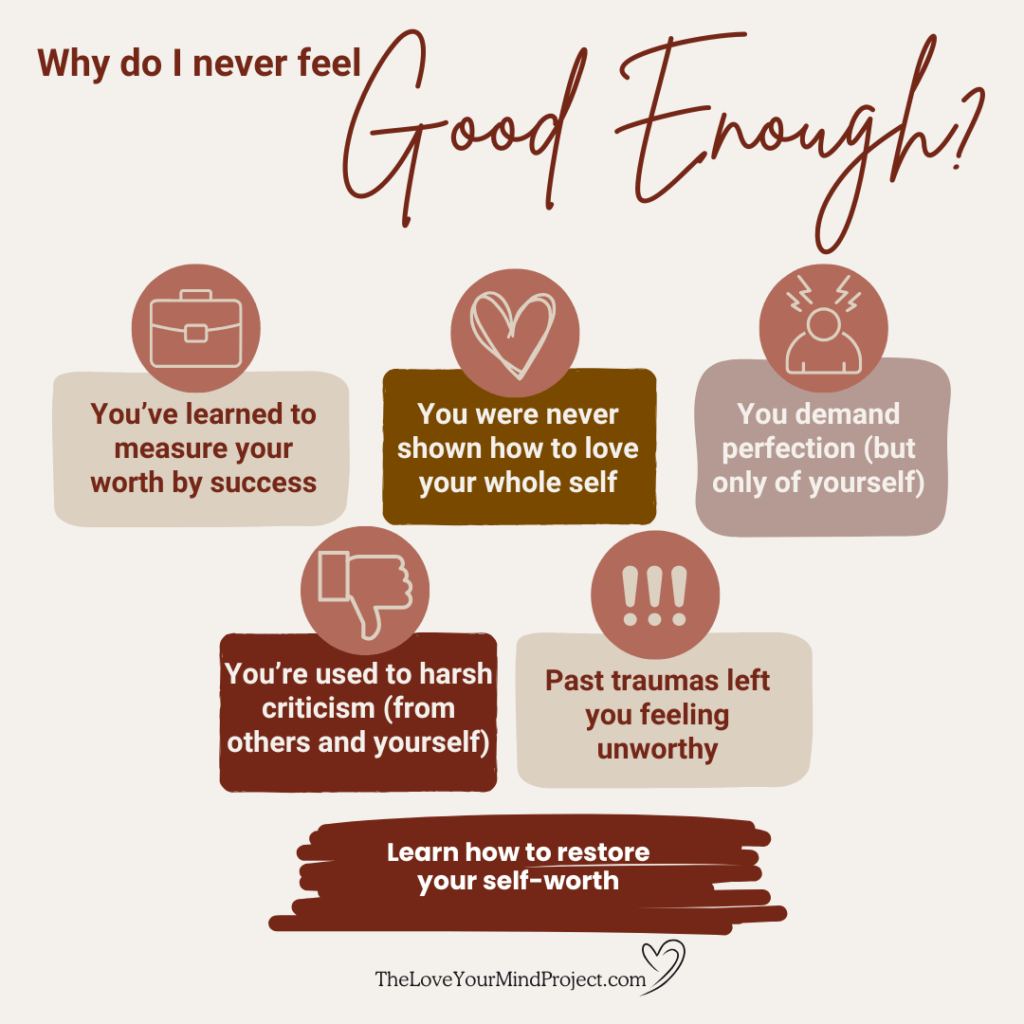
A lot can fuel low self-worth, especially in Black women. Childhood experiences, cultural expectations, and broader systemic challenges can all play a role.5 Here are five core reasons you may feel like you never measure up.
#1 You’ve learned to measure your worth by success
Do you only feel worthy when you achieve something? Maybe as a little girl, you were praised solely when you performed well, conditioning you to tie your value to what you produce.
“We can measure our value by how productive we are, how much we can handle, or how well we keep things together,” said Lancit. “But even when we excel, we might still wonder, ‘Am I really enough?’ instead of knowing deep down that we are and don’t have to work so hard to prove it.”
Your worth doesn’t rise or fall with your accomplishments. You’re worthy because you’re you—whether you’re succeeding or struggling.
#2 You were never shown how to love your whole self
In many Black families, certain traits might be encouraged—being strong, responsible, and independent—while others are dismissed, such as feeling sad, tired, or vulnerable.
When loved ones don’t accept our whole selves, we can easily follow their lead. That self-rejection can create the painful belief that we’re defective, broken, or not enough.
But real self-love is accepting all of who you are—both the impressive and the imperfect parts.
>> MORE: Feeling alone even when around others? Here’s what’s behind it
#3 You demand perfection (but only of yourself)
Think of one of the most important people in your life. Would you ever expect them to never make a mistake?
Of course not. Getting everything right all of the time is impossible. Yet, many of us hold ourselves to these unrealistic standards.
Perfectionism is toxic. And chasing it only reinforces the idea that you’ll never be good enough because you can never be flawless.
#4 You’re used to harsh criticism—from others and yourself
Maybe it comes from a hypercritical caregiver, a toxic boss, a judgmental partner, or even a jealous friend. Excessive criticism can gradually tear down your sense of self and convince you that you’ll never measure up.
And while you can’t control others’ opinions of you, you don’t want their criticisms to become your beliefs.
When you protect your worth, what others say won’t shatter your self-view, and you can catch when your own inner critic starts to get out of hand.
>> MORE: How to overcome fear of failure—and unlock unconditional self-love
#5 Past traumas left you feeling unworthy
Abandonment, betrayal, abuse, or emotional neglect can deeply affect how you see yourself. Trauma can leave you feeling powerless and like everything is your fault, especially when it happens in childhood.
When this self-blame goes unchecked, we can internalize feelings of being inherently flawed, unlovable, or “too much.”
But trauma, no matter how painful, doesn’t define you. You can heal and slowly shift how you see yourself—fully, compassionately, and truthfully.
How to restore self-worth
Rebuilding self-worth takes time, but it’s absolutely possible. Start small with these practices that remind you that you are enough right now.
- Do self-worth work: Explore what you believe about your worthiness and where those beliefs came from. Therapy can be especially helpful as you identify and begin to rewrite false narratives.
- Practice real self-love: Not just “glow ups” and spa days—real self-love is about accepting all of you and treating yourself with compassion, even when you fall short.
- Let go of perfectionism: You’re human, not a machine. You don’t have to be perfect to be valuable. You already are.
- Release the critics: Set boundaries with people who constantly criticize. And when you’re hypercritical of yourself, gently shift your thoughts toward affirmations that honor you.
- Heal past wounds: If the feeling that you’re not good enough comes from a trauma, consider working with a therapist to process and release that pain. There is strength, clarity, and peace when you allow yourself to heal.
Never feeling good enough is a learned response to your experiences—it’s not your truth. Give yourself grace as you unlearn those beliefs and grow in radical self-love.
>> MORE: The Black woman’s guide to loving your mind
Why do I never feel good enough? FAQs
Is it common to never feel good enough?
Yes, it’s common, especially among Black women who’ve been conditioned to believe we’re less valuable, less attractive, and can’t show vulnerability or flaws. These are learned narratives that can be unlearned when we begin to see and accept our full selves.
What is “never feeling good enough” a sign of?
It can be a sign of low self-esteem or self-doubt. You may also notice that you deal with perfectionism or impostor syndrome. These feelings can stem from past trauma, constant criticism, or simply never learning early in life that you are inherently enough.
What do I do if I never feel good enough?
You can start by noticing when these feelings arise and exploring where those thoughts come from. The idea is to slowly shift to a new way of thinking—one that’s based on the truth that your worth doesn’t need to be earned, and you deserve unconditional love (including self-love).
Will I ever feel good enough?
Yes, you absolutely can—with time, support, and tools to help you reinforce your inherent worth. The goal isn’t to feel perfect, but to know that you’re already whole and worthy as you are—flaws and all.
References
- (2021, February 2). You Belong in the Room — Exploring Impostor Syndrome from a Black Perspective. Maryville University Online. https://online.maryville.edu/blog/impostor-syndrome-black-perspective/ ↩︎
- Equal Pay Day: Gender pay gap hits historic low in 2024—but remains too large. (2024). Economic Policy Institute. https://www.epi.org/blog/gender-pay-gap-2024/ ↩︎
- Women in the workplace 2024 THE 10TH ANNIVERSARY REPORT. (n.d.). https://cdn-static.leanin.org/women-in-the-workplace/2024-pdf ↩︎
- Boutté, R. L., Johnson, A., Goel, N. J., Simpson, C. C., & Mazzeo, S. E. (2025). Racialized body dissatisfaction in Black women: development of the Black feminist model of body image. Journal of Eating Disorders, 13(1), 38–38. https://doi.org/10.1186/s40337-025-01190-5 ↩︎
- Carter, T. (2024, October 7). How Childhood Trauma Impacts Black Women’s Confidence. JBC Counseling & Consulting. https://jbccounselingandconsulting.com/how-childhood-trauma-impacts-black-womens-confidence-and-self-esteem/ ↩︎

- Inclusive Therapists: Support that honors your whole identity - August 20, 2026
- The Black Women’s Mental Health Institute: Free counseling, support, and community - August 14, 2026
- Therapy for Black Girls: Find therapy and a community that get you - August 6, 2026