Genuine connections are a fundamental need. The right ones can ease emotional strain, strengthen your self-esteem, and remind you that you belong—because you do.

Friendship is so much more than a fun social life.
The mind and body need authentic connections to thrive. These are the friendships where you can show up as your full self—even the messy, tired, and uncertain parts of you—and still feel seen and accepted.
But adult friendship can be hard. And for many of us, it may seem easier to walk alone.
This article is for you.
And don’t worry, this isn’t about boosting your friend count, being more outgoing, or doing anything untrue to who you are.
Instead, we’ll walk through how friendship and mental health are connected—and why healthy bonds are essential to your overall wellness.
What's in this article?
What are healthy friendships?
A healthy friendship is one where you feel safe being yourself.
You’re valued and accepted for who you are—without shrinking, performing, or walking on eggshells.
But it’s not about perfection. Every friendship has disagreements, misunderstandings, and tense moments. But at its core, a healthy bond is supportive, respectful, and mutual.
And when you experience this kind of connection, it doesn’t just feel good—it can boost your mental health.
How healthy friendships support your mental health
Your friends can affect how you see yourself, how you process stress, and how you manage through life’s hard seasons. Here are some of the mental health benefits of healthy friendships.
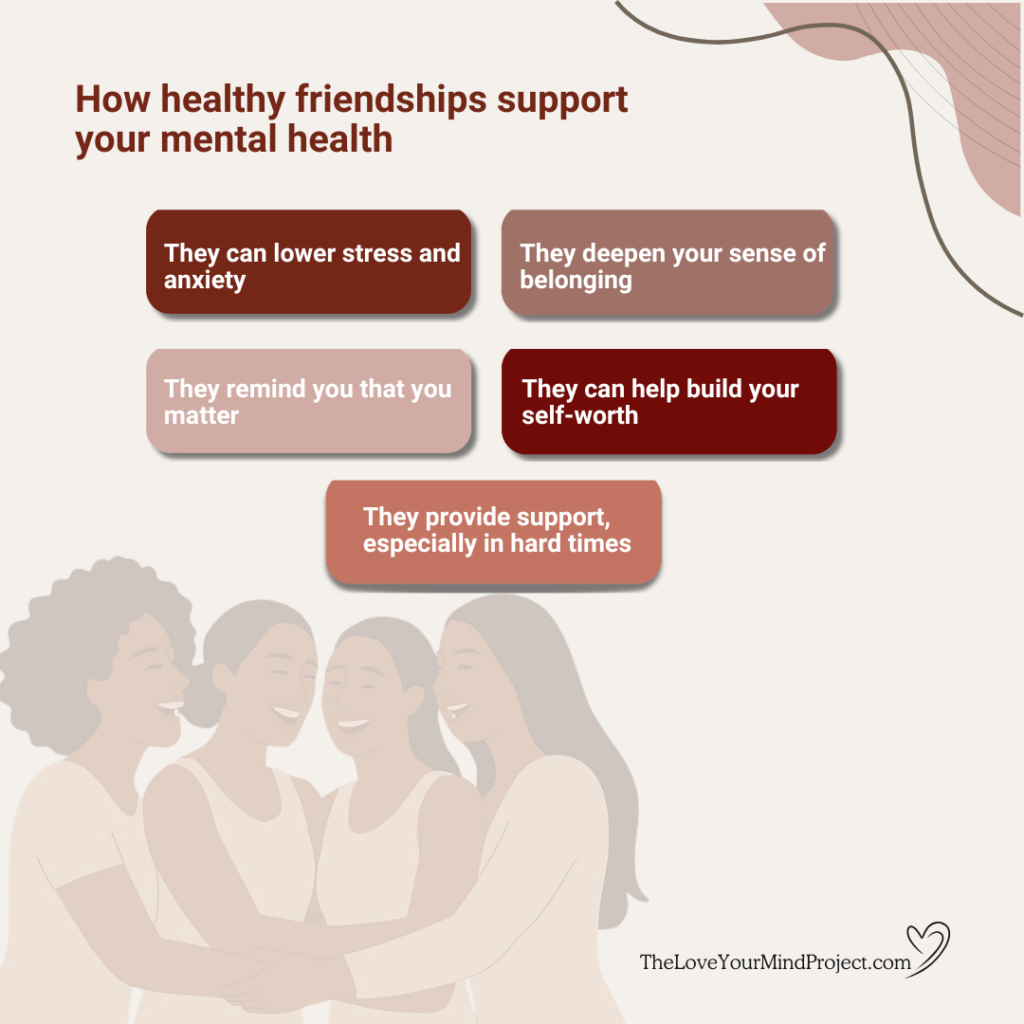

They can lower stress and anxiety
There’s a reason laughing, singing, dancing, or sharing a meal with your best friend feels so good.
Connection releases endorphins—the feel-good chemical in the body that helps calm your nervous system and counter your stress response.1 It’s why friendship can leave you feeling more relaxed and ease symptoms of stress, anxiety, and depression.
And the friendship benefit goes beyond improving your mood. The release of endorphins also supports your body’s ability to recover from the physical effects of stress.
If you tend to experience ongoing stress or emotional strain, a quality friend could help you exhale and let go.
They deepen your sense of belonging
You’re wired for connection.
Really, it’s biological. Since the beginning, our survival has depended on being a part of a group.
And because these bonds were for our protection, the brain learned to reward connection and signal distress when it’s missing.1
It’s why you can feel settled and secure when you have spaces where you truly belong—and on edge or on high alert when you don’t.
So those friendships where you don’t have to shrink or hide any parts of you are doing heavy lifting—reminding you that you’re not alone.
They remind you that you matter
Knowing that you matter is considered a basic human need.2
“Mattering” is understanding your importance—that you’re worth checking in on, talking to, and being cared for. It also includes what you bring to the table—the value you add to the friendship.
Yet in many spaces, we often feel overlooked, undervalued, or invisible.
Healthy friendships can be a remedy. They reaffirm that you’re seen, appreciated, and needed—which can be invaluable in seasons of self-doubt, excessive criticism, or an overall low mood.
They can help build your self-worth
Your self-worth is your perspective, but your friendships can strongly influence it.
Psychologists call it relational self-esteem. It’s how you see yourself through the lens of your closest relationships, like family or friends.
And the impact isn’t small. Some psychologists suggest that friendships can affect your self-esteem more significantly than your personal self-view.3
It’s why supportive friendships can improve your sense of meaning and belonging, increasing your self-worth. And toxic bonds can chip away at your sense of self and fuel self-doubt.
In fact, one study suggests that low relational self-esteem is more directly linked to depression and anxiety than low personal confidence.
They provide support, especially in hard times
Life can bring difficult seasons—loss, illness, uncertainty, disappointment. And in those moments, friendship can move beyond companionship. It can feel like a lifeline.
In hard seasons, being around a supportive friend can help calm your nervous system. It’s called co-regulation, and it’s like borrowing someone else’s calm when yours feels out of reach.
Leaning on others when you’re emotionally vulnerable may sound like the opposite of what a “strong Black woman” does. But allowing a friend to hold space for your emotions may actually be more effective than trying to self-soothe.4
So, you don’t have to carry everything on your own or endure hard seasons by yourself. Go ahead and lean on your circle. It’s not a weakness—it’s essential.
What happens when we don’t have healthy friendships?
The mental health benefits we receive from friendships may seem like a nice-to-have, but they’re not.
Without meaningful connections, our mental health can suffer.
Loneliness affects your mind and body. Like many other difficult emotions, it can put your nervous system on high alert, as if you’re dealing with a threat. This stressed state can amplify feelings of sadness, self-doubt, and fatigue—and even contribute to depression and anxiety over time.1
Chronic loneliness can also show up physically, impacting your immune system and potentially leading to serious health risks.
This isn’t to alarm you, but to show just how important meaningful connection is to your overall wellness. We all need it—not constant access to people. Not performative closeness. But real bonds—the kind that leave you feeling supported, understood, and valued.
Why making and keeping friends can feel so hard
If friendship feels harder as an adult, that’s because for many of us, it is.
Adulthood brings busy schedules, caregiving, work demands, and just limited energy overall to pour into relationships.
But sometimes, it’s a bit deeper.
Past hurt, rejection, social anxiety, or low self-worth can make friendship feel risky or not worth it. You may have had relationships ruined by gossip, betrayal, or competition—sometimes from the people you trusted most. Those kinds of wounds don’t just disappear.
Or maybe it’s hard to open up. If in the past, your vulnerability was met with criticism or rejection, genuine friendship can feel scary.
If you struggle to make friends or find supportive connections, it doesn’t mean anything is wrong with you. You’re not broken, cold, or undeserving.
You’re simply human and may need the space to heal and recoup while you find your tribe.
Naming those needs is an important first step. Because healthy friendships are worth having—and worth building.
Friendship and mental health FAQs
Are friendships important for your mental health?
Yes, quality friendships are essential for our mental health. They can reduce feelings of loneliness, stress, anxiety, and depression. Healthy friendships can also deepen your sense of belonging and help you get through hard times.
How do you know if a friendship is affecting your mental health?
You might constantly feel drained, anxious, or like you have to hide parts of yourself to keep the peace. While no friendship is perfect, healthy ones should feel more supportive than stressful.
How can you make new friends as an adult?
Look for spaces where connection can happen naturally—shared activities, community groups, or places where you see the same people regularly. Take your time and let it build slowly. And if the friendship doesn’t click, try not to take it personally. A meaningful bond can take time to find.
References
Last accessed April 2026
- Dunbar, R. I. M. (2025). Why friendship and loneliness affect our health. Annals of the New York Academy of Sciences, 1545(1), 52–65. https://doi.org/10.1111/nyas.15309 ↩︎
- Scarpa, M. P., Di Martino, S., & Prilleltensky, I. (2021). Mattering Mediates Between Fairness and Well-being. Frontiers in Psychology, 12. https://doi.org/10.3389/fpsyg.2021.744201 ↩︎
- Li, J., Zeng, M., Liu, M., Zhao, X., Hu, W., Wang, C., Deng, C., Li, R., Chen, H., & Yang, J. (2021). Multivariable pattern classification differentiates relational self-esteem from personal self-esteem. Social Cognitive and Affective Neuroscience, 16(7), 726–735. https://doi.org/10.1093/scan/nsab053 ↩︎
- Co-regulation: Self-Sufficiency’s Greatest Achievement. (2026). Psychology Today. https://www.psychologytoday.com/us/blog/a-new-gps-for-intimate-relationships/202603/co-regulation-self-sufficiencys-greatest ↩︎

- Friendship and mental health: How healthy friendships support your well-being - April 9, 2026
- Coping with a cancer diagnosis: Protecting your mental health when your life turns upside down - April 2, 2026
- Can anxiety or depression make you tired? How mental strain drains your energy - March 26, 2026