
Constant exhaustion can feel like a different kind of tired—one that doesn’t get better with sleep, spa days, or nights in.
It’s the type of ongoing fatigue that’ll leave anyone wondering, why am I so tired all the time? So first, know you’re not alone.
But it’s also not something to push through, especially when it leaves you feeling depleted, irritable, and unmotivated.
Instead, it’s worth understanding what’s going on, so you’re not constantly living on empty.
Let’s explore common reasons you may feel tired all the time—from burnout and emotional exhaustion to sleep issues and possible health concerns. Because when your body is signaling for help, it’s okay to listen.
What your body needs to truly feel rested
To better understand what may be behind constant exhaustion, let’s first discuss what quality rest actually means.
Quality rest isn’t just about how many hours you sleep—it also depends on whether your mind and body have the chance to release tension and recover.
According to Dr. Saundra Dalton-Smith, author of Sacred Rest, there are seven types of rest your body may need.1 Here are four that can play a major role in you feeling tired all the time.
Physical rest: Recovering from physical strain that can fatigue the body. This includes passive rest like sleep, as well as active rest like stretching, yoga, or massage.
Mental rest: Giving your mind a break from racing thoughts, worries, to-do lists, and other mental tasks that keep the nervous system on high alert.
Sensory rest: Our environments constantly stimulate us, whether we’re caring for children or pets, listening to music, watching TV, or scrolling through social media. Intentional quiet time can help the nervous system wind down.
Emotional rest: Suppressing emotions can keep the body’s stress response activated. Acknowledging your feelings and allowing space to process them can help you relax and recover.
Dr. Dalton-Smith also highlights social, creative, and spiritual rest as important forms of restoration. The common thread—having safe spaces where you can be authentic and let your guard down—something many of us don’t feel we have the permission to do.
6 possible reasons you’re tired all the time
There isn’t one universal answer to “Why am I so tired all the time?” But several common factors can contribute. See if any of these resonate with you.
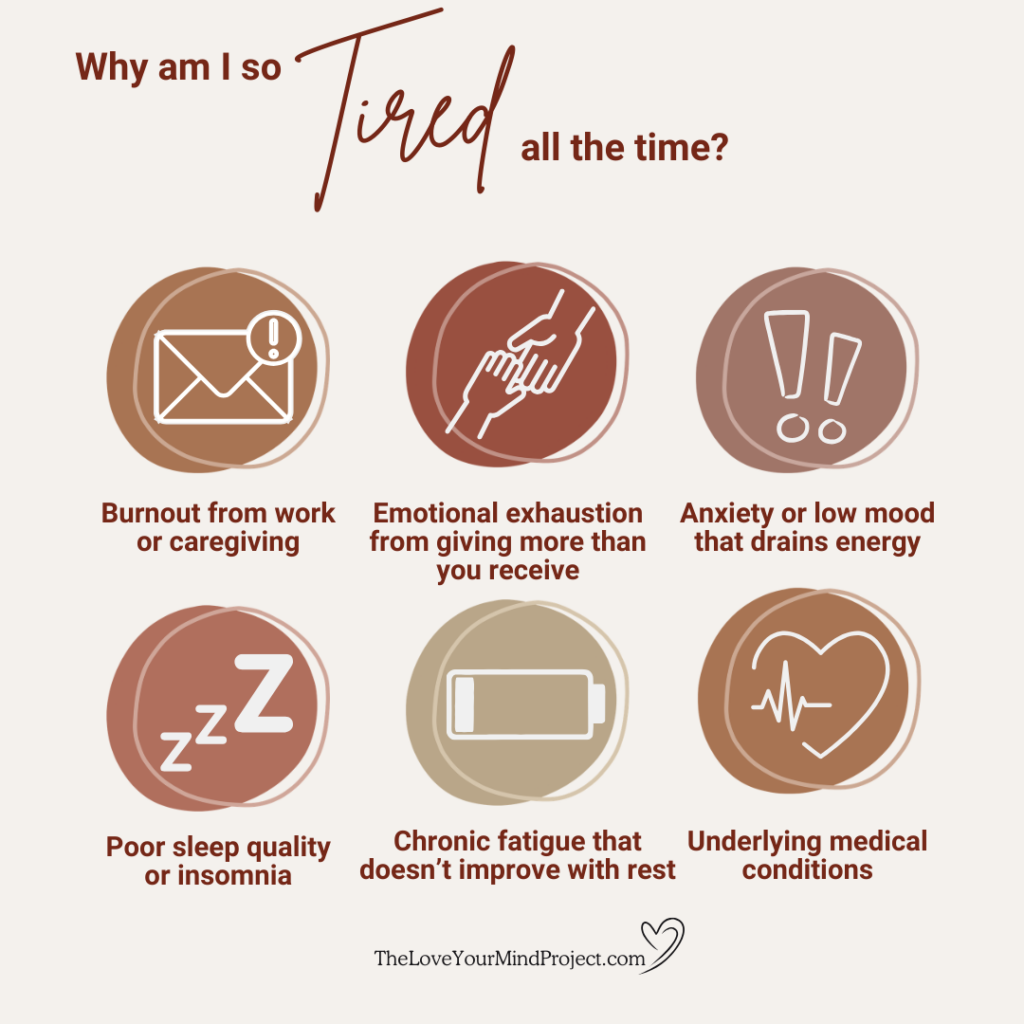

Burnout from work or caregiving
Burnout usually refers to exhaustion, often from work, caregiving responsibilities, parenting, community involvement, or other demanding roles.
The World Health Organization describes burnout as a work-related response to chronic stress that shows up in three main ways2:
- Exhaustion: Feeling drained or lacking energy.
- Detachment: Developing a negative or distant attitude toward the source of stress.
- Diminished sense of accomplishment: Feeling less productive or less confident in your ability to perform well.
If your exhaustion feels tied to constant output with little time to recover, burnout may be part of the picture.

Emotional exhaustion from giving more than you receive
Emotional exhaustion is slightly different from burnout. It’s less about physical or work-related demands and more about what you expend emotionally.
It can happen when you:
- Regularly prioritize others’ needs over your own.
- Feel responsible for everyone else’s well-being.
- Rarely feel supported, poured into, or emotionally cared for.
When you constantly give more than you receive, it can create a deep emotional deficit. While you may still show up for work, family, and other responsibilities, on the inside, you could feel completely depleted.
You might notice irritability, low energy, lack of motivation, emotional numbness, or an urge to withdraw. Some of us may even begin to shut down emotionally.
This type of fatigue rarely goes away with a nap. Your body may need emotional restoration—space to feel and be seen, supported, and cared for.

Anxiety or low mood that drains your energy
Constant mental strain—like what can come with anxiety or depression—can quietly drain your energy and make it harder to achieve quality rest.
Anxiety keeps your body in survival mode—a heightened fight-or-flight response that often leaves the nervous system in overdrive.
Low mood or depression may contribute to persistent fatigue, loss of motivation, and a heavy or sluggish feeling in the body.3
If you feel overwhelmed, emotionally numb, or persistently low, your energy levels may reflect the mental and emotional strain you’ve been carrying.

Poor sleep quality or insomnia
Trouble falling or staying asleep or reaching deep, restorative levels can leave you feeling drained, unfocused, and less able to cope with everyday stress.4
Without quality sleep:
- It becomes harder to process emotions.
- Stress levels remain elevated.
- You may feel more irritable, reactive, or sensitive to stress.
- Memory, focus, and decision-making can suffer.
- Anxiety or depression symptoms can worsen.
If you rarely feel truly rested after sleep, the issue may not be how long you sleep, but the quality of your sleep.

Chronic fatigue that doesn’t improve with rest
Chronic fatigue is a general term healthcare providers may use to describe exhaustion that lasts for months and doesn’t improve despite your efforts to rest more, reduce stress, or take more days off.
This persistent fatigue can be linked to several factors, including burnout or emotional exhaustion mentioned above, as well as long-term stress, hormonal imbalances, poor nutrition, or other underlying health concerns.
If your exhaustion feels long-lasting, unexplained, or debilitating, it’s worth discussing with a healthcare professional who can help you get to the source.

Medical conditions that can cause ongoing fatigue
Several health conditions can contribute to feeling tired all the time.5 Some of the more common ones include:
- Sleep disorders like sleep apnea or restless legs syndrome.
- Hormonal or metabolic disorders like hyperthyroidism or type 2 diabetes.
- Inflammatory conditions like rheumatoid arthritis or inflammatory bowel disease.
- Nutrient deficiencies like low iron, vitamin D, or vitamin B12.
If fatigue continues despite changes to your routine or sleep habits, your doctor can evaluate your symptoms and medical history to help determine what might be the underlying cause.
When to consider professional support
Sometimes feeling tired all the time is your body’s way of signaling that you could use some additional support—and that’s okay.
As Black women, it may seem easier to push through exhaustion to prove that we’re strong, capable, and dependable. But constant fatigue isn’t a character flaw, and seeking help doesn’t make you weak.
Consider reaching out to a healthcare provider if:
- The exhaustion makes it difficult to function day to day.
- Your tiredness stays the same or worsens over several months.
- You feel anxious or in a low mood more often than not.
- You feel emotionally overwhelmed, drained, or disconnected.
Listening to your body is one of the most powerful ways you can care for yourself, allowing space to rest, heal, and build strength.
Why am I so tired all the time? FAQs
Why am I always tired with no energy?
Persistent low energy can come from many factors, including chronic stress, poor sleep quality, emotional exhaustion, or underlying health conditions. If it doesn’t get better with rest or lifestyle changes, a healthcare provider can help identify the root cause.
What are the red flags that fatigue is serious?
Signs that you could use professional support include exhaustion that lasts several months, interferes with daily activities, or makes it difficult to concentrate, sleep, or make decisions.
How do you treat constant fatigue?
The best treatment depends on the underlying cause. Some strategies could include improving sleep habits, reducing stress, adjusting your workload, or ruling out or addressing medical conditions. Working with a healthcare provider is the best way to identify the root cause and find the most appropriate treatment.
References
Last accessed March 2026
- Dalton-Smith, S. (2017). Sacred rest: Recover your life, renew your energy, restore your sanity. FaithWords. ↩︎
- World Health Organization. (2019, May 28). Burn-out an “occupational phenomenon”: International Classification of Diseases. https://www.who.int/news/item/28-05-2019-burn-out-an-occupational-phenomenon-international-classification-of-diseases ↩︎
- National Institute of Mental Health. (2024). Depression. https://www.nimh.nih.gov/health/topics/depression ↩︎
- Sleep Foundation. (2025). Why do we need sleep? https://www.sleepfoundation.org/how-sleep-works/why-do-we-need-sleep ↩︎
- Mayo Clinic. (2026). Fatigue. https://www.mayoclinic.org/symptoms/fatigue/basics/causes/sym-20050894 ↩︎

- How to be vulnerable in a relationship when opening up feels scary - September 17, 2026
- When only needing “me, myself, and I” leaves little room for love - September 11, 2026
- Everyone eventually leaves me: How fear of abandonment gets in the way of love - September 4, 2026