Meditation for sleep isn’t as complex or “spooky” as you may think. Learn more about this gentle way to quiet thoughts, release tension, and find deeper rest.
If the moment your head hits the pillow, your mind starts racing, replaying conversations, creating to-do lists, or worrying about the unknown, you could use a proven technique to gently wind down and let go.
Meditation for sleep might be the missing piece for Black women whose minds stay “on” long after the body wants rest.
And if you’re wondering, does it really work? Will it conflict with my beliefs? You’re in the right place. This guide breaks down what meditation really is and how this practical, evidence-based tool can help us do what so many of us aren’t used to—letting our minds be still.
>> TAKE THE QUIZ: What is it you need most right now?
What's in this article?
What is sleep meditation?
Sleep meditation is the practice of focusing your attention—usually on something calming, like your breath, a soothing sound, or a positive phrase—to help you drift naturally into restful sleep.1
It doesn’t require you to sit cross-legged, chant, or try to achieve some transcendent out-of-body experience. It’s simply a mental exercise—one that teaches you to acknowledge thoughts and let them pass instead of chasing every worry that pops up.
>> MORE: Try these daily habits for those hard seasons
Can meditation really help you sleep?
Yes—and research shows it.
A 2019 analysis of several studies found that mindfulness meditation improved sleep quality and can be as effective as other treatments like cognitive behavioral therapy and exercise. Studies have also shown that meditation can reduce anxiety and stress—two of the biggest culprits behind sleepless nights.2
How meditation for sleep calms the mind and body
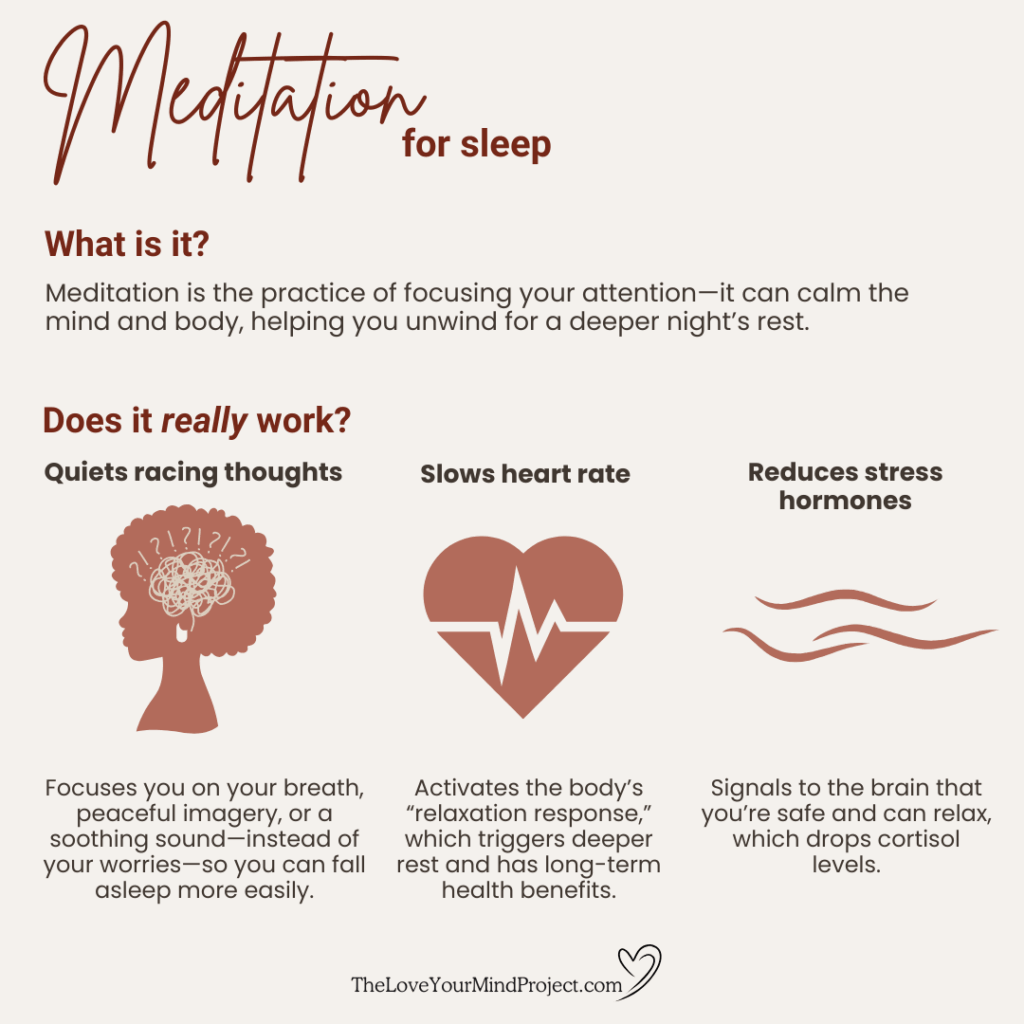
When we’re stressed, the body releases stress hormones, speeds up the heart rate, and keeps us on high alert—the fight or flight response.3 Meditation can counter these effects by:
- Quieting racing thoughts: Focusing on your breath or an affirmation allows anxious thoughts to fizzle out like a fire.4
- Slowing the heart rate: Meditating can activate the parasympathetic nervous system—the body’s “rest and digest” response—which counters fight or flight mode and even has long-term benefits like lowering blood pressure.5
- Reducing stress hormones: Meditation involves deep, intentional breathing, which signals to the brain that you’re safe, leading to a drop in cortisol levels.2
>> WANT MORE? Subscribe for more Black women’s wellness straight to your inbox (because you deserve it)
Simple sleep meditation techniques to try tonight
You don’t need candles, incense, or hours of silence to get started (although feel free to take it there if you like!). All you need for these beginner-friendly techniques is to get comfortable.
Focused breathing to exhale stress
Lie down, close your eyes, and take slow, deep breaths, noticing everything you can about it—how it enters your nose, fills your body, and leaves your mouth.
You can try a breathing method, like 4-7-8 breathing: Inhale through your nose for four counts (at a comfortable pace), hold for seven, and exhale through your mouth for eight. Longer exhales signal to your body that you’re safe and can relax.6
Your mind will wander. Just gently bring it back to your breath, without judgment.
Visualization to limit distractions
Picture a peaceful scene—waves rolling onto the shore, sunlight peaking through trees, or a cozy room. With that image in mind, engage all your senses. What do you see, hear, smell, and feel in this place?
Visualization gives the mind a calming focal point, allowing your worries to fade into the background. Keep bringing your mind back to this imaginary place, slowing your breathing as you do, until you drift off to sleep.
>> MORE: Explore these apps for anxiety to calm your overactive mind
Body scanning to release tension
Mentally “scan” your body from head to toe, searching for areas with tension, and relaxing them.
Start with your toes, noticing any areas of tightness. With each exhale, relax the tension. Move up to your feet, legs, abdomen, and so on—until you reach the top of your head. For each part of your body, ask yourself, Am I really relaxed? If the answer is yes, try to relax even deeper.
This exercise can be especially powerful if you carry tension in your neck, shoulders, or jaw. You may be surprised by how much stress your body holds even while lying down.
Progressive muscle relaxation to truly unwind
This technique takes body scanning a step further. As you focus on the different parts of your body, you’ll gently tense the muscles for a few seconds, and then exhale to release the tension.
Move from your feet to your legs, abdomen, arms, neck, and face. For example, curling your toes or flexing your feet for a few seconds, and then releasing. Each release helps your body sink deeper into rest.
Guided meditations for extra support
If you want a little more support, try a guided sleep meditation. A calm voice can help direct your focus and ease you into rest.
Apps like Listen to Sleep and Insight Timer offer free bedtime meditations, affirmations, and sleep stories.
>> MORE: Is therapy worth it? Here’s how it can help you heal
Do Black women really meditate?
Yes, we do! And those of us who don’t should really consider it. Here’s why.
Some of us may be conditioned to “carry it all” while suppressing how we feel.7 But unaddressed stress stays in our bodies—hijacking our health and stopping us from much-needed rest and recovery.8 Meditation can be one way to pause, release, and put down that “strong Black woman” armor.
And whether you’re Christian, Muslim, or not affiliated with any religion, meditation can work for you because it’s simply a tool to focus your mind. What you focus on is entirely up to you. For example, many Christians choose to meditate on scripture or prayer.
We all meditate on something. Anxiety can keep our minds on future worries, while depression leaves us stuck on past mistakes. By practicing mindful meditation, you can notice and redirect your focus to what gives you life, peace, and rest.
>> MORE: A Black woman’s guide to loving the mind
Get started on more restful nights
Even the most restless mind can learn to slow down with regular sleep meditation. Start small—a few minutes before bed—and build from there. Aim for consistency. The more you signal it’s time to relax, the easier your mind and body can recognize the cue.
And give yourself grace as you try something new.
Meditation for sleep FAQs
Is meditation okay for Christians?
Yes, Christians can meditate—and many do. The Bible mentions focusing your mind or thoughts quite a bit (Psalm 27:4, Isaiah 26:3, Colossians 3:2). It’s one way to connect more deeply with God and grow our faith. You can meditate on scripture, a song of worship or praise, prayer, or whatever God has on your heart in that moment.
What’s the best meditation for sleep?
Start with what feels easiest. Guided meditation can be great for beginners who can simply follow the lead of the instructor. It’s okay to try different methods to see what works for you. You may find you need to switch it up depending on the type of day.
How long should I meditate before bed?
Even five minutes can help quiet your mind, especially if you meditate regularly. But the goal isn’t a strict regimen—it’s getting your body to recognize the cue to relax, helping you fall and stay asleep.
References
Last accessed October 2025
- Clinic, C. (2023, May 12). 4 Benefits of Sleep Meditation and How To Do It. Cleveland Clinic. https://health.clevelandclinic.org/sleep-meditation ↩︎
- Meditation and Mindfulness: Effectiveness and Safety. (2020). NCCIH. https://www.nccih.nih.gov/health/meditation-and-mindfulness-effectiveness-and-safety ↩︎
- Stress. (2018, November). Stress effects on the body. Https://Www.apa.org. https://www.apa.org/topics/stress/body ↩︎
- How meditation helps with depression – Harvard Health. (2018, August). Harvard Health. https://www.health.harvard.edu/mind-and-mood/how-meditation-helps-with-depression ↩︎
- How Does It Work? (2021, December 23). Spencer Fox Eccles School of Medicine | University of Utah Health. https://medicine.utah.edu/students/wellness/what-is-wellness/mindful-meditation/how-does-it-work ↩︎
- Longer Exhalations Are an Easy Way to Hack Your Vagus Nerve. (2019). Psychology Today. https://www.psychologytoday.com/us/blog/the-athletes-way/201905/longer-exhalations-are-an-easy-way-to-hack-your-vagus-nerve ↩︎
- Woods-Giscombe, C., Robinson, M. N., Carthon, D., Devane-Johnson, S., & Corbie-Smith, G. (2016). Superwoman Schema, Stigma, Spirituality, and Culturally Sensitive Providers: Factors Influencing African American Women’s Use of Mental Health Services. Journal of Best Practices in Health Professions Diversity : Research, Education and Policy, 9(1), 1124. https://pmc.ncbi.nlm.nih.gov/articles/PMC7544187/ ↩︎
- Chronic stress puts your health at risk. (2025). Mayo Clinic. https://www.mayoclinic.org/healthy-lifestyle/stress-management/in-depth/stress/art-20046037 ↩︎