Emotions aren’t good or bad—they’re neutral signals that help you understand and care for your emotional needs.

Judging your emotions can be subtle. It may sound like:
Toughen up. You’re stronger than this.
Why are you crying? Just get over it.
Stop complaining and be grateful.
You may have the best intentions—trying to motivate yourself, focus a bit more, or just get through the day.
But criticizing yourself for how you feel often has the opposite effect—making emotions heavier and harder to process.
This guide explains what it really means to judge your emotions, why it’s so common yet so harmful for Black women, and what helps instead.
What's in this article?
Understanding emotions (and why they aren’t right or wrong)
Judging your feelings could come from a misunderstanding of what emotions actually are.
But they aren’t good or bad. They aren’t moral failures. They’re pieces of information.
When you see emotions as data rather than defects, it becomes easier to stop judging them and start listening instead.

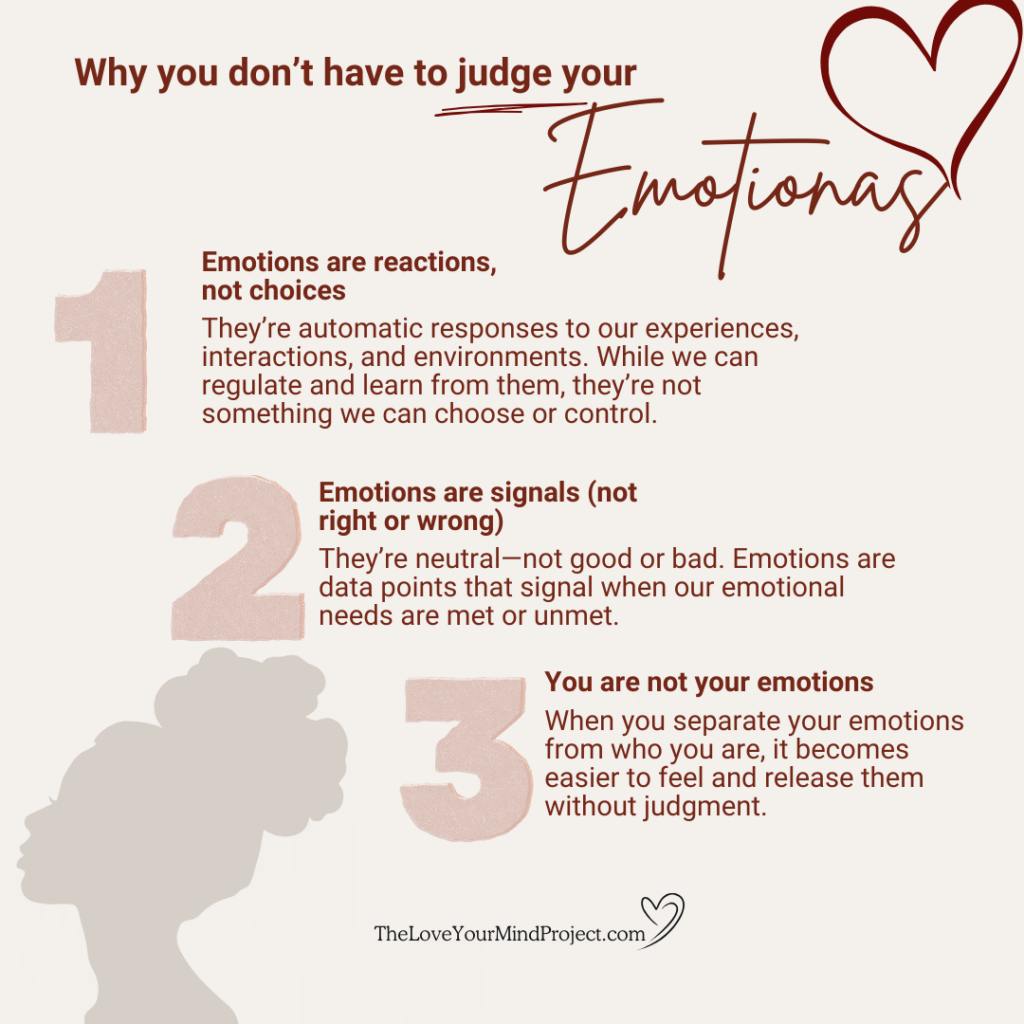
Emotions are reactions, not choices
We don’t control our emotions. They’re automatic responses to experiences, interactions, and environments.
Difficult emotions usually signal a perceived threat1—like moments when you feel powerless, dismissed, unseen, unsafe, or inadequate.
And for many of us, these experiences aren’t rare. So when your body reacts, it makes sense.
There’s no shame in a natural response from your nervous system.
You’re not choosing to feel anxious, sad, angry, or overwhelmed. And you can’t simply will fear or grief out of existence.
Heavy emotions arise to let you know something is off—not that you’re doing something wrong.
Emotions are signals (not right or wrong)
Emotions are neutral—not good or bad. Yes, they can be positive and negative in how we experience them. But there is no moral code when it comes to how we feel.
Some experts liken emotions to data points—physical indicators, like hunger or thirst. When you feel hungry or thirsty, it’s not right or wrong, but a signal of a need.
Positive emotions can indicate satisfaction, while negative ones can point to a lack of physical or emotional safety.
You are not your emotions
Sometimes we judge how we feel because of what we think those emotions say about us.
But an emotion is something you experience—not who you are.
Try to notice the belief behind your self-judgment. You can feel sad without being weak. You can feel anger without being “too much.”
When you separate your self-worth from your feelings, it becomes easier to let emotions come and go without condemning yourself.
Why it’s so easy to judge your emotions
The tendency to judge your feelings doesn’t come out of nowhere. For many of us, it’s learned.
Self-judgment can be a survival strategy used to:
- Demonstrate strength: If you’re labeled “too sensitive” when you show emotions, you may criticize yourself whenever difficult ones come up.
- Align with spiritual beliefs: When you’re taught that anxiety means a lack of faith, or sadness reflects ingratitude, you may shame yourself for experiencing very human emotions.
- Meet cultural expectations: Many of us are expected to prioritize everyone else’s needs, so tending to our own can feel selfish.
Over time, we can internalize these messages, making normal emotional responses feel dramatic, excessive, or wrong—even when they aren’t.
What happens when you judge how you feel
Judging your emotions doesn’t make them disappear. If anything, it can add another layer of distress.
Self-judgment can:
- Intensify emotional pain—like feeling overwhelmed, tense, or stuck in negative thought patterns.2
- Make it harder to cope with life’s challenges.
- Leave you disconnected from your emotional needs.
- Make it harder to acknowledge, process, and release what you’re feeling.
Prolonged emotional stress can keep the body’s stress response activated and the nervous system on high alert.3 Over time, this may contribute to anxiety, depression, or shutting down emotionally.
Not because you’re broken. But because your emotions have been repeatedly pushed aside—even if by you.
How to respond when you feel yourself judging your emotions
When you catch yourself judging how you feel, you don’t have to “think positive” or rush to fix anything.
Instead, try this four-step approach.
- Acknowledge: Name what you’re feeling without explaining, minimizing, or trying to solve it.
- Accept: Remind yourself that feelings may be uncomfortable, but they aren’t right or wrong. It’s okay to feel however you feel.
- Affirm: Validate your emotional response. Because given your experiences, they make sense.
- Allow: Give yourself permission to feel without judging. Emotions can pass naturally when they aren’t resisted or criticized.
And if any of these steps feel too overwhelming to try on your own, consider therapy to help you heal. You can find a culturally competent therapist who gets your unique experiences and can help you learn healthy ways to respond to your emotions.
Judging your emotions: FAQs
What does it mean to judge your emotions?
Judging your emotions usually means labeling them as wrong, weak, or unacceptable. It can show up as self-criticism, shame, or dismissing yourself whenever you feel uncomfortable emotions.
Is judging your emotions bad?
It’s not morally bad, but it is unhelpful. Self-judgment can intensify difficult emotions and make them harder to process. Over time, this added emotional strain can increase stress and wear on your mental and physical well-being.
Can emotions be right or wrong?
No. Emotions are neutral. They’re natural responses to your experiences. Some feel pleasant, others feel uncomfortable—but they’re not morally good or bad. When you begin to see your emotions as information instead of flaws, you create space to heal, respond, and grow from challenging moments.
References
Last accessed February 2026
- Šimić, G., Tkalčić, M., Vukić, V., Mulc, D., Španić, E., Šagud, M., Olucha-Bordonau, F. E., Vukšić, M., & R. Hof, P. (2021). Understanding Emotions: Origins and Roles of the Amygdala. Biomolecules, 11(6), 823. https://doi.org/10.3390/biom11060823 ↩︎
- Barcaccia, B., Baiocco, R., Pozza, A., Pallini, S., Mancini, F., & Salvati, M. (2019). The more you judge the worse you feel. A judgemental attitude towards one’s inner experience predicts depression and anxiety. Personality and Individual Differences, 138(138), 33–39. https://doi.org/10.1016/j.paid.2018.09.012 ↩︎
- Mariotti, A. (2015). The Effects of Chronic Stress On Health: New Insights Into the Molecular Mechanisms of Brain–Body Communication. Future Science OA, 1(3). https://doi.org/10.4155/fso.15.21 ↩︎