Validate what you’re going through and set emotional boundaries—two ways to deal with a toxic boss without shrinking yourself or pretending everything is fine.

There are few things more draining than reporting to a manager who seems to have it out for you or, at the very least, doesn’t support you.
Whether you’re navigating passive-aggressive emails, excessive public criticism, or an inexplicable workload, you’re right to think that you deserve better.
And while you may not be able to change your boss’s behavior or your job right now, you can take steps to protect your peace at work.
This guide walks through how to deal with a toxic boss in ways that honor you—your mental health, your dignity, and your long-term well-being.
What's in this article?
What is a toxic boss?
A toxic boss is one whose actions fuel a negative, harmful, or dysfunctional work environment.
This isn’t just a “tough” manager with high standards, or someone with personality quirks or an occasional bad day. Toxic bosses show a pattern of behavior and can lack empathy or regard for their team’s well-being.1
When the very person assigned to guide and support you becomes the source of confusion, manipulation, or emotional abuse, it can take a toll.
How working for a toxic boss affects your mental health
Working for a toxic boss can erode your well-being over time in quite a few ways. Here are common examples:
- Chronic stress: An environment where you’re constantly expecting criticism, mood swings, or last-minute demands can trigger high stress2 that, when prolonged, impacts several parts of the body—including heart, digestive, and reproductive health. 3
- Damaged self-esteem: Gaslighting, dismissiveness, or continual disapproval can make even the most capable person question their competence.
- Emotional exhaustion: You don’t have to work nights and weekends to experience burnout. Dealing with unclear expectations, little support, or micromanagement can leave you mentally fatigued.4
- Anxiety or depression: Intense work dread, racing thoughts, or feeling low or emotionally numb are common responses to chronic workplace stress.2
Signs of a toxic boss
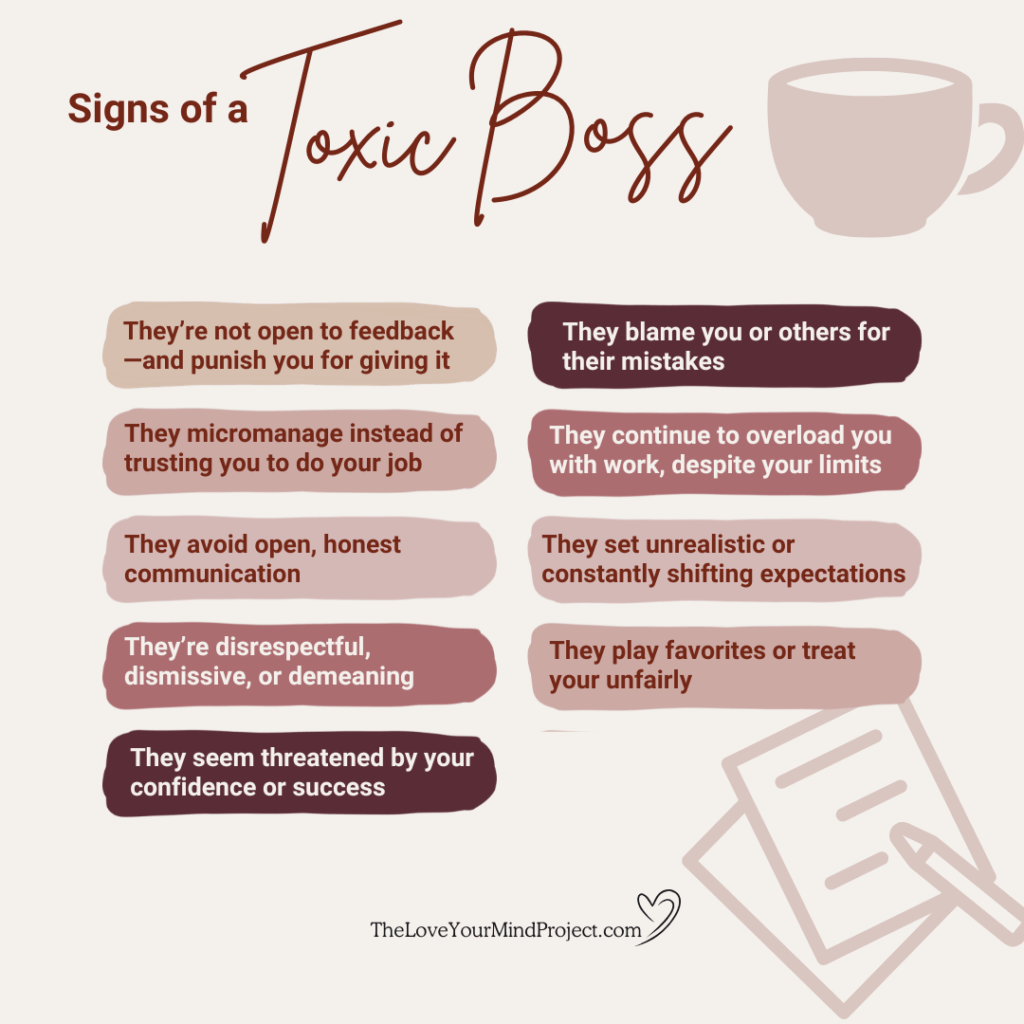
Not all toxic-boss behavior is loud or obvious. Sometimes it’s subtle, but just as damaging. Common patterns could include:
- They’re not open to feedback—and punish you for giving it.
- They micromanage instead of trusting you to do your job.
- They avoid open, honest communication or are often passive-aggressive.
- They’re disrespectful, dismissive, or demeaning.
- They seem threatened by your confidence or success.
- They blame you or others for their mistakes.
- They continue to overload you with work—even when you’ve communicated your limits.
- They set unrealistic or constantly shifting expectations.
- They play favorites or treat you unfairly.
If any of this resonates, you’re not being “too sensitive” or asking for too much. Healthy leadership is supportive and encourages growth—it’s not belittling or controlling to boost their ego.
Why these bosses can be especially toxic for Black women
Toxic leadership can affect anyone. But for many Black women, it can feel especially destructive.
With much of our behavior and responses rooted in survival, we can build a high tolerance for toxic behavior in the workplace. We see a lot of this in what’s known as the “strong Black woman” schema.5 For example:
- We’re often used to minimizing our needs being minimized (by ourselves or others).
- We try to outwork the harm, hoping that if we do more, we’ll gain respect or job security.
- We may avoid speaking up for ourselves out of fear of being labeled “difficult” or facing retaliation at work.6
- We feel alone because we often are, with fewer advocates or people who look like us in leadership positions.
- We tolerate what we have to out of financial necessity.
Trauma responses can’t be the standard. You deserve emotional safety, dignity, and respect—yes, even at work.
How to deal with a toxic boss (without losing yourself)
You don’t need to get your boss fired. But you don’t have to accept harmful behavior either. These steps focus on protecting you, not fixing your boss.

Start by validating your experience
An important step in dealing with a toxic boss is acknowledging your reality. The barriers, frustration, and pain you feel at work are real. And wanting to improve your situation is absolutely okay.
You don’t have to compare yourself to coworkers who seem “fine” or to older generations who tell you to be grateful for a job. This is your lived experience. That means you know what you’re going through better than anyone else. Trust yourself.
Process the emotions, instead of suppressing them
Difficult feelings like anger, sadness, resentment, anxiety, or self-doubt are normal reactions to a toxic work environment.2 So you don’t have to be ashamed of your emotions or feel pressure to ignore or get over them.
Process what you feel by simply noticing and letting it out through journaling, reflection, or talking with a therapist.
When you name what you feel, you can release it—rather than internalize false narratives or hold that stress in your body.
Document your experiences
Keeping notes about troubling interactions or concerning behavior from your boss can protect you emotionally. It’ll remind you it’s not “all in your head,” and may even uncover those situations that trigger you more than others. In these moments, you can meet yourself with compassion—like take a pause, deep breaths, or stepping away if you can.
Set emotional boundaries
Your boss’s behavior is not a reflection of your competence or worth. Although it can be difficult, it’s important to emotionally separate yourself from what you’re experiencing at work.
Many of us pour so much into our jobs that they can feel like a part of who we are. But you can be passionate and high-performing without tying your identity to your boss’s approval.
When you start to question your value or hit a place where you never feel good enough, remind yourself that your worth is inherent and intact.
Leverage your safe space—inside and outside of work
Counter that tough work environment with intentional moments that help you decompress, feel seen, or just be—whether that’s time with family, friends, in therapy, or by yourself.
You might look into employee resource groups, or a regularly scheduled coffee break or lunch with trusted coworkers while in the office. Even brief moments can help you regulate work stress instead of pushing through it.
Address it at work (if you can do so safely)
If it feels safe, you may choose to have a conversation with your manager and/or HR about what’s not working and how it can improve. But you’re not required to do this, especially if you work in a retaliatory environment.
And remember, you’re not responsible for changing your boss.
Know your options if things don’t improve
There’s nothing wrong with exploring options that better support your well-being. And you don’t have to hit rock bottom to do so.
Take your time to know what’s available. This could look like stress leave, an internal transfer, or leaving the company.
But there’s no pressure.
You don’t need all the answers right now. Just know that your emotional and mental health are that important and worth addressing—always.
Remember, you’re not alone
If dealing with a toxic boss feels like heavy lifting, that’s because it is. And it’s okay to ask for help.
A harmful work environment might leave you feeling isolated or hopeless. Support, especially therapy, can help you rebuild your confidence and clarity as you decide your next steps.
And remember, you’re not the problem. You’re talented, capable, and worthy of a manager and workplace that respects you.
How to deal with a toxic boss FAQ
What are the signs of a toxic boss?
Common signs include micromanagement, lack of boundaries, disrespect, favoritism, and other behavior that consistently leaves you stressed, anxious, or doubting yourself.
Should I quit my job because of a toxic boss?
Only you can decide what’s right for you. Sometimes the job isn’t worth the toll on your physical and mental health. Other times, quitting isn’t financially possible. It’s okay not to have a clear answer just yet. Move at your own pace.
How do you survive a toxic boss when you can’t quit
Focus on meeting your emotional needs. Set boundaries to avoid internalizing their behavior. Lean into your safe spaces to process and release stress. Staying at the job doesn’t mean you have to accept toxic behavior. You can take care of yourself while you explore next steps.
References
Last accessed January 2026
- Coleman, J. (2025, June 26). The Toxic Boss: What to Watch For and How to Take Action. Axcethr.com; Axcet HR Solutions. ↩︎
- Cleveland Clinic. (2025, June 4). 11 Signs of a Toxic Work Environment. Cleveland Clinic. https://health.clevelandclinic.org/toxic-work-environment
↩︎ - (2018, November). Stress effects on the body. Https://Www.apa.org. https://www.apa.org/topics/stress/body
↩︎ - Know the signs of job burnout. (2025). Mayo Clinic. https://www.mayoclinic.org/healthy-lifestyle/adult-health/in-depth/burnout/art-20046642
↩︎ - Woods-Giscombe, C., Robinson, M. N., Carthon, D., Devane-Johnson, S., & Corbie-Smith, G. (2016). Superwoman Schema, Stigma, Spirituality, and Culturally Sensitive Providers: Factors Influencing African American Women’s Use of Mental Health Services. Journal of Best Practices in Health Professions Diversity : Research, Education and Policy, 9(1), 1124. https://pmc.ncbi.nlm.nih.gov/articles/PMC7544187/ ↩︎
- Women in the workplace 2024 THE 10TH ANNIVERSARY REPORT. (n.d.). https://cdn-static.leanin.org/women-in-the-workplace/2024-pdf ↩︎