Romantic relationships can bring unhelpful emotional patterns to the forefront.
Maybe you’ve been called “too needy” or “too closed off.”
Or perhaps you’ve heard no complaints from your partner, but you still feel like the relationship could end at any moment.
Why is love so hard?
It’s not that you’re bad at love, and you’re definitely not unlovable.
Romantic relationships can challenge the unhelpful emotional patterns many of us learned to rely on to feel safe, protected, or accepted.
This article explores four ways these patterns can show up—and how they can make giving and receiving love feel more complicated.
What are emotional patterns?
Emotional patterns are those thoughts, feelings, beliefs, and responses that tend to keep showing up in your life.
They matter because they can influence how you see yourself, interpret situations, and respond to the people around you, including romantic partners.
Some of these patterns can be helpful—like reminding yourself that mistakes don’t make you a failure.
Others can make life more difficult, like shutting down when you receive negative feedback.
The thought of being stuck in a pattern may feel frustrating. But don’t be quick to judge yourself. These habits aren’t always conscious decisions. They can be learned responses from past experiences—ways you adapted to situations that felt emotionally unsafe.
For example, if expressing your emotions repeatedly led to you being criticized or dismissed, you may have learned to keep your feelings to yourself.
But sometimes, you can hold on to beliefs and responses, even when they no longer serve you.
Healthy love requires emotional openness
Some of those familiar emotional patterns that protect you from hurt can also complicate romantic relationships.
That’s because healthy love requires vulnerability—a level of emotional openness where you can admit to your partner that you’re hurt instead of pretending you’re fine. Or trust that they’re being genuine unless they give you a reason to believe otherwise. Or simply allow yourself to lean on them even when you’re used to handling everything on your own.
So what happens when the habits and beliefs that helped you cope also keep you from the vulnerability a close relationship asks of you?
You might unintentionally shut out your partner, see every disagreement as a sign you don’t belong together, or simply have a hard time giving and receiving the love you deserve—no matter how badly you want to.
4 emotional patterns that can make love feel complicated
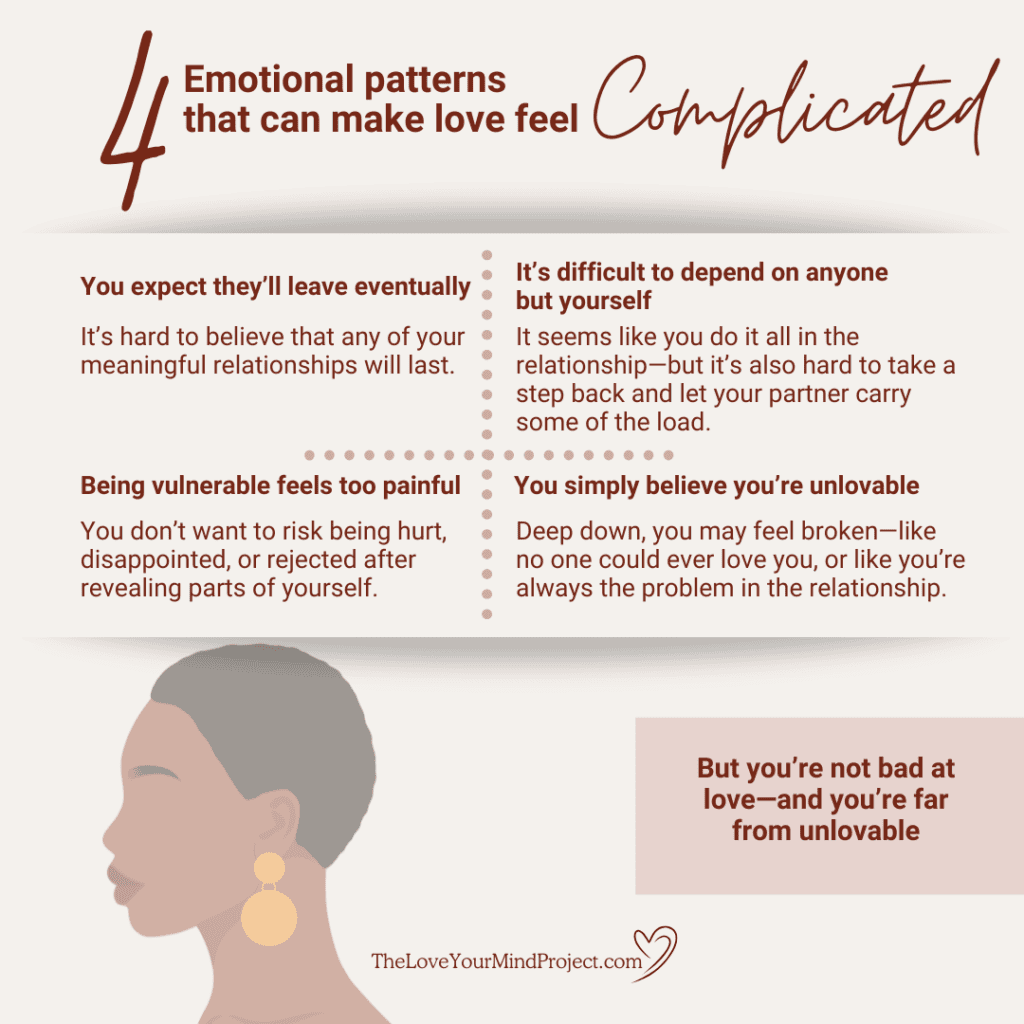
There are many ways emotional patterns can affect how you approach a romantic relationship.
If any of these feel familiar, know that it’s not a reason to judge yourself. The goal is to notice what may be getting in the way of the love you deserve.
You expect they’ll leave eventually
Your partner takes a while to respond to your text, and you wonder if they’re pulling away. Or a disagreement over where to go for date night leaves you wondering if the relationship is ending.
If it seems like you’re constantly worried they’ll leave, check out emotionally, or disappoint you, you could be dealing with fear of abandonment. It can stem from a deep-seated belief that your meaningful relationships simply won’t last.1
Past experiences with rejection, loss, or even a childhood where you never felt secure can contribute to this fear. And it can feed anxiety and doubt that leave you craving constant validation or evidence that they’re committed to you. You might even leave a good thing before they have a chance to leave you.
But you deserve to be present in a healthy relationship. And to accept the love you receive without always preparing to lose it.
It’s difficult to depend on anyone but yourself
It seems as if you’re the one who does it all in the relationship. You make the decisions, maintain your friendships as a couple—you may even take the lead with parenting, finances, household responsibilities, and everything in between.
This can feel frustrating, like you’re the manager in your relationship, not a romantic partner.
But here’s the tricky part: You may also have a hard time stepping back and letting your partner carry some of the load.
Handling everything yourself may feel more comfortable, predictable, or easier than depending on someone else. But when it gets in the way of having an equal partnership, you might be relying a little too much on yourself.
The problem isn’t that you’re independent—it’s feeling like you’re the only person you can truly depend on. That can leave you feeling alone, exhausted, and resentful in your own relationship.2
You deserve a relationship with balance. Where you both maintain your independence but can also rely on each other. This might even help you feel a deeper connection with your partner, knowing you’re truly in it together.
Being vulnerable feels too painful
At the first sign of a deep conversation or uncomfortable topic, you crack a joke, get defensive, or find a way to shut it down. Maybe you downplay how you really feel, work hard to hide your flaws—or maybe you simply never allow the relationship to get too serious.
These can be ways you protect yourself from emotional vulnerability. It’s the risk of being hurt, disappointed, or rejected after revealing sensitive parts of who you are.
The tendency to avoid vulnerability can stem from past experiences. Opening up may have led to someone criticizing, abandoning, or betraying you—or using your feelings against you.3 So keeping those parts of yourself hidden might feel safer.
But fear of vulnerability doesn’t just reduce the risk of being hurt—it can also make it harder to experience the intimacy that comes from being fully known and accepted.
When you don’t allow any vulnerability, you can be deeply loved and still wonder whether they’d love you if they really knew you.
You deserve to know what it feels like to have a partner who’s with you, flaws and all. A relationship where you don’t have to hide parts of yourself, and you still feel loved, accepted, and enough.
You simply believe you’re unlovable
Compliments from your partner may not seem genuine. Maybe you wonder what they really see in you. Or you assume that every challenge that pops up in your relationship is your fault.
When you believe no one could love you, it can feel like everything points to you as the problem in the relationship.
If things are going well, you wonder if the love is real, or you think one day they’ll “come to their senses.” And when things aren’t going well, every disagreement, disappointment, or mistake feels like confirmation that you were right about yourself all along.
The belief that you’re unlovable can be shaped by past rejection, excessive criticism, inconsistent care as a child, or being taught that love and acceptance were conditional.
Over time, these experiences can affect how you see yourself and the kind of love, support, and care you believe you deserve.4 It can make it difficult to fully accept the love your partner gives you. Or, on the other hand, you might accept less because you don’t believe you deserve more.
But you are lovable. And no, that doesn’t mean you’re perfect. Because you don’t have to be. You can have needs, make mistakes, have flaws—and you’re still worthy of love.
It’s possible to give and receive love more freely
Emotional patterns aren’t a reflection of how good you are at love or how worthy you are of receiving it. They developed over time, which means they can change over time, too. And that often starts with simply noticing.
But if some patterns feel especially difficult to work through, therapy can help. It can be a safe space to explore where those patterns come from and to find ways to let down your emotional guard—on your terms.
And remember, you are lovable, even now. This isn’t about you needing to make some major transformation to find love. It’s about small steps that build emotional openness and help you give and receive the kind of love you deserve.
Why is love so hard? FAQs
Why is love so hard for me?
Love can feel hard because it often brings up past hurts and the beliefs, responses, and behaviors that developed from them. Some emotional patterns can get in the way of experiencing love freely and fully. But it doesn’t mean you’re bad at relationships. You can unlearn unhelpful patterns over time.
Can you have a healthy relationship without being vulnerable?
It’ll be tough. Healthy relationships generally require some level of vulnerability. Allowing your partner to know you—your feelings, needs, fears, and other meaningful parts of who you are—is an important part of building intimacy. But you can do this slowly and with healthy boundaries.
How do past relationships affect a new relationship?
Past relationships can influence what you expect from a partner and how you respond. Negative experiences can leave you more guarded, even with someone who hasn’t given you a reason to be. You might struggle with closeness, trust, conflict, or vulnerability—or even start to believe you’re inherently bad at love. But recognizing old patterns and beliefs is a good first step to deciding how you want to respond differently in your current or future relationships.
References
Last accessed August 2026
- Tyler, D. (2025, February 18). The Abandonment Schema: Why Fear of Loss Shapes Relationships | Brisbane Psychologist. Brisbane Psychologist. https://qualiapsychology.com.au/abandonment-schema-relationships/ ↩︎
- Mark Travers Ph.D. (2025, January 3). Hyper-independence can make finding love challenging. Here’s why. Psychology Today. https://www.psychologytoday.com/gb/blog/social-instincts/202501/3-signs-youre-too-independent-to-be-in-a-relationship ↩︎
- Health, B. M. (2026, June 29). Fear of Vulnerability: Why Am I Afraid to Be Emotionally Open? Breeze Mental Health. https://breeze-wellbeing.com/blog/fear-of-vulnerability/ ↩︎
- Brown, E. L. (2026, March 2). Why Do I Feel Unlovable? Eleanor Brown Counseling. https://www.eleanorbrowncounseling.com/blog/why-do-i-feel-unlovable ↩︎

- Why is love so hard? 4 emotional patterns that can make love complicated - August 28, 2026
- Inclusive Therapists: Support that honors your whole identity - August 20, 2026
- The Black Women’s Mental Health Institute: Free counseling, support, and community - August 14, 2026