

Chronic lower back pain, regular headaches, or digestive discomfort could be signs of your body holding emotional stress—but you don’t have to push through the pain.

Emotional stress doesn’t just live in your head. It can settle into your body, showing up as tension, pain, fatigue, or more.
You may be used to pushing through discomfort, but understanding how emotions affect the body can help you tend to your needs rather than ignore them.
This article explores common ways unprocessed stress can show up physically and why paying attention matters—so you’re not carrying more than you need to.
What it means when emotions are stored in the body
When we say emotions are stored in the body, we’re usually describing unprocessed ones that keep the body’s stress response activated.
This fight-or-flight mode is designed to be short-term. The body releases stress hormones, increases the heart rate, and tightens muscles—preparing to respond to a perceived threat.1
But when feelings go unacknowledged, the body can remain in this heightened state for longer than intended.2
For many Black women, this can look like shrinking ourselves in a workplace that doesn’t always accept or support us—or prioritizing everyone else’s needs to show we’re loyal and “strong” enough to handle it.3
While we can’t always control what happens to or around us, we can acknowledge how it impacts us. And we can unapologetically make space to release what we’re holding.
Common ways emotional stress can show up physically
Everyone processes stress differently, but there are common ways it can show up in the body.
This isn’t an exhaustive list or a guide for self-diagnosis—just a few examples to help you build awareness and begin noticing how your body communicates its needs.
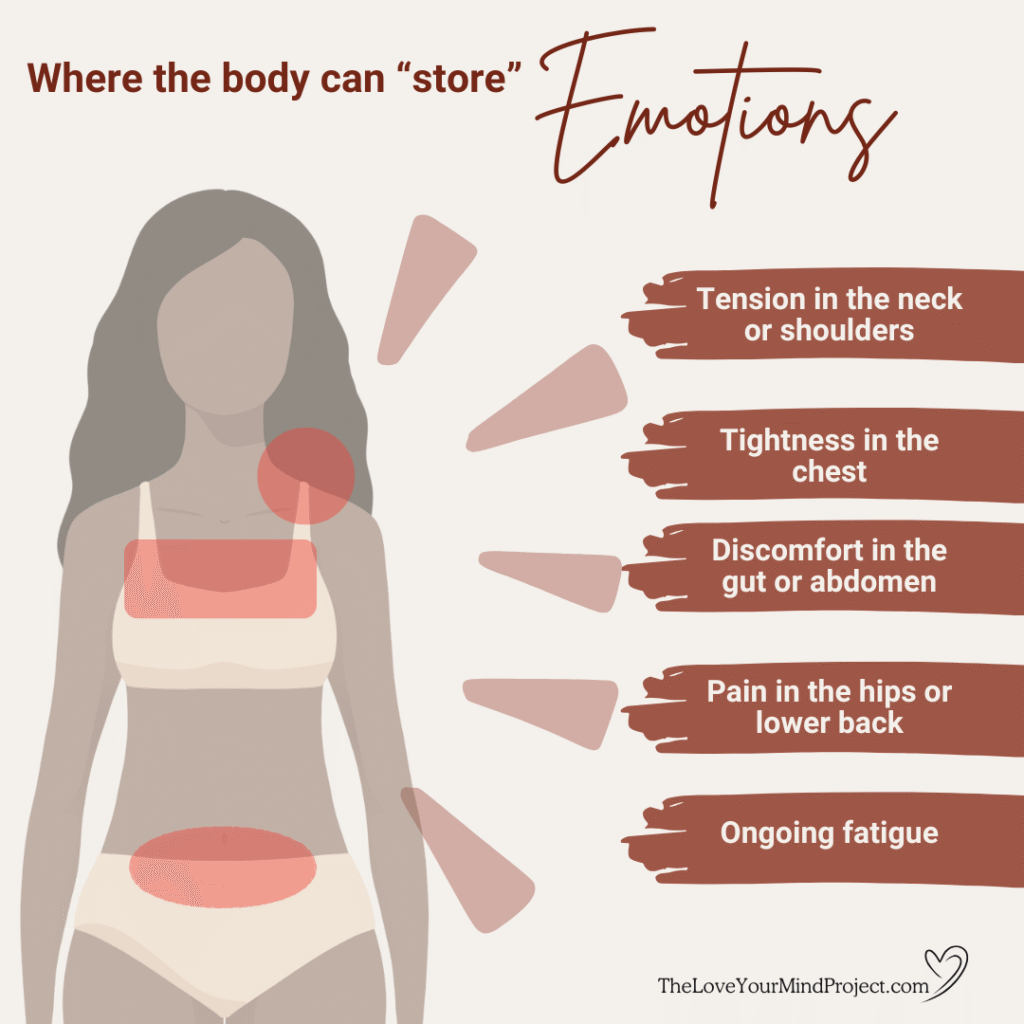

Tension in the neck or shoulders
When the muscles in your neck and shoulders stay tense for long periods—for example, in response to prolonged overwhelm, fear, or anxiety—you may notice stiffness, pain, or nerve sensitivity. The discomfort can feel dull and achy or sharp and radiating.4
Tension headaches are also common, with pain that starts in the neck or shoulders and moves upward into the head.
Tightness in the chest
Chest muscles can tighten when you experience emotions like fear or anxiety, creating a heavy or constricted feeling. 5
As the body releases adrenaline and other stress hormones, you may notice an increased heart rate, raised blood pressure, or shallow breathing. Over time, this can contribute to chest pain or discomfort. Some may experience spasm or palpitations
Because some of these symptoms can mimic serious heart issues, it’s important to talk to a doctor to rule out other causes.
Discomfort in the gut or abdomen
Persistent emotional stress can disrupt digestion, slowing it down or speeding it up, through what’s called the brain-gut connection. You might feel bloating, cramping, nausea, constipation, or diarrhea.6
Prolonged stress can also increase stomach acid, contributing to heartburn or acid reflux.7
Or it can alter the balance of “good bacteria” in the gut, which can worsen conditions like irritable bowel syndrome and even influence symptoms of anxiety or depression.8
Pain in the hips or lower back
Muscles around the hips, pelvic floor, and lower back can stiffen in response to emotional stress.
The psoas muscle, in particular, is closely tied to the body’s fight-or-flight response.9 It connects the back, legs, and pelvis and supports posture and mobility. When this muscle is tight for long periods, it can contribute to lower back pain or radiating discomfort in the groin, pelvis, legs, or buttocks.10
Ongoing fatigue
A prolonged fight-or-flight response can be mentally and physically exhausting.
When the nervous system stays on high alert—through constant worry, vigilance, or emotional strain—it can drain your energy throughout the day and make it harder to gain quality rest at night.
Why pay attention to your body’s signals?
Noticing what’s happening in your body can help disrupt the stress cycle, allowing you to respond in ways that better support your body.
You might intentionally relax tense muscles by taking slow, deep breaths, lying down for a bit, or doing gentle stretches.
Awareness also creates space to process emotions that may be fueling the tension. Simply naming what you’re feeling can signal safety to the body when it senses a threat.
If you’re not used to seeing yourself—your pain or your needs—this can take practice. But it’s worth it. Self-love includes allowing yourself to heal where it hurts, emotionally or physically.
How emotions are stored in the body FAQs
Is it really possible for stress to affect the body physically?
Yes. Emotional stress can trigger the fight-or-flight response that releases hormones, tightens muscles, and prepares the body for a perceived threat. When prolonged, it can cause aches and pains, digestive issues, and other physical challenges throughout the body.
Does emotional stress mean symptoms are “all in my head?”
Absolutely not. “All in your head” typically means “made up,” but physical symptoms from emotional stress are real experiences. The pain or discomfort is real and worth paying attention to, especially since it can impact mobility, digestion, and heart health—not to mention your joy and peace over time.
How does your body store emotions?
While the body doesn’t literally house emotions, it can remain affected by those that are unresolved. When we’re unable to release fear, anger, betrayal, or grief, it can leave the body stuck in a stress response that can disrupt our health and wear us out over long periods of time.
How do you release emotions stuck in your body?
Releasing emotional stress often starts with awareness—simply noticing what’s happening so you can respond in ways that better support you. This can look like slow breathing, gentle movement, or rest to help signal safety to the body. For deeper or persistent stress, consider partnering with a therapist who can help you work through complex emotions and release them safely over time.
References
Last accessed February 2026
- (2018, November). Stress effects on the body. Https://Www.apa.org. https://www.apa.org/topics/stress/body ↩︎
- What Happens When We Push Emotions Down? (2026). Psychology Today. https://www.psychologytoday.com/us/blog/the-stories-we-tell/202601/what-happens-when-we-push-emotions-down ↩︎
- Woods-Giscombe, C., Robinson, M. N., Carthon, D., Devane-Johnson, S., & Corbie-Smith, G. (2016). Superwoman Schema, Stigma, Spirituality, and Culturally Sensitive Providers: Factors Influencing African American Women’s Use of Mental Health Services. Journal of Best Practices in Health Professions Diversity : Research, Education and Policy, 9(1), 1124. https://pmc.ncbi.nlm.nih.gov/articles/PMC7544187/ ↩︎
- optimaladmin. (2025, July 14). Stress and Neck Pain: How Tension Affects Your Neck and Shoulders – Neuroscience Group. Neuroscience Group. https://neurosciencegroup.com/blog/stress-and-neck-tension/ ↩︎
- What is Adrenaline? | Mental Health America. (2025, January 6). Mental Health America. https://mhanational.org/resources/what-is-adrenaline/
↩︎ - (2025, November 12). Why Your Gut Reacts to Stress & How to Get Relief Naturally. GI Partners of Illinois – Partnering for Better Health. https://gipartnersofil.com/why-your-gut-reacts-to-stress-how-to-get-relief-naturally/ ↩︎
- Golen, T., & Ricciotti, H. (2022, May). Could stress be making my acid reflux worse? – Harvard Health. Harvard Health. https://www.health.harvard.edu/diseases-and-conditions/could-stress-be-making-my-acid-reflux-worse ↩︎
- Jagielski, C., Gi, H., Psychologist, G., Behavioral, H., Program, L., & Chang. (n.d.). Gut-Brain Axis (GBA) and Irritable Bowel Syndrome (IBS). https://www.uofmhealth.org/sites/default/files/2025-03/Gut-Brain-Axis-and-IBS.pdf ↩︎
- Loupy, K. (2024, July 17). Releasing Trauma and Stress with the Psoas Muscle – Integrative Psychiatry Institute. Integrative Psychiatry Institute. https://psychiatryinstitute.com/releasing-trauma-and-stress-with-the-psoas-muscle/ ↩︎
- Rauseo, C. (2017). THE REHABILITATION OF A RUNNER WITH ILIOPSOAS TENDINOPATHY USING AN ECCENTRIC-BIASED EXERCISE-A CASE REPORT. International Journal of Sports Physical Therapy, 12(7), 1150–1162. https://doi.org/10.26603/ijspt20171150 ↩︎