

- Job search depression: What to do when the rejection feels personal - January 15, 2026
- How to deal with a toxic boss—without losing yourself - January 8, 2026
- Stress leave from work: Know your options when your job becomes too much - January 2, 2026
Unresolved pain can feed trust issues. By creating space to feel, you can heal and learn to let others in safely.

For many of us, trust feels outright irresponsible.
We’ve put ourselves out there before—been open, honest, vulnerable, only to feel betrayed, dismissed, or disrespected. So, we build walls.
And while these walls may protect us from pain, they can also keep out the genuine, meaningful connections we truly crave.
This guide breaks down trust issues—what they are, how they show up, and how you can begin healing, one small step at a time.
>> MORE: Socially awkward? Here’s how to overcome social anxiety
What's in this article?
What does it mean to have trust issues?
When you have trust issues, you may find it hard to believe others at face value. Will they really show up, protect you, love you, or support you as they say? But it’s more than being skeptical or discerning. At its core, distrust is a struggle to be vulnerable, even with people who’ve shown they’re trustworthy.1 Trust issues can impact all types of relationships, whether it’s with a romantic partner, friend, family member, or coworker.
Is having trust issues really such a big deal?
Culturally, we’re taught to be the strong ones, only needing “me, myself, and I.” But when we’re constantly guarded and always keeping others at arm’s length, we limit their ability to see, support, and appreciate us fully, as we are.
We risk becoming emotionally detached, in danger of missing out on essential needs, like love, intimacy, joy, and even rest. And this can leave us feeling anxious, lonely, disconnected, and depressed.2
Why is it so hard to trust?
Trust requires vulnerability, and that’s hard when you’ve been hurt.
Your mind is wired to protect you. It uses emotions to encourage what feels good and discourage what feels bad. Emotional pain—like being lied to, abandoned, judged, or rejected—feels horrible. So, we simply prefer not to trust anyone than to feel that hurt again.
But the mind isn’t perfect. And sometimes our survival instincts can get in the way of growth and healing.
>> MORE: How to overcome fear of failure (and unlock unconditionally self-love)
Signs you may have trust issues
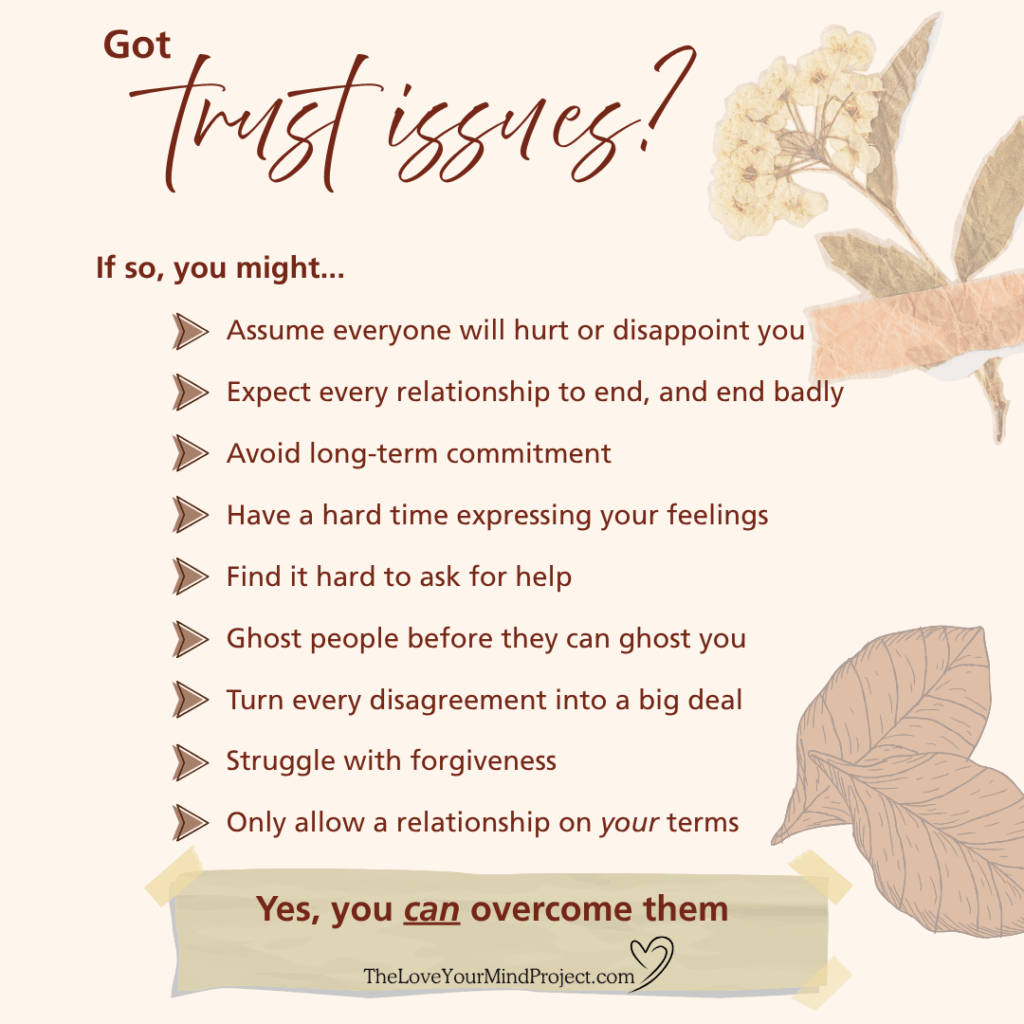
The signs don’t look the same for everyone or every type of relationship. But here are some signals you can look out for.1,3
Emotionally, you might:
- Tend to assume people will hurt or disappoint you.
- Expect every relationship to end, and end badly.
- Feel anxious when getting emotionally close.
- Avoid long-term commitment.
Behaviorally, you may:
- Have a hard time expressing your feelings.
- Find it hard to ask for help or depend on others.
- Ghost people before they can ghost you.
- Turn every disagreement into a big deal.
- Struggle with forgiveness.
- Only allow a relationship on your terms.
What causes trust issues?
Distrust isn’t part of your personality—it’s a way to cope with unresolved pain. Here are some of its common causes.4
- Childhood trauma: If you experienced neglect, abuse, or instability as a child, you may find it hard to feel emotionally safe around others, even as an adult.
- Betrayal or infidelity: When a close friend or partner lies, cheats, or breaks a promise, it can shatter your faith in people—and leave you vowing never to trust again.
- Abandonment: When people you love walk away or make themselves emotionally unavailable, you may feel rejected and choose to guard your heart at all costs.
- Domestic abuse: Being mistreated by someone you love, especially in an intimate relationship, can make it difficult to trust anyone, even those who treat you with respect and care.
Important note: Learning to trust again doesn’t mean you excuse abusive behavior or stay in harmful relationships. If you or a friend needs help, please reach out to the National Domestic Violence Hotline for 24/7, confidential support.
>> MORE: 7 signs of a toxic relationship (and what to do about it)
How to overcome trust issues
You’re not a bad person for having trust issues. But you can begin to heal. Here’s how.
Consider when the trust issues started
Think back to when you could trust others—that last time you truly allowed yourself to be vulnerable. What happened? What changed? Was it a specific person or a series of experiences? Getting to the root of the distrust can help uncover where the healing needs to begin. And if this feels like a tall task, therapy can be a safe space to reflect.
Identify how it affects you
How do trust issues show up in your life? You may struggle to express your feelings or ask for help. Or assume every person you get close to will eventually leave you. When you know how distrust shows up, you can recognize the patterns and, with time and support, shift them.
Allow space to heal from past hurt
We often bury pain from the past. But to heal from it, we have to feel it so we can grieve it. You can be honest about how badly the situation hurt and why. Have a conversation with yourself. Journal it out. Release it in prayer. This doesn’t take away from your strength—it builds it.
Do this as often as you need to. This is how we process pain and let it go.
Challenge harmful thought patterns
The next time you think “this relationship will fail just like the others,” or “I can’t depend on anyone,” gently challenge these and similar thoughts by reminding yourself of a few truths:
- “I don’t have to carry past hurt into current relationships.”
- “I can recover from pain and disappointment.”
- “I’m worthy of being my authentic self in my relationships.”
>> MORE: Black women experience depression too—signs it’s too heavy
Communicate your concerns
It’s okay to be honest about your journey with those who feel emotionally safe. You can say something as simple as, “Opening up is hard for me, but I’m working on it.” Share as much or as little as you want. You don’t owe anyone full access. But even these small moments can help you practice vulnerability and build connections.
Don’t abandon your boundaries
This journey isn’t about tolerating mistreatment or ignoring your emotional needs or preferences. You’re allowed to be discerning about who you want to build trust with and what that looks like. Go at your own pace. Keep those healthy boundaries that protect your peace. Those worthy of your trust will respect your limits.
Show self-compassion throughout the journey
You’re likely unlearning years of self-protection. That takes time and patience. The fear of being hurt may still creep in now and then. The goal isn’t to avoid pain but to slowly and safely open yourself up to meaningful connections and know that you can recover from any pain that may happen along the way.
>> SUBSCRIBE for weekly encouragement in your inbox!
Overcoming trust issues FAQs
Why do I have trust issues?
Trust issues usually stem from emotional pain, like betrayal, rejection, or abandonment, from childhood or previous relationships. It’s not a personality flaw, but a defense mechanism—one where we apply hurt from one relationship to future ones.
Do trust issues go away?
Yes, with awareness, healing, and support, it’s possible to trust again. Trust isn’t necessarily a switch that you can turn on. But you can rebuild it with time as you learn to set healthy boundaries, process hurt and disappointment, and practice vulnerability.
How do I stop overthinking my trust issues?
Journaling and breathing exercises are great ways to intercept overthinking and gently shift your focus back to the present. You can meet these moments with self-compassion. Remind yourself that distrust is your mind’s way of protecting you, but you’re taking steps to safely let your guard down and build deeper connections with others.
Can therapy help with trust issues?
Absolutely. Talking with a therapist who gets you can help you unpack what’s at the root of the distrust, process past hurt, and rebuild a sense of safety in your relationships, at your own pace.
References
- Gillette, H. (2020, March 21). How to Cope When Trusting Is a Challenge. Psych Central. https://psychcentral.com/blog/trust-issues-causes-signs#causes-of-lack-of-trust ↩︎
- Alan, Toko Kiyonari, Matsumoto, Y., Haruto Takagishi, Li, Y., Kanai, R., Masamichi Sakagami, Rei Akaishi, Ichikawa, N., Takamura, M., Yokoyama, S., Machizawa, M. G., Chan, H.-L., Ayumu Matani, Shigeto Yamawaki, Okada, G., Okamoto, Y., & Yamagishi, T. (2022). The neuroanatomy of social trust predicts depression vulnerability. Scientific Reports, 12(1). https://doi.org/10.1038/s41598-022-20443-w ↩︎
- Risser, M. (2025, February 26). 13 signs of trust issues & how to trust again. Choosing Therapy. https://www.choosingtherapy.com/trust-issues/ ↩︎
- Bennett, T. (2022, March 10). Trust issues: Signs, causes, and how to overcome them. Thriveworks; Thriveworks Counseling. https://thriveworks.com/help-with/relationships/trust-issues/ ↩︎