

Processing your emotions is recognizing, accepting, and understanding how you feel—without shame—so you can release the pain, trauma, or hurt you’ve carried for so long.

If you’re used to minimizing, masking, or rejecting how you feel, the idea of processing your emotions may seem uncomfortable, irresponsible, or downright confusing.
Maybe you’ve learned to push through those heavy feelings. To pray harder. To “get over them” or simply “don’t accept them.”
But emotions aren’t something to control or fear. And when we learn how to face them, not fight them, we can begin to truly see, accept, and care for ourselves in the way we deserve.
This guide breaks down what it really means to process emotions, why it matters for Black women, and how to practice and build this foundational skill of self-love.
What's in this article?
- 1 What it really means to process emotions (and why it matters so much for Black women)
- 2 What happens when we suppress emotions instead of processing them
- 3 Signs you might be pushing through your emotions instead of feeling them
- 4 How to process emotions: Feel your feelings to let them go
- 5 How therapy can help you process emotions
- 6 How to process emotions FAQs
What it really means to process emotions (and why it matters so much for Black women)
To process an emotion simply means allowing it to move through you.
Think of an emotion like a wave. You can’t control it or make it go away—but you can let it rise, peak, and pass naturally.
While this may sound simple, processing emotions can be especially difficult for Black women.1 Maybe you learned early on that you don’t have time to feel—that hard feelings are a liability, signaling weakness, lack of faith, or something else you might be doing wrong.
These messages may be reinforced by unhealthy relationships that fuel emotional abuse, making it even harder to trust and process what you feel.
But difficult emotions are not a personal failure.
They’re a natural response to stress, trauma, loss, pressure, and other lived experiences. When we suppress them, that pain can stay in the body.2
Feeling your emotions doesn’t make you weak—it makes you human. And all humans (including you) have needs worth tending to.
What happens when we suppress emotions instead of processing them
Some of us might suppress our emotions to appear calm or strong, but it can actually have the opposite effect.
Chronic emotional suppression can keep the nervous system on high alert, increasing blood pressure and contributing to cardiovascular strain over time.3
It’s also linked to chronic inflammation, stress-related hormonal changes, and other processes that can weaken how the immune system functions.4
Suppressed emotions also affect how you process and react. Research connects it to both depression and anxiety.5,6 You might feel irritable, angry, or even rage. And overthinking, worrying, and trouble sleeping are also common when you keep your mind and body in this state of hyperarousal.7
Simply put, the body wasn’t meant to handle constant “fight-or-flight” mode, but perpetually suppressing our emotions can keep us there.
Signs you might be pushing through your emotions instead of feeling them
You might be so used to deprioritizing your emotions that you’re not sure what it looks like. Here are common signs.
- You stay busy, so you don’t have to think or feel.
- You minimize or criticize your emotions by telling yourself, “Others have it worse.”
- You feel emotionally or physically exhausted for no clear reason.
- You rely heavily on distractions—scrolling, food, or alcohol—to avoid emotional discomfort.
- You often feel guilt or shame about how you feel.
- You’ve shut down emotionally—feeling nothing at all.
How to process emotions: Feel your feelings to let them go
It’s not about wallowing or feeling sorry for yourself. Processing your emotions is a form of self-care—treating yourself with the same compassion you’d offer someone you love.
Here’s how to begin.
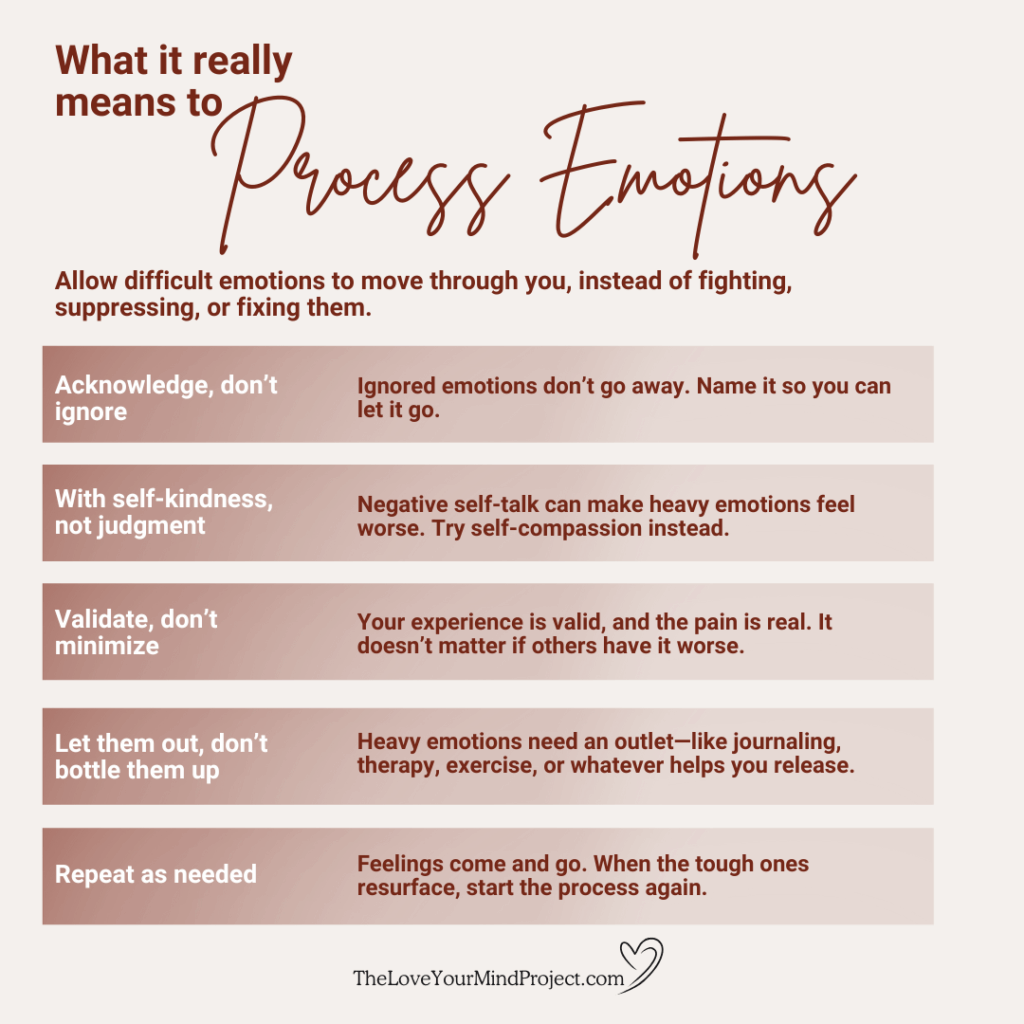

Name what you’re feeling
Acknowledge your emotions, instead of rebuking them.
If you’re used to criticizing or being criticized for how you feel, this could take some practice—and that’s okay.
A simple, “What am I feeling right now?” can help you feel seen and worthy of care. And this alone can reduce some of the emotional intensity of intense feelings like sadness, anger, disappointment, or grief.8
Notice how it shows up in your body
Emotions can show up in the body as tension, pain, or other physical symptoms.9 When you feel emotionally heavy, pause and notice where it’s settling.
Is it a clenched jaw? Neck and shoulder pain? Fluttering stomach? Tight chest?
Some experts believe that shifting your focus to your body can help regulate stress by grounding you in the present moment—rather than staying stuck in your thoughts.10
Explore why it’s there
Emotions can signal unmet needs. So try asking yourself what’s triggering your feelings and what your mind and body might be asking for.
Low self-worth or feeling invisible or perpetually lonely could be signs that you need more authentic love and quality connection.
Constant anxiety or hypervigilance could be signaling that you’re looking for more emotional safety and security.
A journal is a great way to uncover the “why” behind your feelings. And if you want a bit more guidance, you can unlock and unpack heavy emotions safely in therapy.
Create a space to let your emotions out
Heavy emotions need an outlet. And whatever you choose doesn’t have to be pretty or put together.
It could be talking with a friend, crying in therapy, journaling before bed, moving your body, taking deep breaths, or listening to music. As long as it helps you acknowledge, validate, and release what you’re feeling, you’re processing, not suppressing your emotions.
Practice self-compassion in that moment
An important part of processing your emotions is to let yourself feel them without judgment.
There is no wrong way to feel. And no, you don’t need to be stronger, more grateful, or have more faith. Your emotions are data points, not a verdict.
Instead of, “Why am I still dealing with this?” Try, “I feel ___, and that’s okay. What do I need right now?”
Negative self-talk, like judgment or criticism, can trigger the brain’s threat response11—which can make difficult emotions feel worse. Kindness and compassion, on the other hand, can have the opposite effect—helping you feel safer, more connected, and calmer, and making it easier to release heavy feelings.
Repeat as needed (because feelings come and go)
Remember, feelings are like waves. So when difficult ones resurface, you’re not doing anything wrong.
Keep processing—acknowledging, validating, and releasing them. Over time, this builds emotional resilience—the ability to experience sadness, fear, anger, or anxiety without being consumed by them.
How therapy can help you process emotions
If any of this feels hard to do on your own, therapy can help—and tapping into it doesn’t mean you’re failing.
Many of us weren’t taught the skills to identify or process emotions. Therapy helps us build these skills while gently addressing and healing from past wounds.
A therapist, especially one who understands the unique pressures Black women face, can help you:
- Safely unpack long-held trauma and pain.
- Learn to regulate emotions in ways that work best for you.
- Challenge the thoughts or behaviors that keep you stuck in survival mode.
- Practice meeting your emotional needs so it becomes second nature.
Trying therapy doesn’t mean you’re broken—it means you’re choosing a dedicated space to heal so you can live more fully and authentically.
How to process emotions FAQs
What does it mean to process emotions?
Processing emotions means allowing yourself to fully experience a feeling without trying to hide, judge, or rush it away—so it can eventually leave your system. It’s the opposite of pushing through, rejecting, or fighting to “get over” how we feel.
Why is it so hard to feel your feelings?
Difficult emotions can leave you feeling vulnerable, exposed, or uncomfortable, especially if you’re struggling with the idea that emotions are a sign of weakness, a lack of faith, or personal failure—which is simply not true.
How do you process overwhelming emotions?
In the moment, try slow, deep breathing to calm your nervous system. You can focus on what’s in front of you—the sights, smells, sounds, and textures—or positive affirmations. Consider therapy if you often experience overwhelming emotions, as it can help you process them and uncover underlying causes and unmet emotional needs.
References
Last accessed January 2026
- Woods-Giscombé, C. L. (2010). Superwoman Schema: African American Women’s Views on Stress, Strength, and Health. Qualitative Health Research, 20(5), 668–683. https://doi.org/10.1177/1049732310361892 ↩︎
- Suppressing Emotions Can Harm You—Here’s What to Do Instead. (2022). Psychology Today. https://www.psychologytoday.com/us/blog/the-truth-about-exercise-addiction/202212/suppressing-emotions-can-harm-you-heres-what-to-do ↩︎
- Quartana, P. J., & Burns, J. W. (2009). Emotion suppression affects cardiovascular responses to initial and subsequent laboratory stressors. British Journal of Health Psychology, 15(3), 511–528. https://doi.org/10.1348/135910709×474613 ↩︎
- Slavich, G. M. (2019). Psychoneuroimmunology of Stress and Mental Health. The Oxford Handbook of Stress and Mental Health, 518–546. https://doi.org/10.1093/oxfordhb/9780190681777.013.24 ↩︎
- Compare, A., Zarbo, C., Shonin, E., Van Gordon, W., & Marconi, C. (2014). Emotional Regulation and Depression: A Potential Mediator between Heart and Mind. Cardiovascular Psychiatry and Neurology, 2014, 1–10. https://doi.org/10.1155/2014/324374 ↩︎
- Ananda Amstadter. (2007). Emotion regulation and anxiety disorders. Journal of Anxiety Disorders, 22(2), 211–221. https://doi.org/10.1016/j.janxdis.2007.02.004 ↩︎
- (2025, January 23). Hyperarousal: What It Is, Causes, Symptoms & Treatment. Cleveland Clinic. https://my.clevelandclinic.org/health/symptoms/hyperarousal ↩︎
- Powerful Strategies for Naming and Taming Your Emotions: A Guide to Emotional Mastery – Chicago Psychoanalytic Institute. (2025, April 11). Chicago Psychoanalytic Institute Treatment Center. https://chicagoanalysis.org/blog/elements-of-psychoanalytic-technique/naming-and-taming-emotions/ ↩︎
- (2025, March 20). Pacific Coast Mental Health. Pacific Coast Mental Health -. https://pacificcoastmh.com/the-science-of-stored-trauma/ ↩︎
- Can mindfulness exercises help me? (2025). Mayo Clinic. https://www.mayoclinic.org/tests-procedures/meditation/in-depth/mindfulness-exercises/art-20046356 ↩︎
- Fehlner, P., Bilek, E., Harneit, A., Böhringer, A., Moessnang, C., Meyer‐Lindenberg, A., & Tost, H. (2020). Neural responses to social evaluative threat in the absence of negative investigator feedback and provoked performance failures. Human Brain Mapping, 41(8), 2092–2103. https://doi.org/10.1002/hbm.24932 ↩︎