

- How emotions show up in the body (and why it matters) - February 6, 2026
- How to heal from emotional abuse: A Black woman’s guide to gentle rebuilding - January 29, 2026
- How to process emotions: What it really means and why it’s essential for Black women - January 22, 2026
When anxious thoughts won’t slow down, it can help to let them out. Try these journal prompts for anxiety to release what’s heavy and reconnect with peace.

Anxiety can leave your mind spinning with what-ifs, worst-case scenarios, and endless to-do lists—leaving little space for calm.
Journaling can create more room for peace. And guided prompts make it easier to get started.
For those of us Black women learning it’s okay to feel and express tough emotions—that it’s in fact required to heal and grow stronger—this article shares simple, but effective journal prompts for anxiety.
>> Pause and see what you need right now. Take the quiz
How journaling helps calm an anxious mind
Some experts describe anxiety as a habit loop. A thought or situation triggers a worry. As you dwell on it, its magnitude grows.1 The next thing you know, you feel a million times worse from simply living in your head.
Journaling can break that loop. It takes you out of automatic negative thoughts, catastrophizing, and other types of overthinking—allowing just enough space to separate how you feel from how you respond.2
Through journaling, you can:
- Acknowledge and release the pressure to constantly perform or appear “unbothered.”
- Identify triggers—the situations, people, or responses that heighten anxiety.
- Gently challenge negative thought patterns and replace them with truth and compassion.
- See, validate, and accept yourself—rebuilding a sense of safety and self-trust.
>> MORE: Can’t stop overthinking? Try these 6 tips for more peace
16 journal prompts for anxiety
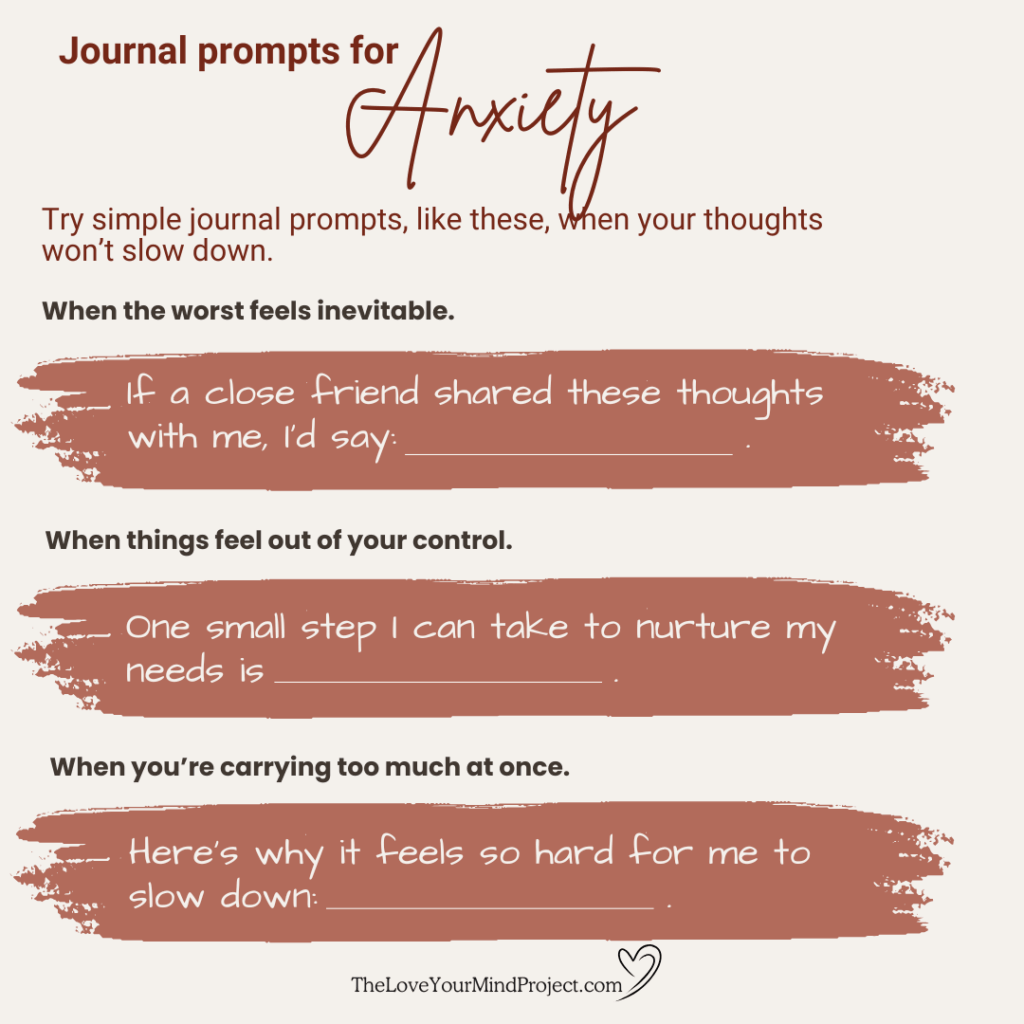
These prompts are just a guide. Don’t overthink it. This is simply your time to see you, sis.
Prompts for when you think the worst is inevitable
When your thoughts spiral into all the things that will go wrong, these prompts can help you slow down and focus on the present.
- What I’m really afraid of is _______ and that’s okay—but it’s not happening now.
- If a close friend shared these thoughts with me, I’d say _______.
- I can handle whatever comes next—here’s why, _______.
>> MORE: Do you get social anxiety? Here’s how to overcome it
Prompts for when things feel out of your control
Anxiety can thrive in uncertainty.3 These prompts remind you to focus on what’s within your reach and release what’s not.
- I can’t control _______, but I can control _______.
- I feel safest when I’m doing these things: _______.
- One small step I can take to nurture my needs is _______.
Prompts for those heavy thoughts that won’t go away
Those nagging thoughts may just need an outlet. Use these prompts to release what’s been weighing you down.
- These thoughts keep circling in my mind: _______.
- When I think these thoughts, they leave me feeling _______.
- I imagine this thought is a balloon I can let go into the breeze. As it floats away, I feel _______.
Prompts for when you feel the pressure to be perfect
Perfectionism can often hide behind anxiety and a fear of not being enough.4 These prompts help you practice radical self-compassion.
- Is what I’m asking of myself actually realistic? Why or why not?
- When I fall short of my goals, I usually tell myself _______ but what I’d rather hear is _______.
- I am enough because _______; not because of my achievements.
>> MORE: How to overcome fear of failure (and unlock unconditional self-love)
Prompts for when you’re carrying too much at once
You don’t have to carry it alone. Use these prompts to explore what support could look like and what you can release.
- Right now, this priority feels the heaviest: _______.
- Here’s why it feels so hard for me to slow down: _______.
- If I had help, here’s what it would look like: _______.
- One small way I can prioritize myself today is by _______.
How to get the most out of journaling for anxiety
Journaling doesn’t have to be another task on your to-do list. You can make it your own so that it works for you.
- Make it a calming routine, in the morning or before bed, if your goal is consistency.
- Let your thoughts flow freely, with censoring and without judgment.
- Write when you need to, whether daily, weekly, or whenever it feels right.
It’s not about long, eloquent entries, beautiful notebooks, or a strict regimen—it’s about creating space for you to release.
>> Want more? Subscribe for more tips and encouragement in your inbox
Journaling for anxiety FAQs
How often should I journal for anxiety?
There’s no right or wrong frequency. If you’re building a habit, focus on consistency over length. If your goal is simply to release, write whenever your thoughts feel heavy or your mind needs a reset.
What if journaling makes me feel more anxious?
That’s normal, especially when you’re facing emotions you’ve held in for a long time. If journaling feels overwhelming, try writing for shorter periods or ending with something positive, like gratitude or an affirmation. You could also connect with a therapist who can help you process difficult emotions safely.
Are there special journals or apps for anxiety?
Yes, tools like Reflectly, Journey, and Day One Journal offer digital prompts and reminders. Guided physical journals like The Five-Minute Journal or The Healing Anxiety Workbook can also help. Pick the type of journal and style that works for you. What matters most is that you show up for yourself.
References
Last access October 2025
- Brewer, J. A., & Roy, A. (2021). Can Approaching Anxiety Like a Habit Lead to Novel Treatments? American Journal of Lifestyle Medicine, 15(5), 489–494. https://doi.org/10.1177/15598276211008144 ↩︎
- Carpenter, S. (2001). A new reason for keeping a diary. Https://Www.apa.org. https://www.apa.org/monitor/sep01/keepdiary ↩︎
- Fell, A. (2024, June 25). How Uncertainty Builds Anxiety. UC Davis. https://www.ucdavis.edu/curiosity/news/how-uncertainty-builds-anxiety ↩︎
- Limburg, K., Watson, H. J., Hagger, M. S., & Egan, S. J. (2016). The Relationship Between Perfectionism and Psychopathology: A Meta‐Analysis. Journal of Clinical Psychology, 73(10), 1301–1326. https://doi.org/10.1002/jclp.22435 ↩︎