
- Job search depression: What to do when the rejection feels personal - January 15, 2026
- How to deal with a toxic boss—without losing yourself - January 8, 2026
- Stress leave from work: Know your options when your job becomes too much - January 2, 2026
It’s not your dream job, luxury vacation, or new Birkin bag. Learning how to live your best life comes down to prioritizing and nurturing your authentic self.

It’s a great goal to have, living your best life. But what does it really mean?
Highlight reels on social media might spotlight expensive self-care routines, luxury brands, or “do-it-big” vacations. But if you truly want to know how to live your best life, it starts with getting to know you.
There’s no single roadmap because we’re all unique. Still, there are general steps you can take, backed by therapists, to stop living the life others expect of you and start creating the one you were made for.
>> Subscribe for weekly encouragement curated for Black women
What's in this article?
- 1 What it really means to live your best life (beyond the highlight reel)
- 2 Why living your best life can feel out of reach, especially for Black women
- 3 How to live your best life—expert tips from Black women therapists
- 4 It’s okay to want help (and therapy might be the answer)
- 5 How to live your best life FAQs
What it really means to live your best life (beyond the highlight reel)
Stepping into your best life isn’t about perfection or chasing someone else’s definition of success. It’s about embracing what brings you joy, what gives you peace, and helps you serve your purpose.
“Living your best life depends on the individual,” said Emely Rumble, licensed clinical social worker, psychotherapist, and founder of LiterapyNYC. “In my experience, it means living in alignment with your values and well-being in mind—giving yourself permission to live life fully and authentically without shrinking or apologizing.”
Why living your best life can feel out of reach, especially for Black women
Choosing yourself may sound simple, but it can feel unfamiliar—even impossible—for many of us. These Black women therapists explain why.
Systemic barriers: “Black women’s experiences in the world are laden with systemic barriers and daily microaggressions that weigh on us heavily,” explained Rumble. “We’re impacted by racism1, sexism2, economic inequities3, and healthcare disparities4 that further inhibit our ability to live our best lives.”
Cultural expectations: “What often gets in the way is the invisible ‘strong Black woman‘ cape we feel obligated to wear,” said Dr. Michelle Harris, licensed clinical social worker and founder of Charlotte-based The Clarity Code Effect. “We’re expected to carry so much but are often viewed as angry when we express our emotions—leaving us feeling like we don’t have a safe space for vulnerability.”
Overwhelm and overload: “The idea of family has pressured some of us into feeling guilty for saying ‘no,’” said Dr. Naricia Futrell, licensed clinical social worker and psychotherapist at Memphis-based Gihon Counseling. “Our identities get wrapped up in family and relationships, and we forget—if we’ve ever known—who we are and what we’re passionate about.”
How to live your best life—expert tips from Black women therapists
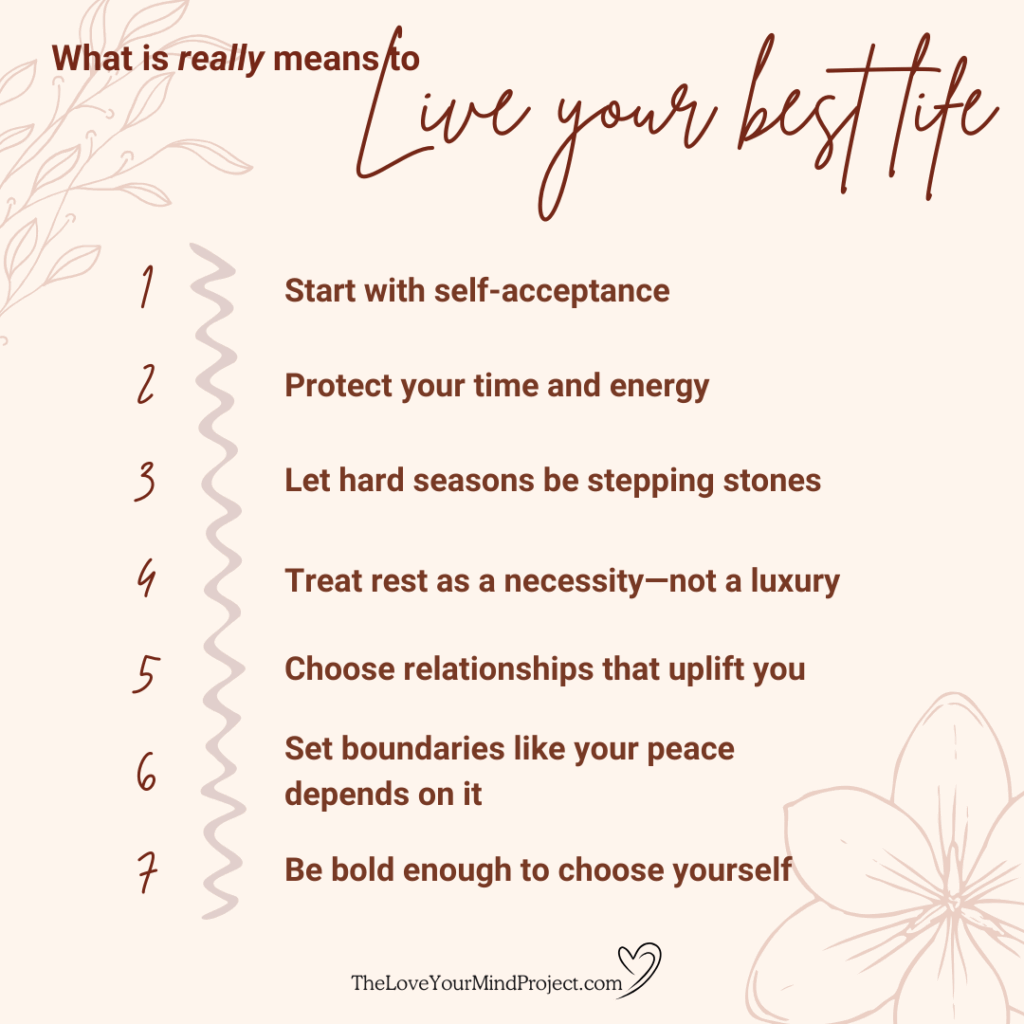
So, where do you begin on this journey to live a more authentic life? Here are insights from Black mental health experts who get it.
Start with self-acceptance
It’s hard to live your best life if you don’t like who you are. That’s why the first step to living authentically is self-acceptance.
“Embrace the full mix of strengths and weaknesses that make you who you are,” said Dr. Harris. “Your weaknesses are not flaws to hide—they’re part of your story, your strength, and your authenticity.”
Releasing the pressure to be perfect gives us the space to grow and learn to love every part of who we are, explained Dr. Harris.
Protect your time and energy
Part of living your best life is prioritizing what moves you.
“Know who you are and what fuels you beyond your titles—mother, sister, daughter, and more,” said Dr. Futrell. “Put more energy into those things, even if it’s only for small moments several times a day.”
And since there’s only so much time in a day, you may need to let go of some things.
“Give yourself permission to say ‘no’ to what no longer serves you, and permission to say ‘yes’ to a life you once thought was a dream but can be a reality today,” said Dr. Harris.
Let hard seasons be stepping stones
Not even your best life will be perfect. But you can still thrive in it all, primarily if you make space to feel, heal, and grow.
“Know there will be days that are good and days that aren’t so good, but you can use it all to drive you toward your greater purpose,” said Dr. Harris. “Even the moments when you feel like you’re breaking down can actually be the start of a breakthrough.”
>> MORE: How to preserve your mental wellness in hard seasons
Treat rest as a necessity—not a luxury
Quality rest is one of the body’s greatest needs.
“Rest is not laziness—it’s truly an act of resistance and restoration that allows us to show up in ways that are sustainable and without self-abandonment,” said Rumble. “We can work with what we’ve got to access radical rest despite societal pressures to constantly perform and produce.”
And it can be small moments, according to Rumble, like closing your eyes or lying down for just a few minutes—insights she gleaned from The Nap Ministry.
>> MORE: 6 strategies to improve sleep quality for Black women
Choose relationships that uplift you
The company you keep matters when trying to live your best life.
It’s critical, especially for us, to “surround ourselves with people, books and art, and practices that affirm our inherent self-worth and remind us that we are not alone,” said Rumble. “There’s something truly special about the way Black women affirm each other. We can be accountability partners because we understand the unique emotional, physical, spiritual, and psychological challenges we navigate daily.”
Set boundaries like your peace depends on it
Those of us who tend to people-please will need to practice setting healthy boundaries if we want to thrive.
“Say ‘no’ and allow the people you love to foster their own independence and be accountable for themselves,” said Dr. Futrell. “If setting boundaries for your own sanity means the relationship is over, that is okay.”
>> MORE: 7 signs of a toxic relationship—and what to do about it
Be bold enough to choose yourself
At its core, living your best life means choosing you. It’s not selfish or irresponsible—it’s self-love.
“Love yourself, flaws and all, and release the need to define yourself by someone else’s terms,” said Dr. Harris. “Embrace your unique qualities, because it’s not just ‘Black girl magic’—it’s Black girl excellence you bring to the world.”
It’s okay to want help (and therapy might be the answer)
Much of what it takes to live your best life goes against the strong Black woman trope. That means you may need new tools, and therapy can help.
If you feel unworthy of rest, unable to set boundaries, or stuck in past hurts or trauma, a trusted therapist can help you uncover what’s in your way and practice strategies for healing, growth, and stepping into your fullness.
>> Want more? Read this Black woman’s guide to loving your mind
How to live your best life FAQs
What does it mean to live your best life?
Living your best life means creating a life that aligns with your purpose, values, and needs. It’s not about curating the perfect highlight reel or living for approval. Instead, it’s about knowing your authentic self and showing up as that self every day.
How can I live my best life today?
Be intentional with your energy, devoting more time to those relationships and activities that bring you joy and fulfillment. Prioritize rest for physical, mental, and emotional recovery.
How do you live your best life when life feels heavy?
Hard seasons may not feel good, but they don’t have to prevent you from living your best life. Acknowledge your mental and emotional needs. Make space for your emotions, without judgment, and surround yourself with people who genuinely support you.
References
- Racism and Mental Health | Mental Health America. (2025, June 10). Mental Health America. https://mhanational.org/resources/racism-and-mental-health/ ↩︎
- (2022). Social support and identity help explain how gendered racism harms Black women’s mental health. Https://Www.apa.org. https://www.apa.org/pubs/highlights/spotlight/issue-236 ↩︎
- Institute for Women’s Policy Research. (2024, July). Black Women Wage Gap Fact Sheet. https://iwpr.org/wp-content/uploads/2024/07/Black-Women-Wage-Gap-Fact-Sheet-2024.pdf ↩︎
- (2024, May 8). What the Data Show: Black Women Report More Pervasive Negative Experiences in Health Care Compared to Other Groups | KFF. KFF. https://www.kff.org/racial-equity-and-health-policy/what-the-data-show-black-women-report-more-pervasive-negative-experiences-in-health-care-compared-to-other-groups/ ↩︎