

- How to help a friend with depression: Ways Black women can be supportive without carrying the whole load - December 12, 2025
- Why do I feel anxious when I wake up? What’s behind it and how to find calm in the morning - December 4, 2025
- How does anxiety medication work? What Black women should know before we decide - November 29, 2025
Being their safe space, while still having your own, is one of many ways to care for a friend with depression without neglecting yourself.

This information is for educational purposes only and not a replacement or substitute for professional therapy or mental health advice.
You may be their day one—their ride-or-die who’d never let them carry a burden alone. Still, helping a friend dealing with depression can be especially heavy.
Maybe you worry about saying the wrong thing, not doing enough, doing too much, or somehow letting them down.
And what about your needs? Do they still matter? What do you do when you feel tired, overwhelmed, or simply need space?
Supporting someone you care about on an emotionally taxing journey requires that you also show up for yourself. Here’s how to help a friend with depression—with compassion, kindness, and patience—while giving yourself the same grace.
>> Subscribe and get weekly resources, tips, and encouragement in your inbox
What's in this article?
- 1 What depression can look like in someone you care about
- 2 The emotional load many Black women carry for others
- 3 How to help a friend with depression—without losing yourself in the process
- 4 What not to do when supporting a friend with depression
- 5 Supporting a friend with suicide risk
- 6 Helping a friend with depression FAQs
What depression can look like in someone you care about
Depression can look different for everyone, but it’s generally persistent—more than a passing mood or hard season.1
“In some people, depression looks like silence—in others it can be anger, irritability, shutting down, or suppressing emotion,” said Dr. Latoya Taylor, clinical psychologist and founder of Michigan-based Tailored Clinical Services. “Especially for Black women, depression is often misinterpreted as attitude or anger.”
Here are common signs you might notice2:
- They feel sad more often than not.
- They lose interest in things they used to enjoy.
- They’re often fatigued or have low energy.
- They talk about changes in their sleep patterns or appetite.
- They’re irritable or easily triggered.
- They have trouble concentrating.
- They express hopelessness, shame, or guilt.
>> Learn more about how depression can show up differently in Black women
The emotional load many Black women carry for others
Being someone’s emotional support is honorable. But it’s also hard—especially for those Black women who were never taught that our needs matter, too.
Many of us may have grown up as the caretakers, problem-solvers, or the “strong ones” in our circle—conditioned to put everyone else before ourselves.3 But these habits can lead to carrying burdens we were never meant to.
“If you’re not grounded, resourced, and regulated yourself, you’ll absorb their distress, burn out, or begin helping from a place of resentment,” said Dr. Taylor. “Caring for yourself is not selfish—it’s protective—it allows you to be present without losing yourself in someone else’s pain.”
Simply put, while you help your friend, be sure to make space for yourself, too.
>> Tired, but can’t sleep? Here’s why it might be happening (and how to rest better)
How to help a friend with depression—without losing yourself in the process
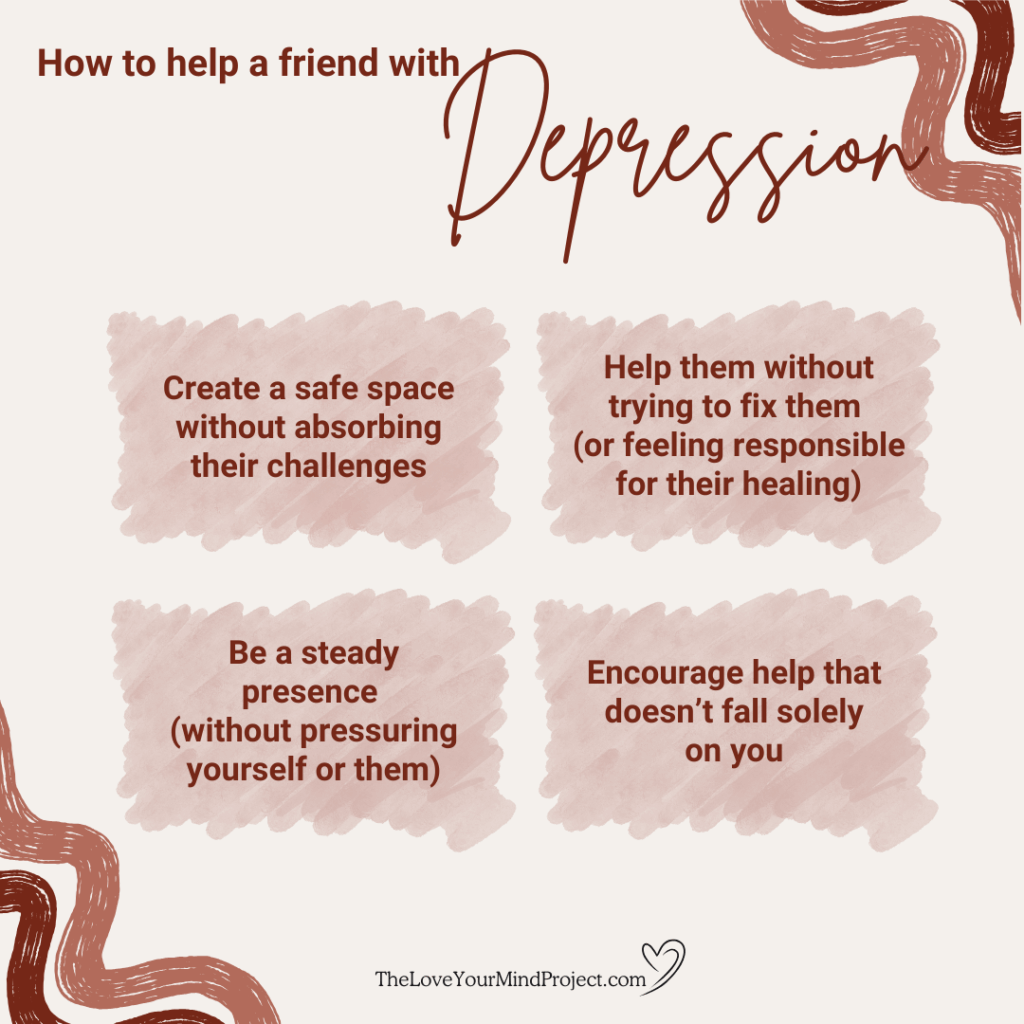
Create a safe space without absorbing their challenges
One of the most powerful ways to support a friend with depression is to offer a non-judgmental space where they can be honest and vulnerable.
As Black women, we’re often expected to hold everything together, be grateful, and demonstrate our faith. But in those heavy moments, we need a place where we can just be.
If your friend feels like they have to hide their heaviness from everyone, showing them otherwise is a true gift.
Invite open conversation, with no pressure, letting your friend know they can be real with you. That their feelings and experiences are valid, not wrong. And what they’re going through is not because of a lack of faith or gratitude—and it’s definitely not a sign of weakness.
How to protect your well-being: You might have your own heavy emotions—sadness, frustration, and even guilt. None of this makes you a bad friend. Make sure you have a space to process, whether through journaling, therapy, or talking with someone you trust.
Help them without trying to fix them (or feeling responsible for their healing)
When someone we love is hurting, you may naturally want to fix it or make them better. But a friend who deals with depression doesn’t need a savior—they need someone who really sees them.
“Depression isn’t something you can solve for someone, and the person experiencing depression ultimately guides what they are willing or ready to receive,” said Dr. Taylor. Some friends want you to sit on the phone, others want distraction or space, or genuinely aren’t ready for help yet—your role is not to control the situation but to be available within your capacity.”
Instead of problem-solving, listen to understand—not to fix, judge, or compare. Ask what support would feel good for them in that moment. And if they don’t know, that’s okay. Your presence (physical or emotional) matters more than what you can do for them.
How to protect your well-being: You’re not responsible for their emotions, reactions, or progress. Release that pressure, so you’re not carrying more than you need to.
>> Is it hard to set boundaries? Here’s how to stop being a people-pleaser
Be a steady presence (without pressuring yourself or them)
Someone dealing with depression may go quiet or pull away, convinced they’re a burden. By being a consistent, reliable presence, you’re showing them you’re not going anywhere. It’s unconditional love on full display.
This could look like a simple “thinking of you” text or an occasional no-pressure invite that shows you want them around, whenever they’re ready.
How to protect your well-being: Being a steady presence in your friend’s life doesn’t mean you must neglect your own needs. Stay connected to your support system, leaning on those relationships that fill you up, so you have the strength to continue being a resource for others.
Encourage help that doesn’t fall solely on you
There’s only so much you can do to help a friend with depression. Professional support can assist them in ways you might not be able to, like unpacking trauma, shifting harmful thought patterns, and managing symptoms.4 But the thought of therapy can be scary or outright offensive to some.
You can introduce the idea without forcing it. It’s not telling your friend what to do, it’s reminding them they don’t have to navigate this alone—that help from someone trained to support them can be the start of deep healing.
And if they’re not ready, that’s okay. Your role isn’t to convince them. Continue supporting them while releasing yourself from the responsibility of their journey.
>> These 50 Black women therapists are pioneering culturally-affirming care
What not to do when supporting a friend with depression
When you have a friend who’s experiencing heavy emotions, knowing what not to do can be as important as knowing what to do.
Here are a few things to avoid:
- Trying to fix them: Your friend isn’t broken or a lesser version of themselves. Think support, not savior.
- Minimizing their experiences: Saying things like “other people have it worse” or “is it really that bad” can make them feel ashamed of what they’re experiencing.
- Judging their feelings: You don’t have to understand how they feel or agree with their perspective to support them. Be the voice that reassures them that they’re seen and that they matter.
- Giving unwanted advice: Sometimes we just want to be heard. Try to avoid giving advice unless they ask for it.
- Telling them what they need: Your friend’s experience is theirs, no matter how well you know them. Don’t assume you know their needs. Ask and really hear them out.
- Taking their responses personally: A low mood or snappy reply could be from the depression, not a personal rejection or judgment of you. Try to extend grace if they react in a way that hurts you. And give your friend, or yourself, space if needed.
- Becoming responsible for their healing: Walk beside them, not for them. You can’t “lift” their mood, anticipate every need, or sacrifice your own peace and overall wellness to hold them together.
>> Is the relationship out of balance? Here are signs of a toxic one and what to do about it
Supporting a friend with suicide risk
If your friend talks about self-harm or suicide—saying things like, they don’t want to be here, or things would be better without them—take it seriously.
Let them know you hear them, are glad they told you, and that, together, you can get help.
Depending on your level of concern, encourage them to call or text 988 (The Suicide & Crisis Lifeline), or you can call with them. Trained counselors are available 24/7 to guide you or your friend on what to do next.
If your friend doesn’t want help, try to get a sense of how safe they are. If you’re unsure or feel they might act out their thoughts, call 911 or 988 anyway. Their safety is most important.
Try to stay with them, in person or over the phone, until you’ve connected them with support or you feel they’re no longer in immediate danger.
Emergency resources to know:
- Suicide & Crisis Lifeline: Call or text 988.
- Crisis Text Line: Text HOME to 741741.
- Call 911 if you sense immediate danger.
>> Here’s how to get mental health help—read this guide to loving your mind
Helping a friend with depression FAQs
What’s the best way to help a friend with depression?
Be present and compassionate—a safe space where they can be themselves without fear of judgment or rejection. And make sure you have places where you, too, can process and release heavy emotions.
What should I say to a friend with depression?
Think genuine validation and support. “I hear you,” or “I may not understand, but I’m here for you,” can go a long way. Try to avoid judging or dismissing their feelings or pushing advice, unless asked.
What if supporting my friend impacts my own mental health?
Your well-being matters, too. If you feel mentally or emotionally drained, frustrated, or stretched too thin, it’s okay to take a step back and refill your cup. Lean on your support system, engage in those activities that allow you to exhale, or talk to a professional.
What if they don’t want help?
You can’t force healing. If they want space, honor that. You can love them from a distance and stay connected with low-pressure check-ins and reminders that they’re loved, seen, and not forgotten.
References
Last accessed December 2025
- What Is Depression? (2025). Psychiatry.org. https://www.psychiatry.org/patients-families/depression/what-is-depression ↩︎
- Depression (major depressive disorder) – Symptoms and causes. (2025). Mayo Clinic; https://www.mayoclinic.org/diseases-conditions/depression/symptoms-causes/syc-20356007 ↩︎
- Woods-Giscombe, C., Robinson, M. N., Carthon, D., Devane-Johnson, S., & Corbie-Smith, G. (2016). Superwoman Schema, Stigma, Spirituality, and Culturally Sensitive Providers: Factors Influencing African American Women’s Use of Mental Health Services. Journal of Best Practices in Health Professions Diversity : Research, Education and Policy, 9(1), 1124. https://pmc.ncbi.nlm.nih.gov/articles/PMC7544187/ ↩︎
- Therapy | Mental Health America. (2025, March 26). Mental Health America. https://mhanational.org/resources/therapy/ ↩︎