

- How emotions show up in the body (and why it matters) - February 6, 2026
- How to heal from emotional abuse: A Black woman’s guide to gentle rebuilding - January 29, 2026
- How to process emotions: What it really means and why it’s essential for Black women - January 22, 2026
Emotional abuse can be just as harmful as physical abuse—but healing is possible when you learn to honor your feelings, needs, and sense of safety.

The absence of scars or bruises doesn’t make emotional abuse any less damaging. It’s just as real as physical abuse—and equally unacceptable.
If you’ve experienced or are experiencing emotional harm, you don’t deserve it. And you don’t have to sweep it under the rug—no matter who causes it.
This guide is here to remind you of something you should never forget: your experiences, feelings, and needs matter.
Keep reading to understand emotional abuse—what it can look like, how it might affect you, and how to process those difficult feelings as you begin rebuilding self-confidence and trust.
Why it’s important for Black women to heal from emotional abuse
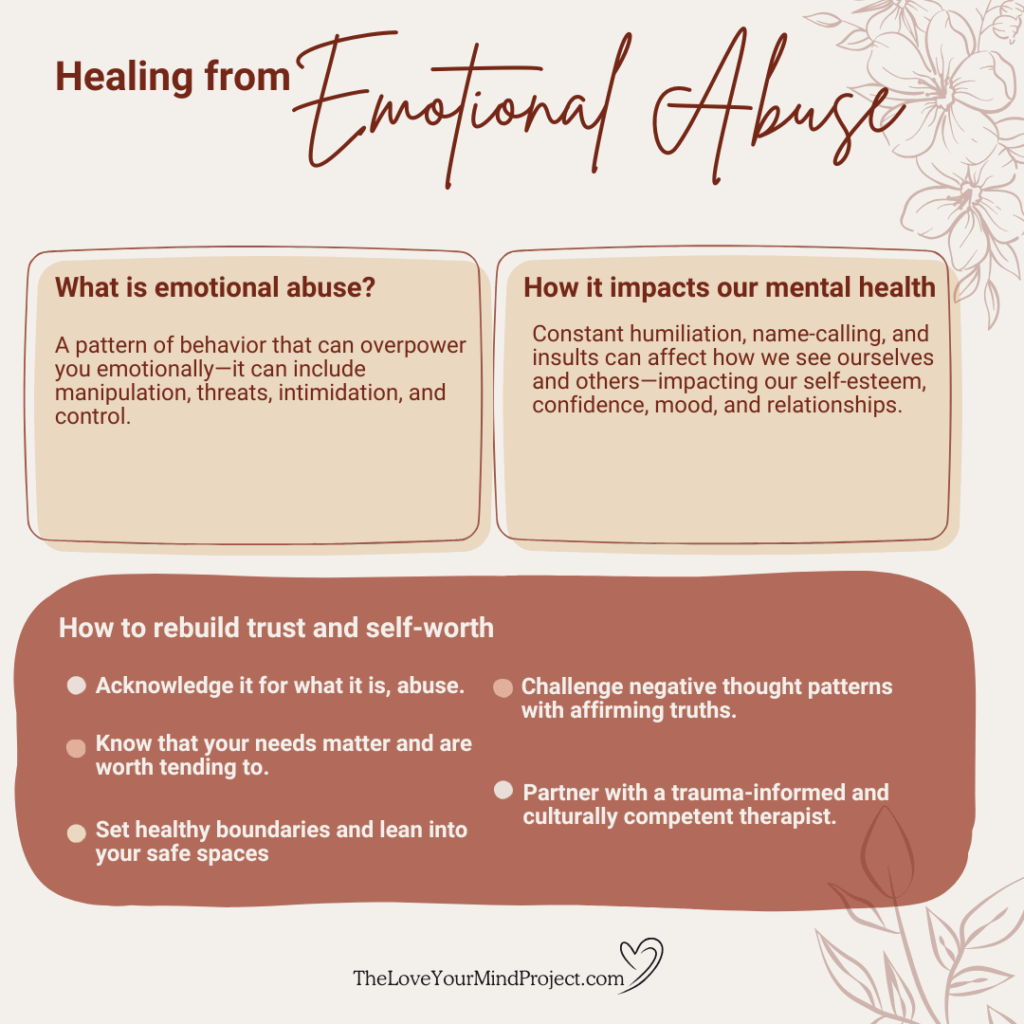
Emotional abuse is a pattern of behavior that can involve manipulation, threats, intimidation, or control to overpower someone emotionally.
Its effects can be profound and long-lasting. Some research has linked emotional abuse to higher levels of depression, anxiety, and stress than physical or sexual abuse alone.1
And as Black women, we can carry a disproportionate burden.
Research suggests we experience higher rates of psychological abuse—including humiliation, insults, name-calling, and other controlling behaviors—compared to women overall.2
Over time, this kind of harm can gradually reshape how you see yourself and others, affecting self-esteem, confidence, mood, and relationships—even when significant time has passed.
Common examples of emotional abuse
Emotional abuse isn’t always obvious. And it can show up between partners, in families, friendships, and other close relationships.
For example, you might feel suffocated by a partner who monitors your every move, questions your choices, or constantly has opinions on how you spend your time and who you spend it with.
Or relentless criticism from a parent or guardian leaves you feeling like you’re never good enough—no matter how hard you try.
When love or affection is given only when they approve of you, or your feelings are dismissed as being “too sensitive” or “dramatic,” it can wear you down over time, to the point where you begin believing lies such as you’re not enough, you’re too much, or you don’t deserve better.
How to heal from emotional abuse (at your own pace)
Healing from emotional abuse won’t look the same for everyone. But with support, healthy boundaries, and self-compassion, it is possible to rebuild trust—in yourself and relationships.

Recognize when emotional abuse is happening
Naming the behavior is often the first step toward healing. It’s a conscious decision not to minimize, ignore, or accept emotional harm as normal.
When you’re able to call the abuse what it is, you’re practicing powerful self-validation—acknowledging that it’s not “all in your head” and that you don’t deserve to be treated this way. And this can open the door to deeper healing.
Acknowledge your emotional needs—and share them if it’s safe
Even if no one else has ever honored your needs, you still can.
This can be especially difficult if dismissal has been a long-term pattern in your life—first in childhood, and later in adult relationships.
But emotions you suppress don’t go away on their own. They need your attention.
Try to notice when you feel dejected, inadequate, or unlovable. What was said or done to stir it up? And what would have helped in that moment—encouragement, validation, reassurance, grace?
Recognizing your needs is how you can begin to meet them—and that level of care is what you deserve.
Set boundaries to protect your emotional well-being
Boundaries exist to protect you, especially while healing from emotional abuse. They’re not meant to punish or hurt others.
Part of your healing may involve processing emotional pain and reconnecting with yourself—but it could also include unlearning toxic patterns, like people-pleasing to avoid rejection or internalizing insults from loved ones.
You’re allowed to create distance between you and those who manipulate, disrespect, or devalue you. Taking a break from relationships, or disengaging entirely, can be a necessary part of your healing process.
Yes, it may be hard—but your mental wellness is worth protecting.
Practice forgiveness (letting go)
Forgiveness is for you, sis—not them.
It’s the decision to release feelings like resentment, anger, or bitterness toward the person who caused you harm. It does not excuse their behavior, erase your pain, or blame you.
Simply put, forgiveness helps you let go of the weight you’ve been carrying.
And the benefits are real. Lower levels of anxiety, depression, and post-traumatic stress have been linked to forgiveness—and it can even support heart health.3
This can and should be a daily practice. When painful memories resurface, let them be a cue to pause, breathe, release, and forgive again.
Challenge toxic thought patterns to rebuild self-worth
It’s understandable if your self-worth has taken a hit after experiencing emotional abuse.
When you’ve repeatedly been told what’s “wrong” with you—especially by people who were meant to protect or nurture you—it can become easy to believe those messages.
But healing often requires rewriting that internal narrative.
One truth to hold onto: your worth is not tied to their behavior. It’s intact—independent of their harm and even the pain you’ve endured.
Gently challenge negative thoughts and beliefs that say, “I’m not good enough,” “This must be my fault,” or “This is what I deserve.” Replace them with what’s true. You’re worthy, enough, and lovable—exactly as you are.
Build safe spaces where you don’t have to stay silent
You need spaces that allow you to feel freely.
That might look like crying, sitting quietly, deep-breathing, journaling, or listening to music that helps you let go.
A safe space could also mean finding genuine support—those people who truly see and affirm you—whether it’s a trusted friend, a support group, or a therapist.
Prioritizing these environments isn’t weak. It’s recognizing what you didn’t receive, and choosing to give yourself that care now.
Partner with a therapist to support your healing
If you don’t have a safe or consistent support system, therapy can be that space.
Trauma-informed therapy can help you identify unhelpful patterns that may have been shaped by emotional abuse—and learn healthier ways to cope with overwhelming emotions, like anxiety, depression, or post-traumatic stress.
You can look for a culturally affirming therapist—someone who understands your experiences—who can help you reconnect with the truth that you’re worthy of unconditional love. And that love begins with you.
Healing from emotional abuse: FAQs
Should you leave a relationship because of emotional abuse?
If a relationship consistently costs you your peace, safety, or self-respect, it’s okay to walk away. Your well-being matters, and love shouldn’t require you to shrink or diminish yourself.
Can you fully heal from emotional abuse?
You can. Healing can take time, but it’s possible to rebuild your self-worth after emotional abuse, especially when you acknowledge the harm, validate your experience, and lean into safe spaces that allow you to process and grow.
How long does it take to recover from emotional abuse?
There’s no set timeline, and healing isn’t linear. Some days you may feel good, and other days, you might not—and both are okay. Take it one day, or even one moment, at a time, prioritizing space to feel, release, and lean on support.
References
Last accessed January 2026
- Dye, H. L. (2019). Is Emotional Abuse As Harmful as Physical and/or Sexual Abuse? Journal of Child & Adolescent Trauma, 13(4), 399–407. https://doi.org/10.1007/s40653-019-00292-y ↩︎
- Green, S., Green, S., & Green, S. (2017, July 13). Violence Against Black Women – Many Types, Far-reaching Effects – IWPR. IWPR – Institute for Women’s Policy Research. https://iwpr.org/violence-against-black-women-many-types-far-reaching-effects/ ↩︎
- Forgiveness. (2025). Psychology Today. https://www.psychologytoday.com/us/basics/forgiveness#the-benefits-of-forgiveness ↩︎