

- Mental health goals for 2026: What Black women need most (according to therapists who get us) - December 26, 2025
- Depression after drinking: Understanding the emotional crash and what to do about it - December 18, 2025
- How to help a friend with depression: Ways Black women can be supportive without carrying the whole load - December 12, 2025
You can survive the family members who work your nerves when you know how to protect your peace. Here’s how to set boundaries and still enjoy the people you love.

The holidays are supposed to be a time of love, joy, and connection. But for many of us, the thought of family gatherings brings an anxiety we’d rather not deal with.
It could be the questions about your love life, career, or other “life choices.” Or maybe it’s the pressure to be the responsible one that makes the family proud. Either way, it can make the holiday season more draining than joyful.
But surviving your loved ones doesn’t have to be your norm—not when you know how to protect your peace.
This guide explores how to set boundaries with family, respectfully and without guilt, so you can maintain your mental wellness this holiday season.
>> MORE: Nurture your mental wellness this season with the Black woman’s guide to loving your mind
Wait, what are healthy boundaries?
Boundaries are limits that protect your time, energy, and emotional well-being.
Relationship boundaries don’t necessarily cut people out of your life. Instead, they act as guardrails—helping you notice when a conversation, situation, or relationship overall has crossed a line and is no longer serving you.1
“For example, you may choose not to engage in certain conversations that elicit difficult emotions or refuse to sit with a certain person at the dinner table,” said Anim Aweh, licensed clinical social worker and co-founder of Aweh Support Consulting. “This shows that you are advocating for yourself and no longer allowing that person full access to you.”
Healthy boundaries with family can look like:
- Saying “no” to hosting when you’re already overwhelmed.
- Limiting how long you stay at family gatherings.
- Steering away from conversations that could be triggering or disrespectful.
When you set boundaries, you’re not being selfish or dramatic. You’re practicing self-awareness and self-compassion—acknowledging and tending to your needs.
>> MORE: Signs of a toxic relationship and what to do about it
Do we really need to set boundaries with family?
Yes, we do.
In some Black families, the expectation is to tolerate disrespect or allow unlimited access to your personal matters, time, and emotional energy. But that’s not okay—it’s exhausting.
“For some people, establishing healthy boundaries is about reinforcing a sense of safety they never had—it’s about finally prioritizing their mental well-being,” said Aweh. “This can be even more important during the holidays if we’re around people who’ve hurt us before or still think certain actions are okay when they’re not.”
Here’s why boundaries are so necessary, especially for Black women.
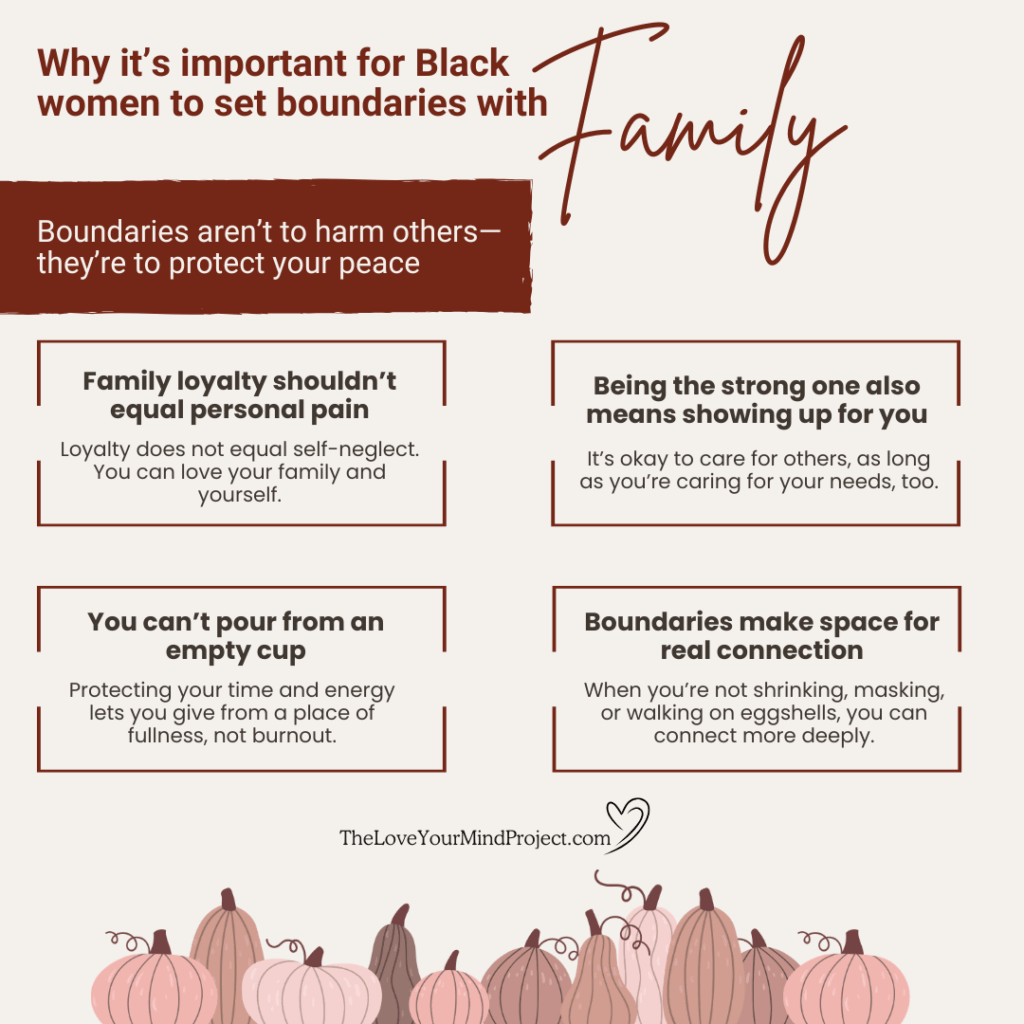
- Family loyalty shouldn’t equal personal pain: You can love your family and yourself. Loyalty does not mean self-neglect.
- Being the strong one includes showing up for you: It’s okay to care for others, as long as you’re also caring for your own needs.
- Healthy boundaries don’t harm relationships: Limits can actually strengthen the connection through honesty and mutual respect.
- Boundaries make space for real connection: When you’re not shrinking, masking, or walking on eggshells, you can connect more deeply.
- You can’t pour from an empty cup: Protecting your time and energy, even during the holidays, lets you give from a place of fullness, not burnout.
>> Are you taking care of your emotional needs? Take this quiz to find out
How to set boundaries with your family (and actually enjoy the holidays)
Setting boundaries starts with clarity on what you need to feel safe and at peace. These tips help you do it with confidence and compassion this holiday season.
Get clear on what you want to protect
Before you set boundaries, reflect on what drains you the most during your holiday visits. Is it the constant criticism, the gossip, or being pulled into other people’s drama?
Identifying those emotional triggers will reveal which boundaries will be most helpful in protecting your peace.
Communicate your boundaries (if needed) with love—not guilt
Not every boundary needs a big announcement. Some you can quietly enforce, like leaving early or casually changing subjects.
But if certain family members don’t take the hint, it’s okay to be direct. You can do it clearly and kindly—without apology and without a lengthy explanation.
Try simple statements like:
- “No, I’m not going to stay for that this year,”
- “Yeah, I’m not talking about my dating life right now.”
>> MORE: How to stop being a people pleaser (without feeling guilty)
Have a plan for your emotional triggers
You might already know who and what might test your patience. So, plan ahead with a few strategies that can help you keep your calm (and your sanity). That could mean taking a breather in the bathroom, thinking of a calming phrase, or texting a supportive friend.
Commit to your boundaries (and stand firm when needed)
Once you set your boundaries, keep them. The more consistent you are, the more your loved ones will understand that your limits are real, not wordplay.
Some might get offended, and that could leave you feeling guilty. But remember why you set the boundaries in the first place—your peace is non-negotiable.
It’s not your job to defend your choices, parenting style, career, or otherwise. And it’s not your role to carry everyone else’s emotional load.
No matter how others react, you’re not doing anything wrong by taking care of yourself.
>> MORE: Feeling stuck in life? Ditch these mental health myths to break free
Prioritize joy and genuine connection
Boundaries aren’t walls—they can make more room for laughter, love, and meaningful connections with those who truly see and respect you.
This holiday season, lean into those people and moments of genuine joy—where you feel safe, valued, and free to be your whole self.
How to set boundaries with family FAQs
What are examples of boundaries with family?
Boundaries can be physical (no hugs if you’re not comfortable), emotional (avoiding gossip or political debates), or time-based (leaving early or skipping certain events).2 The idea is to know what drains your peace during the holidays and to set limits to protect it.
How do you politely set boundaries with family?
You can enforce some boundaries quietly, like redirecting conversations to avoid certain topics. Others might require a simple and direct statement, like “I know I’m usually in town for a week, but this year I can only stay a few days.” Using “I” statements can help you communicate your needs without blaming others.3 Try to keep it short and resist the urge to apologize or over-explain.
What if my family doesn’t respect my boundaries?
When someone crosses the line, respectfully restate the boundary—that you’re not discussing that topic right now, you don’t need dating advice, or you simply can’t attend that event. If it keeps happening, it’s okay to step away or limit contact. Even a temporary break can help you reset. Remember, your boundaries aren’t meant to control, change, or convince others—they’re to let you know when it’s time to preserve your peace and overall wellness.
References
- Setting Firm and Consistent Boundaries With Your Family. (2024). Psychology Today. https://www.psychologytoday.com/us/blog/your-emotional-meter/202401/setting-firm-and-consistent-boundaries-with-your-family ↩︎
- Moores, G. (2025, January 10). What are boundaries? A professional counselor explains – Office of Engagement and Extension. Office of Engagement and Extension. https://engagement.source.colostate.edu/what-are-boundaries-a-professional-counselor-explains/ ↩︎
- Setting Healthy Boundaries in Relationships. (2022, July 6). HelpGuide.org. https://www.helpguide.org/relationships/social-connection/setting-healthy-boundaries-in-relationships ↩︎