If you deal with constant worry or stress, these apps for anxiety can help you pause, exhale, and reclaim your peace.
On any given day, there can be so much that demands our time. As Black women, we’re caregivers, employees, business owners, sisters, and friends—pouring our energy into everything we commit to.
But with that can come pressure. Pressure to perform, to stay strong, to endure, and look well doing it. When that weight gets too heavy, it helps to have a little relief at your fingertips.
These apps for anxiety can help you practice proven skills to manage stress and restore your peace—no matter what’s happening around you.
>> Have you subscribed? Sign up for weekly encouragement in your inbox!
Can apps help with anxiety?
Absolutely. While they don’t replace professional care, some apps are built on strategies known to reduce anxiety symptoms, like breathwork, meditation, or cognitive behavioral therapy (CBT).
These apps can help you identify harmful thoughts so you can reframe them, counter them, or let them pass.
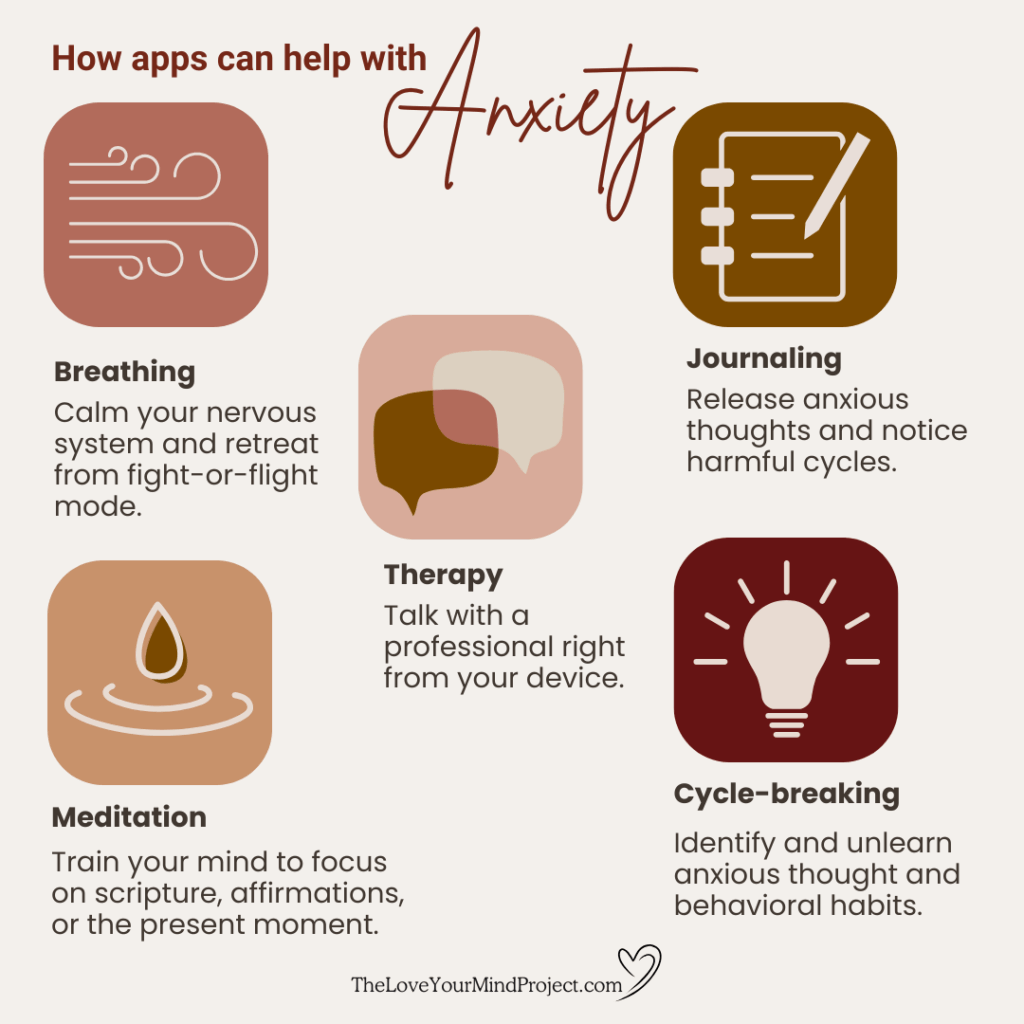
17 apps for anxiety to help calm your overactive mind
For the busy Black woman, these apps offer convenient ways to address anxiety symptoms, depending on your needs and preferences.
Apps for breathing
Deep, focused breathing calms the nervous system. It signals to the body that you’re safe and can retreat from the fight-or-flight mode that anxiety often triggers.1
- Breathwrk: A variety of guided exercises with visuals to help you relax, sleep, or improve focus. Try the free plan, or Pro for $12/month or $69/year.
- iBreathe: A free, easy-to-use app for Apple devices with pre-defined and customizable breathing techniques—great for those looking for a simple tool.
- The Breathing App: Focuses on slow breathing—five to seven breaths per minute—to reach a calm state where your heart rate, heart rate variability, blood pressure, and brainwave function are aligned.
Apps for journaling
Journaling helps you release anxious thoughts, recognize patterns, and identify triggers so anxiety doesn’t overwhelm you.2 These apps make it a little easier to build the habit.
- Penzu: An online journal that offers unlimited entries and reflections of previous posts, for free. Paid plans have more security and customization options for $19.99/year or $49.99/year.
- AI Journal Daily: Uses AI prompts for guided reflections, analysis, and coaching. The app’s core features are free, including unlimited entries, prompts, and insights. Pro is $69/year.
- Mirror: A visual mood tracker that leverages AI to help you understand and break out of unhealthy emotional cycles. The app is free to download, with in-app purchases.
>> MORE: How to start a journal (and why it’s powerful for Black women’s mental health)
Apps for meditation
Meditation trains your mind to focus—whether that’s on your breath, body, scripture, positive thought, or a generally relaxing idea.3 This tool can be invaluable for Black women dealing with chronic anxiety because we can learn to gently bring our thoughts out of worrisome spirals and into peace and calm.
- Exhale: Designed specifically for women of color with guided meditations, breathing exercises, and sound therapies. Choose from a free plan or get full access for $4.99/month or $49.99/year.
- Alkeme: A Black mental health app with meditations, audiotherapies, and courses on topics like stress, anxiety, grief, racial trauma, and microaggressions. Join for $10/month or $60/year.
- Calm: A mental wellness app with a vast library of meditations, grounding techniques, and even specialized content, like an ADHD support series. Full access is $14.99/month or $69.99/year after a seven-day free trial.
- Balance: This app adapts to your needs based on feedback and curates personalized meditations. Get full access for $69.99/year after a 30-day trial.
- Happier: Guided meditations and courses on topics like resilience, connection, and joy in good and bad times. A free account gets you over 50 guided meditations and three courses. The annual subscription is $99.99/year.
>> MORE: Can’t stop overthinking? Here are 6 tips to try
Apps for shifting thought patterns
Anxiety can thrive on an unhealthy thought-life. These apps help you recognize and rewire those cycles into healthier ways of thinking.
- Unwinding Anxiety: A guided program created by neuroscientist and psychiatrist Dr. Jud Brewer, that helps you identify and unlearn anxious habits with video lessons, community support, check-ins, and weekly calls. After a 7-day free trial, choose a monthly or annual plan, from $29.99/month to $209.99/year—or get lifetime access for a one-time $499.99 payment.
- Neurocycle: This app, founded by neuroscientist Dr. Caroline Leaf, walks you through a 63-day brain detox, helping you get to the root of toxic thoughts and associated behaviors, shift unhealthy thought patterns, and cultivate new ones. Choose from monthly or annual subscriptions, from $14.99/month to $99.99/year.
- Rootd: Helps users face panic attacks head-on or ride them out. It also includes courses for long-term relief. Learn to identify triggers, make lifestyle changes, and shift your perspective to change how you see and respond to anxiety. Get access to the entire library of content for $9.99/month or a one-time payment of $199.
>> MORE: How to stop being a people pleaser (without feeling guilty)
Apps for virtual therapy
If self-guided exercises aren’t enough, virtual therapy apps connect you to professionals who can work with you one-on-one and help you build the skills to better manage anxiety.
- Talkspace: Get matched with a verified therapist within two days and connect live via video, phone, or chat. Filter your therapist search by race, religion, focus area, and more. Insurance is accepted.
- Betterhelp: Virtual therapy with digital worksheets and other online resources. Engage in sessions from your computer, phone, or tablet. Insurance accepted.
- Headspace: This all-in-one app for mindfulness and meditation now includes therapy and accepts insurance. To access its resources outside of therapy, you’ll need a subscription—for $12.99/month or $69.99/year.
>> MORE: Therapy for mental health: How it helps us heal
When to consider professional support
Apps can make mental care more accessible, but if your anxiety symptoms feel constant, overwhelming, or interfere with daily life, it may be time to seek professional help. A culturally competent therapist or primary care doctor can better assess your needs and discuss strategies that may bring relief. Apps can complement therapy, but they’re not a replacement for personalized care.
Apps for anxiety FAQs
Do anxiety apps really work?
Yes, apps can improve anxiety symptoms depending on the severity and your needs. They work by helping you build anxiety-reducing habits, like breathwork, journaling, and meditation. Complex or severe anxiety may still benefit from in-person support, like therapy or a medical treatment.
What is the best anxiety app?
The best app for anxiety is the one you can use consistently. Apps like Alkeme and Exhale are specifically designed for the Black community and our unique challenges. Calm and Headspace offer broader support with various tools, like meditations, courses, and grounding tools.
What are the best free apps for anxiety?
Some apps offer more free features than others. For example, you can access many of the core features for iBreathe (breathing exercises), Happier (meditations), and Penzu (journaling) without upgrading.
References
- Zaccaro, A., Piarulli, A., Laurino, M., Garbella, E., Menicucci, D., Neri, B., & Gemignani, A. (2018). How Breath-Control Can Change Your Life: A Systematic Review on Psycho-Physiological Correlates of Slow Breathing. Frontiers in Human Neuroscience, 12. https://doi.org/10.3389/fnhum.2018.00353 ↩︎
- Guo, L. (2022). The delayed, durable effect of expressive writing on depression, anxiety and stress: A meta‐analytic review of studies with long‐term follow‐ups. British Journal of Clinical Psychology, 62(1), 272–297. https://doi.org/10.1111/bjc.12408 ↩︎
- Chen, K. W., Berger, C. C., Manheimer, E., Forde, D., Magidson, J., Laya Dachman, & Lejuez, C. W. (2012). MEDITATIVE THERAPIES FOR REDUCING ANXIETY: A SYSTEMATIC REVIEW AND META-ANALYSIS OF RANDOMIZED CONTROLLED TRIALS. Depression and Anxiety, 29(7), 545–562. https://doi.org/10.1002/da.21964 ↩︎