
Today’s job market can feel uniquely harsh—spending hours completing redundant applications only to receive an automated “we’re moving forward with other candidates” message.
And if you make it past the algorithm, you might be asked for skills assessments, personality tests, or unpaid assignments—just to be ghosted down the line.
The job search process can be exhausting. And when it lasts longer than expected, it could chip away at your confidence, leaving you feeling discouraged, anxious, or emotionally low.
This guide breaks down job search depression—what it is, why it can feel especially heavy, and practical ways to take care of yourself if you’re experiencing it.
Is job search depression really a thing—or am I just being dramatic?
Yes, it’s real.
Job search depression can include ongoing sadness, anxiety, or hopelessness connected specifically to a prolonged job search. While not a clinical diagnosis, research does link both unemployment and repeated rejection to depression.1,2
But it’s not being “ weak.” And it’s not overreacting—it’s the body responding to continued stress, uncertainty, and disappointment.
How a job search can contribute to depression
When a job search feels unsuccessful, it can fuel low self-worth, helplessness, or emptiness—feelings commonly associated with depression.
Here are a few ways a job search can trigger or intensify depression3:
- Rejection: After so many “no’s,” it’s easy to internalize rejection, accepting it as a reflection of your worth or ability.
- Pressure: The pressure to perform well on applications, interviews, and assessments can heighten anxiety, low self-esteem, and negative self-talk—especially if you deal with fear of failure or perfectionism.
- Uncertainty: Not knowing when you’ll land your next role can intensify stress, irritability, worry, or sadness, especially if you’re struggling financially.
- Grief: If you were laid off, you may still be grieving the job loss—including the role, the routine, the community, or your professional identity
None of these experiences means there’s anything wrong with you. They’re natural responses to lengthy emotional strain.
Signs of job search depression
Depression from a job search process doesn’t look the same for everyone. It can hit you mentally, emotionally, or physically. Here are common examples.3
- Low self-esteem or self-worth
- Loss of confidence
- Anxiety or worry
- Pessimism
- Irritability, frustration, or anger
- Sadness
- Little motivation to keep applying
- Helplessness or hopelessness about your professional future
- Harsh self-criticism or negative self-talk
- Changes in sleep (too much or too little)
- Changes in appetite (not eating much or eating more than usual)
If you experience any of these feelings more often than not, it’s worth taking seriously (with no judgment).
It’s okay to name depression as a Black woman
Acknowledging depression, from any source, isn’t always easy for Black women.
We may attach a stigma—believing we’re weak, too sensitive, or lacking faith when we experience depression symptoms. But we carry real emotional pain that’s worth naming, especially when it comes to employment.
- We’re unemployed at a higher rate: The unemployment rate for Black women is more than double that of white women, increasing more than other groups measured between 2024 and 2025, according to the Bureau of Labor Statistics.4
- We’re more likely to bear the full financial burden: Nearly 70% of Black mothers are the primary earner for their household, according to the Center for American Progress5—adding a layer of pressure or urgency when we’re unemployed.
- We’re more likely to be overlooked: Black women are less likely to be hired into or promoted to managerial and executive roles, according to Lean In’s 2024 Women in the Workplace report.6
The stress, self-doubt, or discouragement you may feel is real, sis. Naming it doesn’t make it worse—it creates space for you to heal.
How to respond when you feel job search depression
When you’re emotionally depleted, sometimes the most supportive move is to pause and care for yourself with compassion. Try these steps.
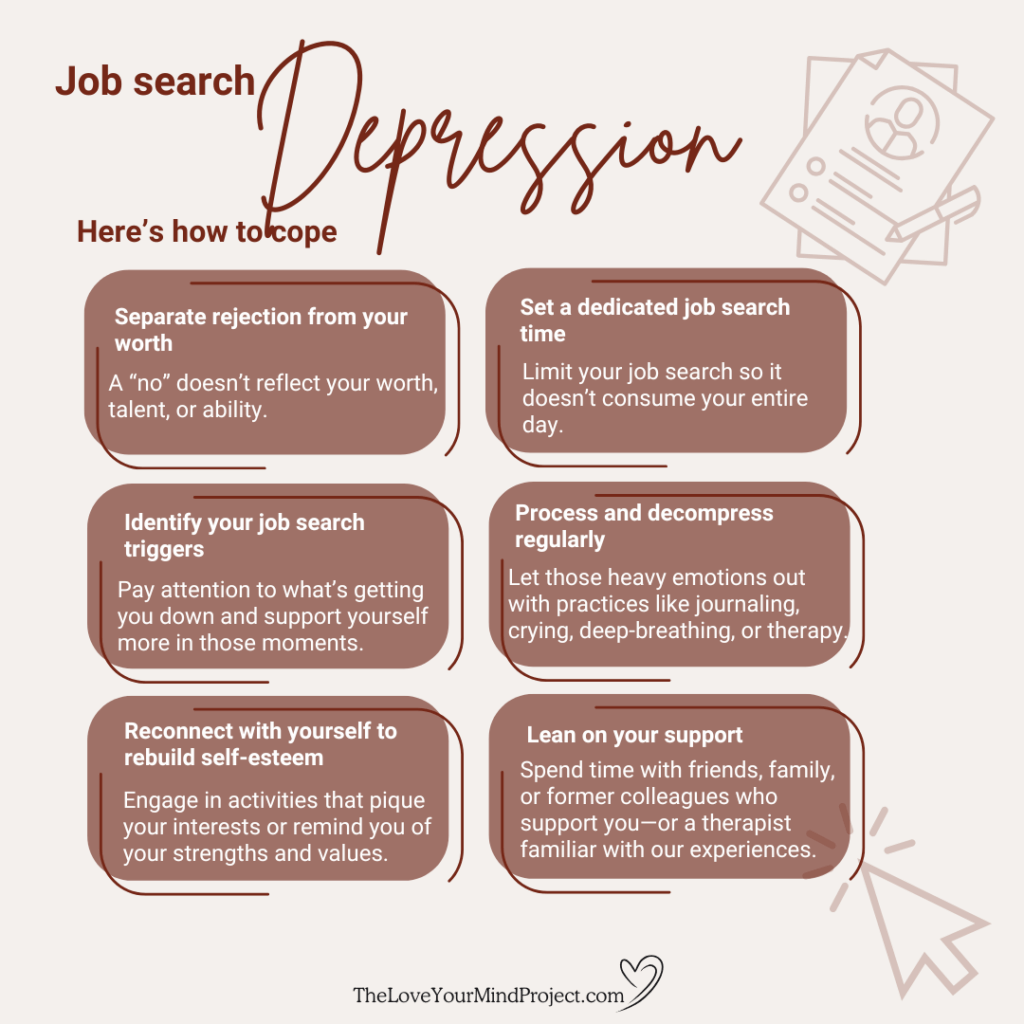

Separate rejection from your worth
A job rejection may feel like a failure on your part, but it’s more likely about the hiring team’s personal preferences, budgets, and even your timing compared to other applicants.
You can be qualified and still passed over. You can be perfect for the job and still overlooked. It’s not always a reflection of what you did or didn’t do.
And it’s definitely not your worth, which is innate—existing independently of your productivity, title, or employer.
So the next time you’re turned down for a job, remind yourself that it’s a decision—not a verdict. You’re still enough.
Identify your job search triggers
Certain parts of the job search might affect you more than others. Pay attention to what really gets you down—scrolling job boards, preparing for interviews, waiting to hear back—so you can support yourself more in those moments.
You may find you need to adjust your process, like taking a few deep breaths after reading a rejection email.
Reconnect with yourself to rebuild self-esteem
If the job search is affecting your self-esteem, you can protect or rebuild it by reconnecting with who you are—especially outside of work.
Engage in activities that pique your interests or remind you of your strengths and values. Hobbies with tangible outcomes can be especially rewarding, like a DIY project, a group fitness class, a volunteer project, or a book club.
Set a dedicated job search time
Consider limiting your job search to specific hours—like a full-time or part-time job—so it doesn’t consume your entire day.
Intentional time away from job search-related stress, uncertainty, or frustration can help you avoid burnout. So when your time is up, really give yourself permission to let it go and focus on other tasks.
Process and decompress regularly
Those heavy emotions you might experience during the job search need somewhere to go. Suppressing them keeps the stress in your body where it can do more damage.
Acknowledge whatever feelings come up without judgment or shame, and give yourself permission to let them go.
Journal, go for a walk, cry, sleep, meditate—whatever truly helps you release stress is valid. You may need to do this multiple times a day, and that’s okay.
Lean on your support
You’re not alone. You’re not a downer, and you’re not a burden. Find your community—a trusted space where you can share, be seen, and receive the support you deserve.
This could be time with close friends, former work colleagues, or a therapist familiar with the experiences of high-achieving Black women.
Support is something we all need, especially in hard seasons. There’s no shame in having these safe spaces.
Job search depression FAQs
Is it normal to feel depressed after repeated job rejections?
Absolutely. Humans are wired for belonging and contribution.7 And repeated rejection can disrupt both. When you feel like you don’t belong or aren’t good enough, it can trigger a low mood. But that’s a physiological response to prolonged stress, not a weakness or failure on your part.8
How can a job search cause depression?
A job search can trigger multiple stressors—financial instability, loss of social connection or routine, and a blow to your self-esteem. When it lasts longer than expected, you can feel empty, hopeless, and other symptoms typically associated with depression.
How do you cope with depression during a job search?
Focus on noticing and tending to your emotional needs throughout the job search process. Start by acknowledging that the stress of job hunting is real. Then set boundaries so you’re not internalizing rejections or burning out from submitting applications all day.
References
Last accessed January 2026
- Yang, Y., Niu, L., Amin, S., & Yasin, I. (2024). Unemployment and mental health: a global study of unemployment’s influence on diverse mental disorders. Frontiers in Public Health, 12, 1440403–1440403. https://doi.org/10.3389/fpubh.2024.1440403 ↩︎
- Slavich, G. M., Aoife O’Donovan, Epel, E. S., & Kemeny, M. E. (2010). Black sheep get the blues: A psychobiological model of social rejection and depression. Neuroscience & Biobehavioral Reviews, 35(1), 39–45. https://doi.org/10.1016/j.neubiorev.2010.01.003 ↩︎
- Pedersen, T. (2023, October 4). What Is Job Search Depression? Healthline; Healthline Media. https://www.healthline.com/health/depression/job-search-depression#symptoms ↩︎
- E-16. Unemployment rates by age, sex, race, and Hispanic or Latino ethnicity. (2025, November 20). Bureau of Labor Statistics. https://www.bls.gov/web/empsit/cpsee_e16.htm ↩︎
- serbin, bianca. (2025, May 9). Breadwinning Women Are a Lifeline for Their Families and the Economy. Center for American Progress. https://www.americanprogress.org/article/breadwinning-women-are-a-lifeline-for-their-families-and-the-economy/ ↩︎
- Women in the workplace 2024 THE 10TH ANNIVERSARY REPORT. (n.d.). https://cdn-static.leanin.org/women-in-the-workplace/2024-pdf ↩︎
- Classics in the History of Psychology — A. H. Maslow (1943) A Theory of Human Motivation. (2026). Yorku.ca. https://psychclassics.yorku.ca/Maslow/motivation.htm ↩︎
- Chu, B., Marwaha, K., Sanvictores, T., Awosika, A. O., & Ayers, D. (2024, May 7). Physiology, Stress Reaction. Nih.gov; StatPearls Publishing. https://www.ncbi.nlm.nih.gov/books/NBK541120/ ↩︎

- Daylio mood tracker app: A simple way to understand your emotional patterns - October 23, 2026
- Is the Calm app worth it? How it can help you prioritize rest - October 15, 2026
- Is Headspace worth it considering our unique needs? - October 8, 2026