Stress leave from work is legally protected time away to recover from emotional overwhelm—like burnout, anxiety, or depression—when it begins affecting your ability to function.

It’s more than a busy work week, annoying coworkers, or feeling tired throughout the day.
For many of us, work is emotionally taxing, mentally overwhelming, and physically exhausting.
Deadlines and workloads may play a role. But we’re also constantly navigating environments that seem to demand perfection—without much support.
For Black women especially, work stress can feel particularly heavy—fueled by constantly being “on” and overperforming to prove we belong. It’s tolerating microaggressions and systemic barriers with a smile, so we’re not labeled difficult. And continuing to show up because we should be “grateful” we have a seat at the table.
But sis, you can be grateful for your job and recognize when it’s time to step away—even temporarily.
This article walks through your options when work stress becomes too much. We’ll cover what stress leave is, when it may be time to consider it, and how to explore your next steps without pressure, shame, or judgment.
First, it’s okay to take stress leave from work
Okay, real talk. Work is way more stressful now than it’s been in past decades. Protecting your peace isn’t emotional weakness—it’s awareness.
This isn’t the 60s or 70s when you clocked out, and work stayed at work. Today, we’re always connected—responding to emails from the moment we wake up, well into the evening and weekends. Working lunches and meetings during our commutes blur work-life boundaries and make it difficult to have the downtime our bodies require.
In fact, since 2020, employee mental health has steadily declined, reaching all-time lows in 2024.1
And as Black women, the stress is complex and layered. Research from Lean In shows that we’re more likely to2:
- Experience disrespectful and “othering” comments or behavior (like, “you’re so articulate”).
- Receive less support from our managers in balancing priorities and deadlines.
- Take on diversity and inclusion work on top of our job responsibilities.
- Face retaliation for speaking up about bias or discrimination.
So no, you’re not weak or dramatic for needing a break. Neither are you quitting on your team or letting down the culture.
If you deal with chronic, debilitating stress fueled by work, stress leave might be what you need to preserve your mental, emotional, and physical health.
What is stress leave from work?
Stress leave is time away from work to recover from severe emotional or mental strain that makes it difficult to perform at work.
Depending on your employer, it might not be labeled “stress leave.” It may fall under medical or protected leave, but the purpose is the same—space to heal when conditions like burnout, anxiety, or depression become overbearing.
Stress leave under the Family and Medical Leave Act
Stress leave under the Family and Medical Leave Act (FMLA) allows eligible employees to take up to 12 weeks of unpaid, job-protected time off for serious mental health conditions. It’s a federal law that applies to employers with 50 or more employees.3
While FMLA is unpaid, your employer has to keep providing health insurance benefits during your leave. And “job-protected” means you’re entitled to your same role, or an equivalent one, when you return.
Other options through your employer
Your employer may offer options outside of FMLA if you need time away from work to recover.
- Paid time off (PTO): This is typically vacation, sick, or personal time that you can request without losing your income.
- Separate sick days: Some companies allocate sick days as a separate category, so employees can take paid time off for health conditions without using vacation time.
- Short-term disability: You may receive partial income if you require time off for a qualifying mental health condition.
Your leave options will depend on your employer. You can review your employee handbook or talk confidentially with HR to understand what’s available to you.
Who’s eligible for stress leave?
Eligibility depends on your employer and the type of leave you’re requesting. For FMLA, you typically must work at the company for at least a year.3 You might also need medical documentation from your healthcare provider.
It might be easier to start with your primary care provider or a culturally-affirming therapist. They may be able to help guide you through the process if you decide it’s the right move for you.
Reasons Black women might consider stress leave from work
Sometimes we can be so used to tolerating workplace stress that we don’t see all that we’re enduring. Here are some common experiences that, when carried on for too long, may require a work break.
A work environment that wears you down
You might:
- Often feel like the target of subtle or blatant biases.
- Constantly deal with passive-aggressive behavior.
- Take the blame for poor communication or unclear expectations.
- Be treated unfairly or with disrespect.
Chronic overload and unrealistic demands
You might:
- Carry the burden of multiple roles because your team is understaffed.
- Face a heavy workload more often than not.
- Feel constant pressure to work nights and weekends.
- Strain yourself to meet unrealistic deadlines.
Personal stress makes work harder to manage
You might be:
- Dealing with grief or loss.
- Managing demanding caregiving responsibilities.
- Tending to your own physical or mental health issues.
- Going through other life changes that fuel severe stress.
And if you don’t see your specific situation listed, it doesn’t mean you should keep pushing through the stress. Your experience is valid, and your pain is worth addressing.
Signs that the stress is becoming too much
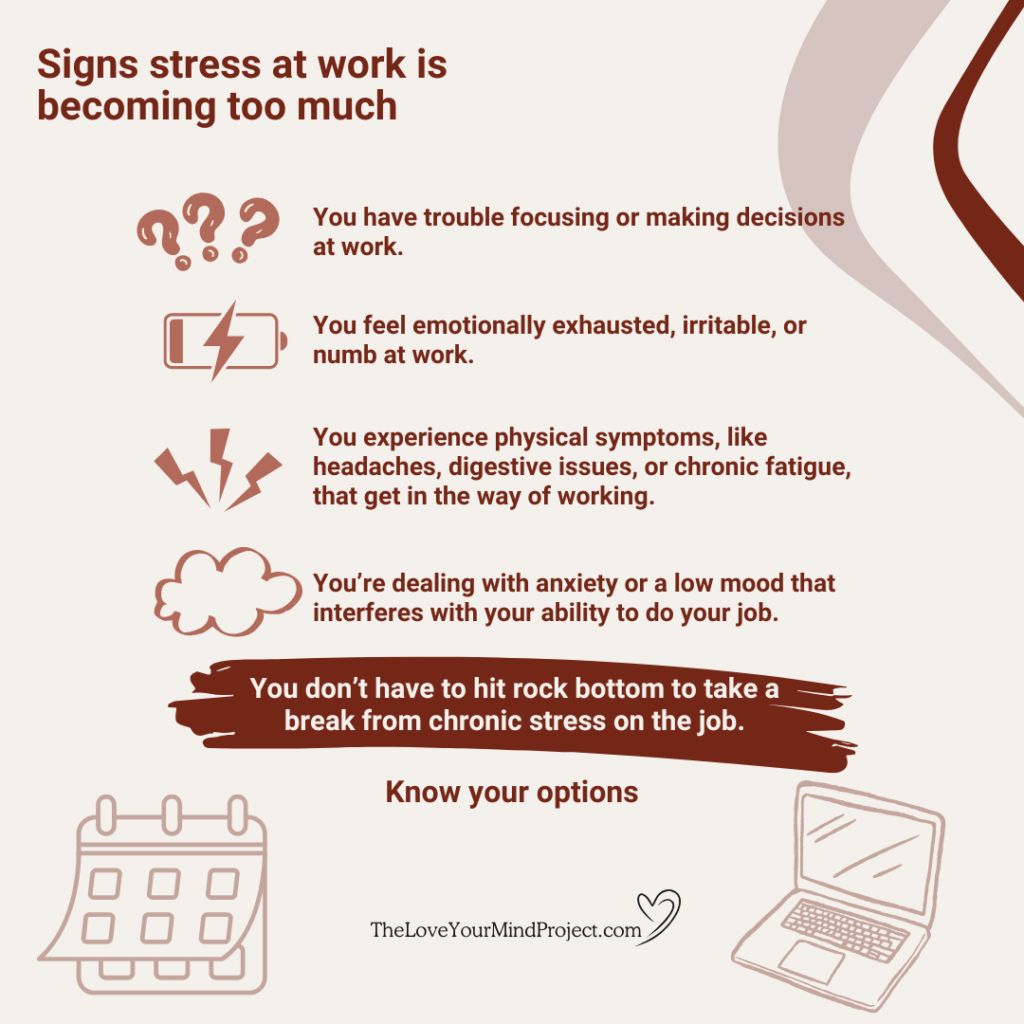
You don’t have to hit rock bottom for the stress to be “bad enough.” Your body often signals when it’s overwhelmed—and it’s okay listen.
Here are common symptoms that signal the stress is too much4:
- Trouble focusing or making decisions at work.
- Emotional exhaustion, irritability, or numbness at work.
- Physical symptoms tied to stress, like headaches, muscle tension, stomach issues, or chronic fatigue, that get in the way of working.
- Anxiety or depression symptoms that interfere with your ability to do your job.
If work stress affects your ability to function, that’s enough of a signal—not something to minimize or push through.
Stress leave from work vs. medical leave
The two may be confusing. But stress leave typically falls under medical leave—an umbrella for time away from work for health-related reasons.
What’s important to know is that conditions like anxiety, depression, and burnout are real medical concerns if they’re chronic, debilitating, and require ongoing care. So it’s okay to step away to recover, especially if your workplace intensifies your symptoms.
If stress leave is right for you
You’re the expert on your body and your limits. If you believe it’s time to consider stress leave, here are a few steps you can explore at your own pace.
- Review your employee handbook or benefits package.
- Have a confidential conversation with HR.
- Talk with your healthcare provider or therapist about how stress is affecting you.
- Give yourself permission to explore your options, without judgment.
This is your decision. There’s no one right answer—only what meets your needs in this season.
Stress leave from work FAQs
When can you take stress leave?
Consider stress leave when stress, anxiety, or depression starts to affect your ability to work or function. You may need to work with your doctor or therapist for eligibility or documentation.
How long can I take off for stress leave?
FMLA allows up to 12 weeks of unpaid leave. Check with your HR department or employee handbook for company-specific policies.
What are the rules for stress leave?
You’ll have to have been with the company for at least a year for FMLA. You may also need documentation from your healthcare provider. Your employer may have additional requirements for other leave policies, like sick days or short-term disability.
Can I lose my job for being off due to stress?
FMLA legally protects your job while you’re out. Other types of leave might not, so it’s important to understand your employer’s policies before making your decision.
How do I ask for stress leave?
You may want to start with your doctor or therapist and discuss how stress is affecting your work. When you’re ready, you’ll likely need to submit the request through HR.
Should I take stress leave?
Only you can answer that. If the emotional drain of work is eroding your mental or emotional well-being, give yourself permission to explore stress leave without judgment or shame.
References
Last accessed December 2025
- Harter, J., & Wigert, B. (2025, March 11). The Post-Pandemic Workplace: The Experiment Continues. Gallup.com; Gallup. https://www.gallup.com/workplace/657629/post-pandemic-workplace-experiment-continues.aspx ↩︎
- Black women face more bias and get less support. (2025). Lean In. https://leanin.org/article/women-in-the-workplace-black-women#! ↩︎
- Family and Medical Leave (FMLA). (2025). DOL. https://www.dol.gov/general/topic/benefits-leave/fmla ↩︎
- Stress: What It Is, Symptoms, Management & Prevention. (2023, August 30). Cleveland Clinic. https://my.clevelandclinic.org/health/diseases/11874-stress ↩︎